Fu Yu-Hsuan, Tseng Chi-Yang, Lu Jeng-Wei, Lu Wen-Hui, Lan Pei-Qi, Chen Chien-Yuan, Ou Da-Liang, Lin Liang-In
Department of Clinical Laboratory Sciences and Medical Biotechnology, National Taiwan University, Taipei 100229, Taiwan.
Antimicrobial Resistance Interdisciplinary Research Group, Singapore-MIT-Alliance for Research and Technology, Singapore 138602, Singapore.
Biomedicines. 2021 Dec 9;9(12):1869. doi: 10.3390/biomedicines9121869.
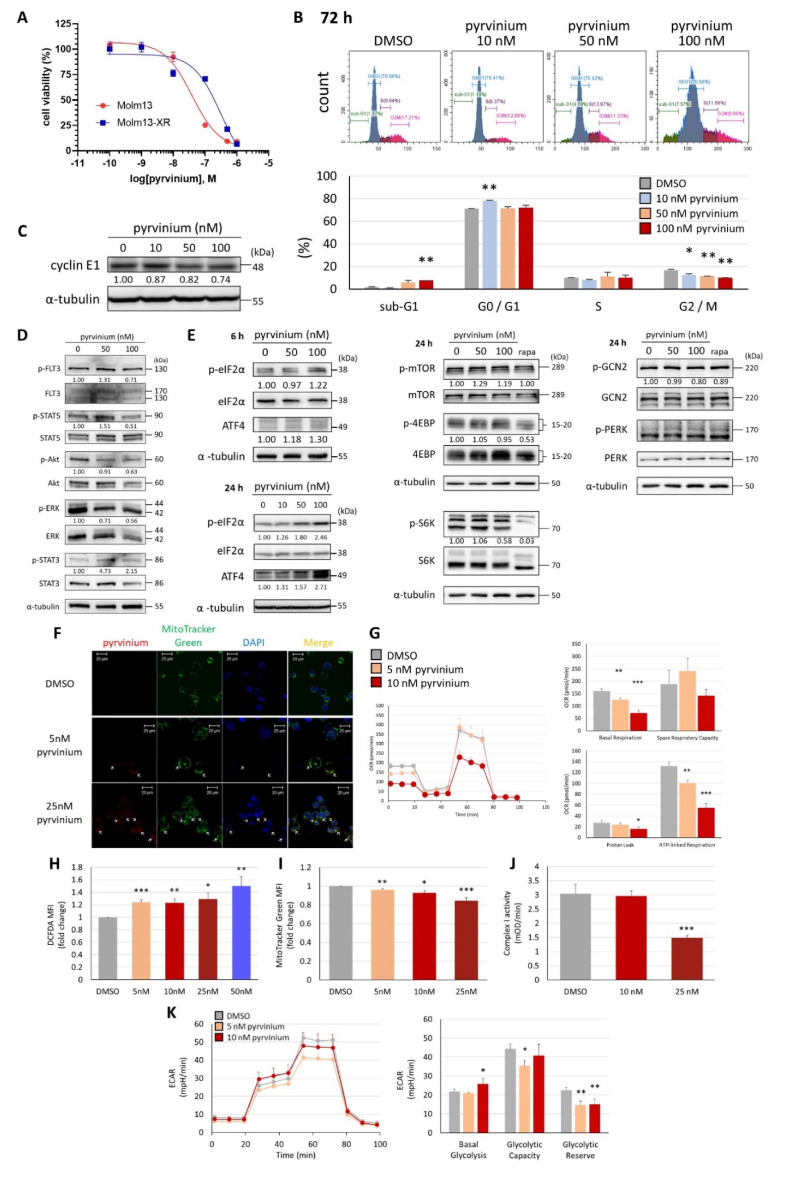
Pyrvinium pamoate, a widely-used anthelmintic agent, reportedly exhibits significant anti-tumor effects in several cancers. However, the efficacy and mechanisms of pyrvinium against myeloid leukemia remain unclear. The growth inhibitory effects of pyrvinium were tested in human AML cell lines. Transcriptome analysis of Molm13 myeloid leukemia cells suggested that pyrvinium pamoate could trigger an unfolded protein response (UPR)-like pathway, including responses to extracellular stimulus [-value = 2.78 × 10] and to endoplasmic reticulum stress [-value = 8.67 × 10], as well as elicit metabolic reprogramming, including sulfur compound catabolic processes [-value = 2.58 × 10], and responses to a redox state [-value = 5.80 × 10]; on the other hand, it could elicit a pyrvinium blunted protein folding function, including protein folding [-value = 2.10 × 10] and an ATP metabolic process [-value = 3.95 × 10]. Subsequently, pyrvinium was verified to induce an integrated stress response (ISR), demonstrated by activation of the eIF2α-ATF4 pathway and inhibition of mTORC1 signaling, in a dose- and time-dependent manner. Additionally, pyrvinium could co-localize with mitochondria and then decrease the mitochondrial basal oxidative consumption rate, ultimately dysregulating the mitochondrial function. Similar effects were observed in cabozantinib-resistant Molm13-XR cell lines. Furthermore, pyrvinium treatment retarded Molm13 and Molm13-XR xenograft tumor growth. Thus, we concluded that pyrvinium exerts anti-tumor activity, at least, via the modulation of the mitochondrial function and by triggering ISR.
帕莫酸哌嗪是一种广泛使用的驱虫剂,据报道在几种癌症中具有显著的抗肿瘤作用。然而,帕莫酸哌嗪对髓系白血病的疗效和机制仍不清楚。在人急性髓系白血病(AML)细胞系中测试了帕莫酸哌嗪的生长抑制作用。对Molm13髓系白血病细胞的转录组分析表明,帕莫酸哌嗪可触发未折叠蛋白反应(UPR)样途径,包括对细胞外刺激的反应(P值 = 2.78×10⁻³)和对内质网应激的反应(P值 = 8.67×10⁻³),以及引发代谢重编程,包括硫化合物分解代谢过程(P值 = 2.58×10⁻³)和对氧化还原状态的反应(P值 = 5.80×10⁻³);另一方面,它可导致帕莫酸哌嗪钝化蛋白折叠功能,包括蛋白折叠(P值 = 2.10×10⁻³)和ATP代谢过程(P值 = 3.95×10⁻³)。随后,证实帕莫酸哌嗪以剂量和时间依赖性方式诱导综合应激反应(ISR),表现为eIF2α-ATF4途径的激活和mTORC1信号传导的抑制。此外,帕莫酸哌嗪可与线粒体共定位,然后降低线粒体基础氧化消耗率,最终使线粒体功能失调。在卡博替尼耐药的Molm13-XR细胞系中也观察到类似的效果。此外,帕莫酸哌嗪治疗可延缓Molm13和Molm13-XR异种移植肿瘤的生长。因此,我们得出结论,帕莫酸哌嗪至少通过调节线粒体功能和触发ISR发挥抗肿瘤活性。