Gallerani Giulia, Rossi Tania, Valgiusti Martina, Angeli Davide, Fici Pietro, De Fanti Sara, Bandini Erika, Cocchi Claudia, Frassineti Giovanni Luca, Bonafè Massimiliano, Fabbri Francesco
Biosciences Laboratory, IRCCS Istituto Romagnolo per lo Studio dei Tumori (IRST) "Dino Amadori", 47014 Meldola, Italy.
Department of Medical Oncology, IRCCS Istituto Romagnolo per lo Studio dei Tumori (IRST) "Dino Amadori", 47014 Meldola, Italy.
Cancers (Basel). 2021 Dec 19;13(24):6369. doi: 10.3390/cancers13246369.
Here, we monitored the evolution of CTCs spread in 11 patients affected by locally advanced EC who were undergoing therapy.
In this perspective study, we designed multiple blood biopsies from individual patients: before and after neoadjuvant chemo-radio therapy and after surgery. We developed a multi-target array, named Grab-all assay, to estimate CTCs for their epithelial (EpCAM/E-Cadherin/Cytokeratins) and mesenchymal/stem (N-Cadherin/CD44v6/ABCG2) phenotypes. Identified CTCs were isolated as single cells by DEPArray, subjected to whole genome amplification, and copy number aberration (CNA) profiles were determined. Through bioinformatic analysis, we assessed the genomic imbalance of single CTCs, investigated specific focal copy number changes previously reported in EC and aberrant pathways using enrichment analysis.
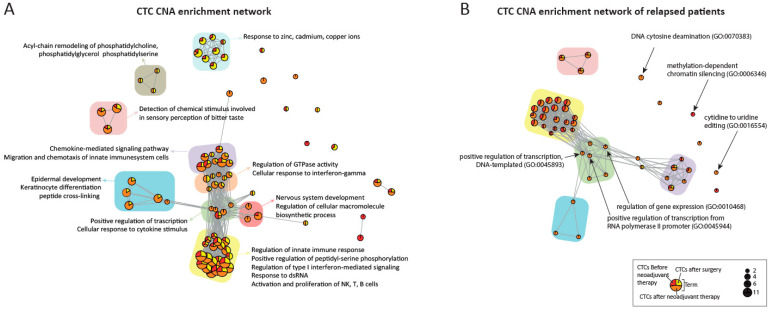
Longitudinal monitoring allowed the identification of CTCs in at least one time-point per patient. Through single cell CNA analysis, we revealed that CTCs showed significantly dynamic genomic imbalance during treatment. Individual CTCs from relapsed patients displayed a higher degree of genomic imbalance relative to disease-free patients' groups. Genomic aberrations previously reported in EC occurred mostly in post-neoadjuvant therapy CTCs. In-depth analysis showed that networks enrichment in all time-point CTCs were inherent to innate immune system. Transcription/gene regulation, post-transcriptional and epigenetic modifications were uniquely affected in CTCs of relapsed patients.
Our data add clues to the comprehension of the role of CTCs in EC aggressiveness: chromosomal aberrations on genes related to innate immune system behave as relevant to the onset of CTC-status, whilst pathways of transcription/gene regulation, post-transcriptional and epigenetic modifications seem linked to patients' outcome.
在此,我们监测了11例接受治疗的局部晚期子宫内膜癌患者循环肿瘤细胞(CTC)的扩散演变情况。
在这项前瞻性研究中,我们设计了对个体患者进行多次血液活检:新辅助放化疗前后以及手术后。我们开发了一种名为全捕获检测的多靶点阵列,以评估CTC的上皮(上皮细胞粘附分子/上皮钙黏蛋白/细胞角蛋白)和间充质/干细胞(神经钙黏蛋白/CD44v6/ATP结合盒转运体G2)表型。通过DEPArray将鉴定出的CTC分离为单个细胞,进行全基因组扩增,并确定拷贝数变异(CNA)图谱。通过生物信息学分析,我们评估了单个CTC的基因组失衡情况,利用富集分析研究了先前在子宫内膜癌中报道的特定局部拷贝数变化和异常通路。
纵向监测使得能够在每位患者的至少一个时间点识别出CTC。通过单细胞CNA分析,我们发现CTC在治疗期间表现出显著的动态基因组失衡。复发患者的单个CTC相对于无病患者组表现出更高程度的基因组失衡。先前在子宫内膜癌中报道的基因组畸变大多发生在新辅助治疗后的CTC中。深入分析表明,所有时间点CTC中的网络富集都与固有免疫系统相关。转录/基因调控、转录后和表观遗传修饰在复发患者的CTC中受到独特影响。
我们的数据为理解CTC在子宫内膜癌侵袭性中的作用提供了线索:与固有免疫系统相关基因的染色体畸变与CTC状态的发生相关,而转录/基因调控、转录后和表观遗传修饰通路似乎与患者的预后相关。