Sun Yanpeng, Chang Zhanyou, Zhao Yong, Hua Zhengxu, Li Sirui
College of Electronic and Information Engineering, Shenyang Aerospace University, Shenyang 110136, China.
Science and Technology on Altitude Simulation Laboratory, Mianyan 621700, China.
Micromachines (Basel). 2021 Nov 27;12(12):1458. doi: 10.3390/mi12121458.
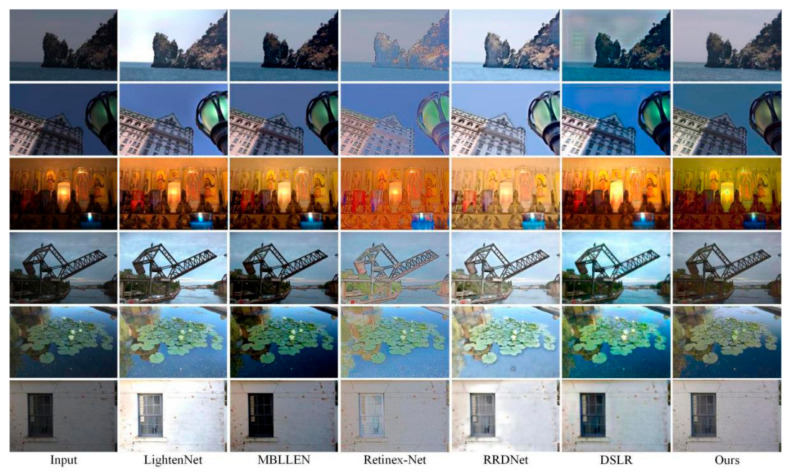
At night, visual quality is reduced due to insufficient illumination so that it is difficult to conduct high-level visual tasks effectively. Existing image enhancement methods only focus on brightness improvement, however, improving image quality in low-light environments still remains a challenging task. In order to overcome the limitations of existing enhancement algorithms with insufficient enhancement, a progressive two-stage image enhancement network is proposed in this paper. The low-light image enhancement problem is innovatively divided into two stages. The first stage of the network extracts the multi-scale features of the image through an encoder and decoder structure. The second stage of the network refines the results after enhancement to further improve output brightness. Experimental results and data analysis show that our method can achieve state-of-the-art performance on synthetic and real data sets, with both subjective and objective capability superior to other approaches.
夜间,由于光照不足,视觉质量会下降,因此难以有效地执行高级视觉任务。现有的图像增强方法仅专注于亮度提升,然而,在低光照环境下提高图像质量仍然是一项具有挑战性的任务。为了克服现有增强算法增强不足的局限性,本文提出了一种渐进式两阶段图像增强网络。低光照图像增强问题被创新性地分为两个阶段。网络的第一阶段通过编码器和解码器结构提取图像的多尺度特征。网络的第二阶段对增强后的结果进行细化,以进一步提高输出亮度。实验结果和数据分析表明,我们的方法在合成数据集和真实数据集上都能达到最优性能,主观和客观能力均优于其他方法。