School of Life Sciences, Liaocheng University, Liaocheng 252000, China.
Institute of Urban Agriculture, Chinese Academy of Agricultural Sciences, Chengdu 610213, China.
Int J Mol Sci. 2021 Dec 15;22(24):13464. doi: 10.3390/ijms222413464.
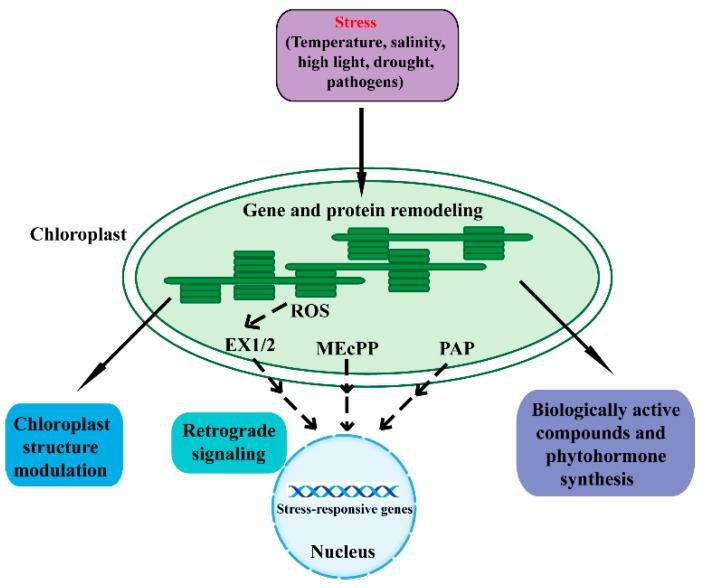
The chloroplast has a central position in oxygenic photosynthesis and primary metabolism. In addition to these functions, the chloroplast has recently emerged as a pivotal regulator of plant responses to abiotic and biotic stress conditions. Chloroplasts have their own independent genomes and gene-expression machinery and synthesize phytohormones and a diverse range of secondary metabolites, a significant portion of which contribute the plant response to adverse conditions. Furthermore, chloroplasts communicate with the nucleus through retrograde signaling, for instance, reactive oxygen signaling. All of the above facilitate the chloroplast's exquisite flexibility in responding to environmental stresses. In this review, we summarize recent findings on the involvement of chloroplasts in plant regulatory responses to various abiotic and biotic stresses including heat, chilling, salinity, drought, high light environmental stress conditions, and pathogen invasions. This review will enrich the better understanding of interactions between chloroplast and environmental stresses, and will lay the foundation for genetically enhancing plant-stress acclimatization.
叶绿体在产氧光合作用和初级代谢中处于中心地位。除了这些功能外,叶绿体最近还成为植物对非生物和生物胁迫条件反应的关键调节剂。叶绿体具有自己独立的基因组和基因表达机制,并合成植物激素和多种次生代谢物,其中很大一部分有助于植物对不利条件的反应。此外,叶绿体通过逆行信号转导与细胞核进行通讯,例如,活性氧信号转导。所有这些都使叶绿体在应对环境胁迫时具有极高的灵活性。在这篇综述中,我们总结了叶绿体参与植物对各种非生物和生物胁迫(包括热、冷、盐、干旱、高光环境胁迫条件和病原体入侵)的调节反应的最新发现。这篇综述将丰富对叶绿体与环境胁迫之间相互作用的理解,并为遗传增强植物适应应激奠定基础。