Molecular Markers Laboratory, IRCCS Istituto Centro San Giovanni di Dio Fatebenefratelli, I-25125 Brescia, Italy.
Neurodegenerative Brain Diseases, VIB Center for Molecular Neurology, VIB, B-2610 Antwerp, Belgium.
Int J Mol Sci. 2021 Dec 20;22(24):13633. doi: 10.3390/ijms222413633.
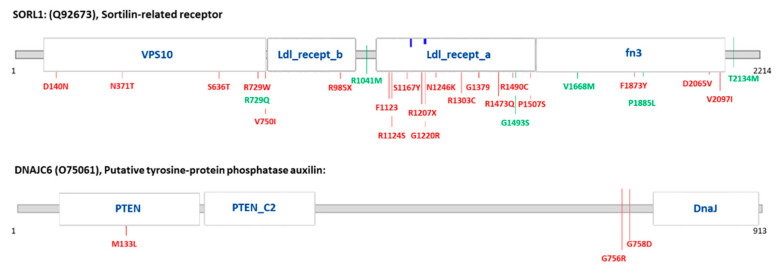
Dysfunctions in the endo-lysosomal system have been hypothesized to underlie neurodegeneration in major neurocognitive disorders due to Alzheimer's disease (AD), Frontotemporal Lobar Degeneration (FTLD), and Lewy body disease (DLB). The aim of this study is to investigate whether these diseases share genetic variability in the endo-lysosomal pathway. In AD, DLB, and FTLD patients and in controls (948 subjects), we performed a targeted sequencing of the top 50 genes belonging to the endo-lysosomal pathway. Genetic analyses revealed (i) four previously reported disease-associated variants in the SORL1 (p.N1246K, p.N371T, p.D2065V) and DNAJC6 genes (p.M133L) in AD, FTLD, and DLB, extending the previous knowledge attesting SORL1 and DNAJC6 as AD- and PD-related genes, respectively; (ii) three predicted null variants in AD patients in the SORL1 (p.R985X in early onset familial AD, p.R1207X) and PPT1 (p.R48X in early onset familial AD) genes, where loss of function is a known disease mechanism. A single variant and gene burden analysis revealed some nominally significant results of potential interest for SORL1 and DNAJC6 genes. Our data highlight that genes controlling key endo-lysosomal processes (i.e., protein sorting/transport, clathrin-coated vesicle uncoating, lysosomal enzymatic activity regulation) might be involved in AD, FTLD and DLB pathogenesis, thus suggesting an etiological link behind these diseases.
内质网-溶酶体系统功能障碍被认为是导致阿尔茨海默病 (AD)、额颞叶变性 (FTLD) 和路易体病 (DLB) 等主要神经认知障碍发生神经退行性变的基础。本研究旨在探讨这些疾病是否在内质网-溶酶体途径中存在遗传变异性。在 AD、DLB 和 FTLD 患者和对照组(948 例)中,我们对属于内质网-溶酶体途径的前 50 个基因进行了靶向测序。遗传分析显示:(i) 在 AD、FTLD 和 DLB 中,SORL1(p.N1246K、p.N371T、p.D2065V)和 DNAJC6 基因(p.M133L)中的四个先前报道的疾病相关变异体,扩展了先前关于 SORL1 和 DNAJC6 分别为 AD 和 PD 相关基因的知识;(ii) 在 AD 患者中,SORL1(早发性家族性 AD 中的 p.R985X、p.R1207X)和 PPT1(早发性家族性 AD 中的 p.R48X)基因中的三个预测的无效变异体,功能丧失是已知的疾病机制。单一变异和基因负担分析显示,SORL1 和 DNAJC6 基因存在一些具有潜在意义的显著结果。我们的数据强调,控制关键内质网-溶酶体过程(即蛋白质分拣/运输、网格蛋白包被小泡脱包被、溶酶体酶活性调节)的基因可能参与 AD、FTLD 和 DLB 的发病机制,因此提示这些疾病背后存在病因学联系。