Department of Health Systems and Population Health, University of Washington, Seattle, WA 98195, USA.
Chronic Disease & Injury Prevention Division, Public Health Seattle and King County, Seattle, WA 98104, USA.
Int J Environ Res Public Health. 2021 Dec 15;18(24):13206. doi: 10.3390/ijerph182413206.
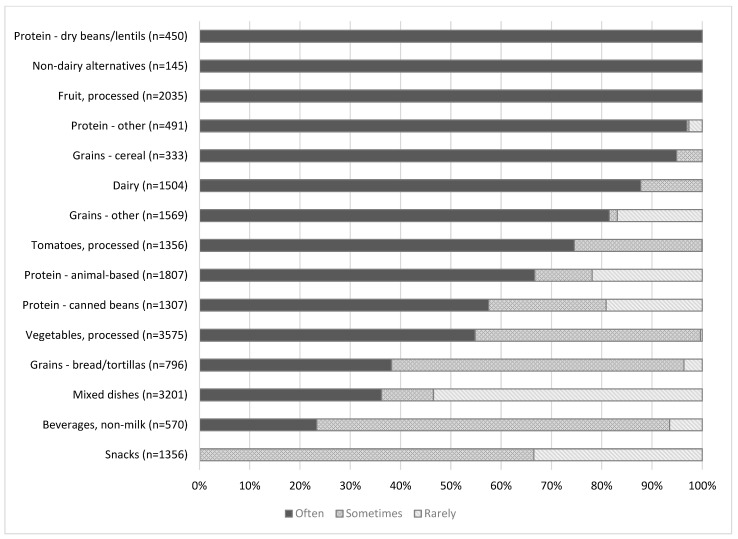
In the United States, food pantries increasingly serve as regular food sources for low income households experiencing high rates of chronic disease, including hypertension. Sodium consumption is a modifiable risk factor for hypertension, so pantry customers would benefit from access to low-sodium foods. Pantry customers often experience difficulty acquiring healthy foods, however; little is known about pantry foods' sodium content specifically. This study assesses the sodium content of pantry foods and lessons learned from an adaptable intervention to support pantries in adopting policies and environmental changes to make healthy, lower-sodium foods appealing and accessible. We conducted sodium assessments of food at 13 food pantries, tracked implementation of intervention strategies, and interviewed 10 pantry directors. More than half of food items in 11 categories met sodium standards for foods to be chosen "often". Pantry directors reported valuing the intervention approach and implemented six of nine behavioral economics strategies, especially those targeting the visibility and convenience of foods, along with layout changes and expanded customer choice. One pantry adopted an agency-specific nutrition policy and 12 adopted a coalition-level policy. Results can inform intervention efforts to make available healthy options appealing and easy to select while also improving the customer experience in food pantries.
在美国,食品储藏室越来越多地成为低收入家庭的常规食物来源,这些家庭患有包括高血压在内的慢性病的比例很高。钠的摄入量是高血压的一个可改变的危险因素,因此食品储藏室的顾客将受益于获得低钠食品。然而,食品储藏室的顾客经常难以获得健康食品;关于食品储藏室食品的钠含量,我们知之甚少。本研究评估了食品储藏室食品的钠含量,并从一个适应性干预措施中吸取了经验教训,该措施旨在支持食品储藏室采取政策和环境变化,使健康、低钠食品更具吸引力和可及性。我们对 13 家食品储藏室的食品进行了钠评估,跟踪了干预策略的实施情况,并对 10 名食品储藏室主任进行了采访。在 11 个类别中,超过一半的食品符合“经常”选择的食品的钠标准。食品储藏室主任报告说重视干预方法,并实施了 9 项行为经济学策略中的 6 项,尤其是那些针对食品可见性和便利性的策略,以及布局变化和扩大顾客选择。一家食品储藏室采用了特定机构的营养政策,12 家食品储藏室采用了联盟层面的政策。研究结果可以为干预措施提供信息,使健康选择更具吸引力和易于选择,同时改善食品储藏室的顾客体验。