Tang Xiaohui, Liu Bohao, Zhang Chen, Tang Wenbin, Liang Shitian, Xiao Yadan, Deng Ruoyu, Li Zhuan
Department of Pharmacy, Hunan Normal University School of Medicine, Changsha, China.
Department of Bioinformatics, School of Life Science, Fudan University, Shanghai, China.
Front Oncol. 2021 Dec 7;11:773045. doi: 10.3389/fonc.2021.773045. eCollection 2021.
Small ubiquitin-like modifier specific peptidase 2 (SENP2) suppresses the progression and chemoresistance of several cancers, while few studies report its role in hepatocellular carcinoma (HCC). This study aimed to evaluate the effect of SENP2 on stemness, sorafenib sensitivity, and downstream pathway in HCC, with validation of its molecular mechanisms by compensation experiment.
SENP2 was regulated by plasmid transfection; meanwhile, in a compensation experiment, protein kinase B (AKT) was activated by SC79 treatment and β-catenin (CTNNB1) was overexpressed by plasmid transfection. After modification, sorafenib sensitivity was detected by cell counting kit-8 assay; stemness was evaluated by CD133 cell proportion and sphere formation assay.
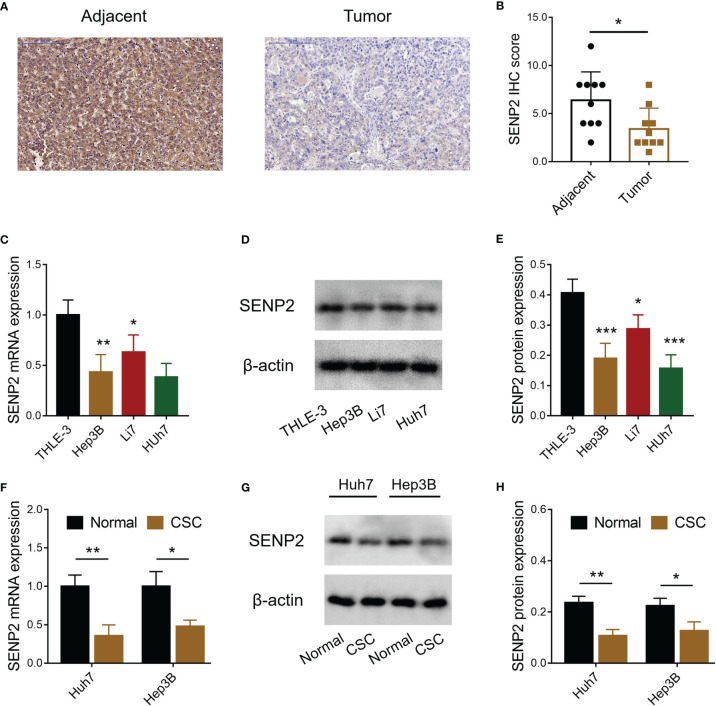
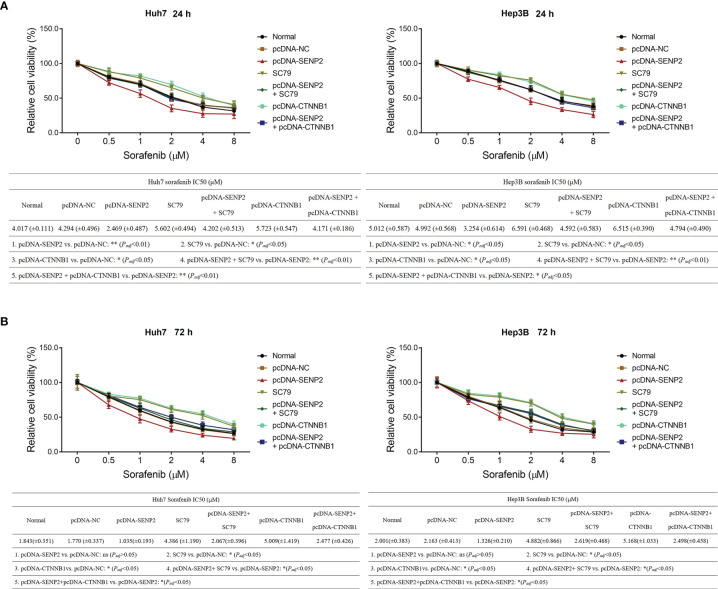
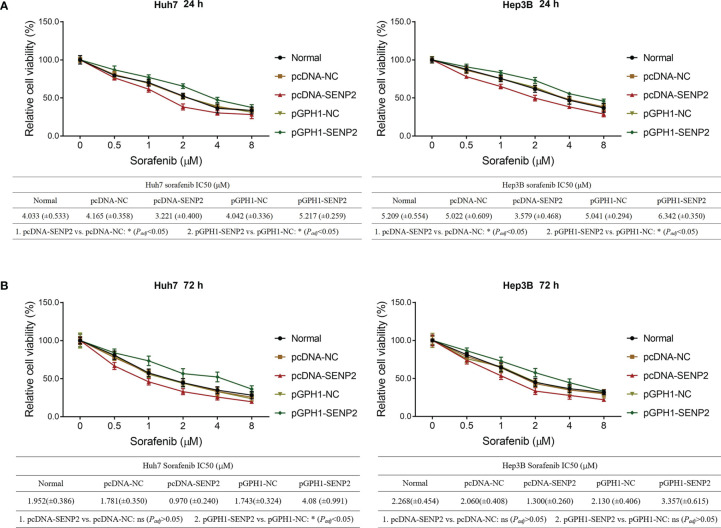
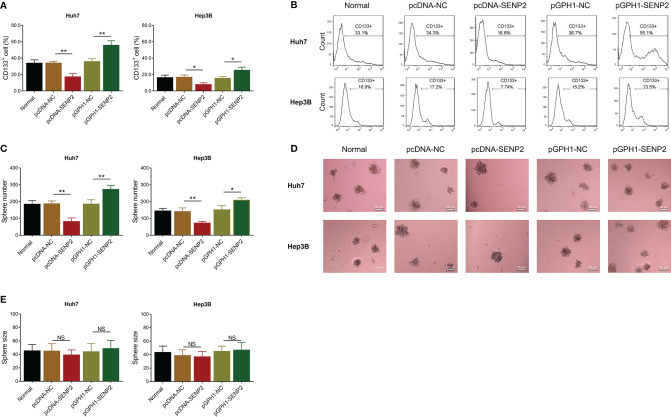
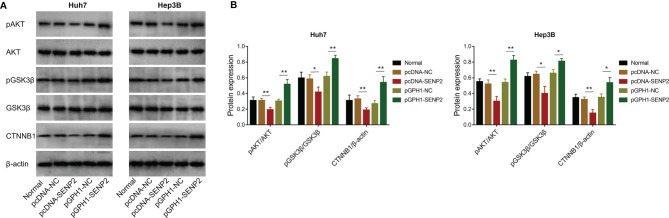
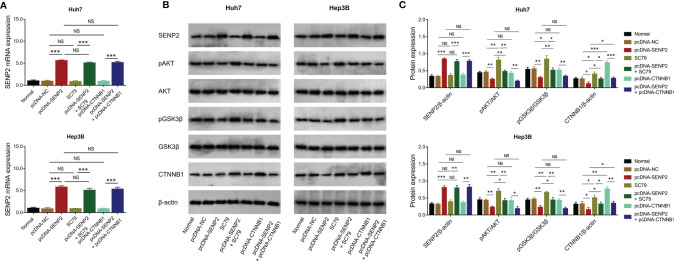
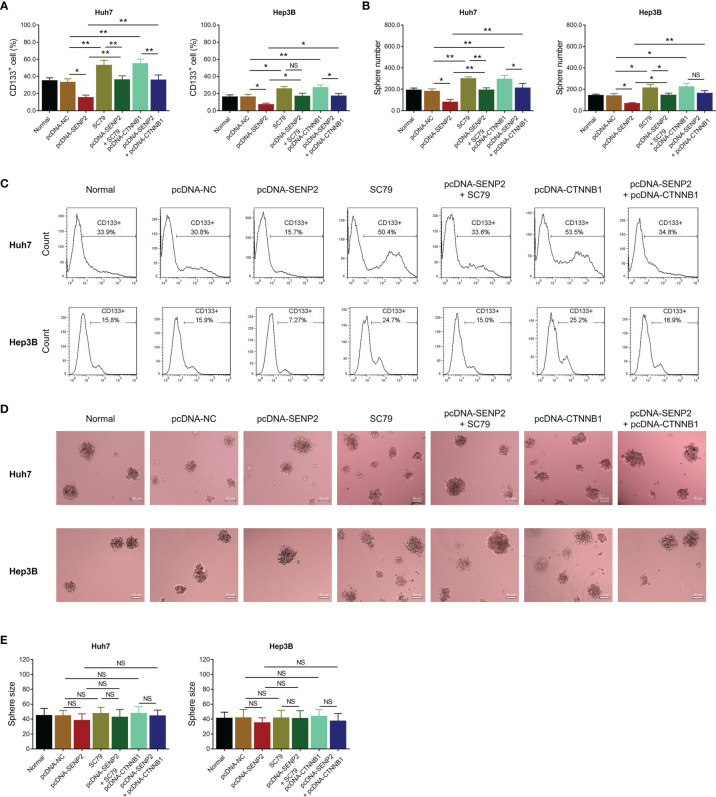
SENP2 was decreased in HCC cell lines (including Hep3B, Li7, and Huh7) compared with normal human liver epithelial cell lines, which was further reduced in HCC stem cells than in normal HCC cells. Subsequently, SENP2 overexpression inhibited CD133 cell proportion, decreased sphere formation ability, promoted sorafenib sensitivity, suppressed AKT and glycogen synthase kinase-3β (GSK3β) phosphorylation, and reduced CTNNB1 expression in Huh7 and Hep3B cells, while SENP2 knockdown showed the reverse effects. The following compensation experiment revealed that activating AKT or overexpressing CTNNB1 promoted CD133 cell proportion and sphere formation ability but suppressed sorafenib sensitivity in Huh7 and Hep3B cells. Moreover, activating AKT or overexpressing CTNNB1 attenuated the effect of SENP2 overexpression on stemness and sorafenib sensitivity in Huh7 and Hep3B cells.
SENP2 suppresses HCC stemness and increases sorafenib sensitivity through inactivating the AKT/GSK3β/CTNNB1 signaling pathway.
小泛素样修饰物特异性肽酶2(SENP2)可抑制多种癌症的进展及化疗耐药性,然而关于其在肝细胞癌(HCC)中的作用鲜有研究报道。本研究旨在评估SENP2对HCC干性、索拉非尼敏感性及下游通路的影响,并通过补偿实验验证其分子机制。
通过质粒转染调节SENP2;同时,在补偿实验中,用SC79处理激活蛋白激酶B(AKT),通过质粒转染过表达β-连环蛋白(CTNNB1)。处理后,采用细胞计数试剂盒-8法检测索拉非尼敏感性;通过CD133细胞比例和球体形成实验评估干性。
与正常人肝上皮细胞系相比,HCC细胞系(包括Hep3B、Li7和Huh7)中SENP2表达降低,且HCC干细胞中的SENP2表达比正常HCC细胞中进一步降低。随后,SENP2过表达抑制了Huh7和Hep3B细胞中CD133细胞比例,降低了球体形成能力,提高了索拉非尼敏感性,抑制了AKT和糖原合酶激酶-3β(GSK3β)磷酸化,并降低了CTNNB1表达,而SENP2敲低则产生相反的效果。接下来的补偿实验表明,激活AKT或过表达CTNNB1可促进Huh7和Hep3B细胞中CD133细胞比例和球体形成能力,但抑制索拉非尼敏感性。此外,激活AKT或过表达CTNNB1减弱了SENP2过表达对Huh7和Hep3B细胞干性和索拉非尼敏感性的影响。
SENP2通过使AKT/GSK3β/CTNNB1信号通路失活来抑制HCC干性并提高索拉非尼敏感性。