Navaratnam Prakash, Arcona Steve, Friedman Howard S, Leoni Matthew, Shaik Shajahan, Sasane Rahul
DataMed Solutions, LLC, New York, NY, India.
Cerevel Therapeutics, Cambridge, MA, India.
Clin Park Relat Disord. 2021 Dec 8;6:100125. doi: 10.1016/j.prdoa.2021.100125. eCollection 2022.
Parkinson's disease (PD) management seeks to balance the benefits and harms of current medications and evolves as the disease progresses. The natural history of PD and associated patterns of treatment change were analyzed to identify unmet needs in treatment of PD symptoms.
Medical charts of patients from clinics across the US diagnosed on or before June 30th, 2014 were retrospectively reviewed. Index date was the first clinic visit, and the post-index period was through study end (June 30th, 2019). Outcomes included the frequency of therapy changes in the post-index period, reasons for therapy change, and adverse events (AE).
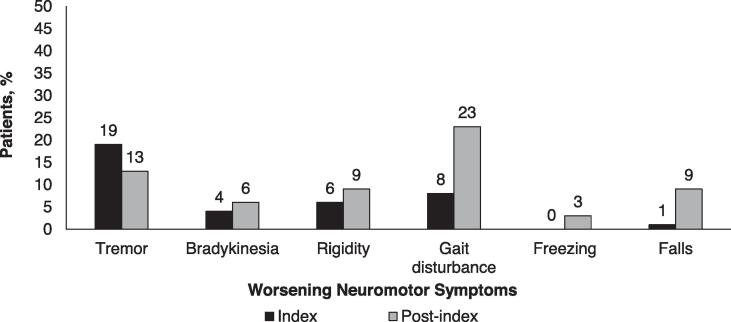
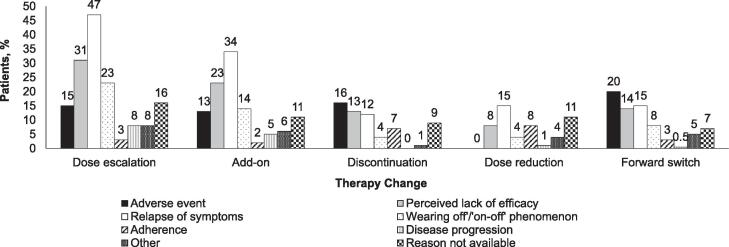
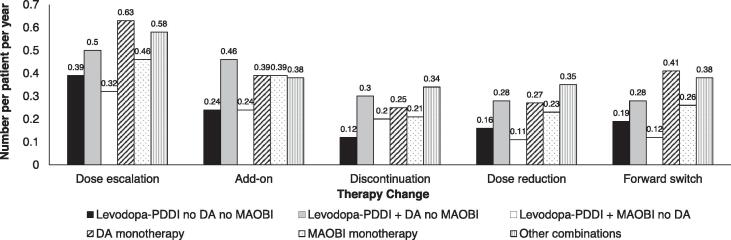
Patients (n = 203) at index were receiving levodopa-peripheral dopa decarboxylase inhibitor (PDDI) monotherapy (47%), dopaminergic agonist (DA) monotherapy (15%), monoamine oxidase B inhibitor (MAOBI) monotherapy (14%), or combination therapies. The percentage of patients in Hoehn-Yahr disease Stage 1-2 was 52% at index and 20% by the end of the study. Frequencies of motor, non-motor, and neuropsychiatric symptoms increased during the enrollment. Levodopa-PDDI monotherapy and levodopa-PDDI + MAOBI had the lowest rates of therapy changes. Symptom relapse was the most common reason for dose escalation, add-on, and dose reduction, whereas AEs were the most common reason for discontinuation and switching. Dose escalation, add-on, and forward switch were most likely to occur in the first 6 months of treatment.
Therapy changes during the study period reflected the challenging and evolving management of PD as the disease progresses. New or add-on symptomatic treatments are needed that are well-tolerated and able to control PD symptoms.
帕金森病(PD)的管理旨在平衡当前药物的益处和危害,并随着疾病进展而演变。分析了PD的自然病史和相关的治疗变化模式,以确定PD症状治疗中未满足的需求。
回顾性审查了2014年6月30日或之前在美国各诊所诊断的患者的病历。索引日期为首次诊所就诊日期,索引后时期至研究结束(2019年6月30日)。结局包括索引后时期治疗改变的频率、治疗改变的原因以及不良事件(AE)。
索引时患者(n = 203)接受左旋多巴-外周多巴脱羧酶抑制剂(PDDI)单药治疗(47%)、多巴胺能激动剂(DA)单药治疗(15%)、单胺氧化酶B抑制剂(MAOBI)单药治疗(14%)或联合治疗。索引时Hoehn-Yahr病1-2期患者的百分比为52%,研究结束时为20%。入组期间运动、非运动和神经精神症状的频率增加。左旋多巴-PDDI单药治疗和左旋多巴-PDDI + MAOBI的治疗改变率最低。症状复发是剂量增加、加用和减量的最常见原因,而AE是停药和换药的最常见原因。剂量增加、加用和向前换药最有可能发生在治疗的前6个月。
研究期间的治疗改变反映了随着疾病进展,PD管理具有挑战性且不断演变。需要新的或加用的耐受性良好且能够控制PD症状的对症治疗。