Kishi Masae, Asgarova Afag, Desterke Christophe, Chaker Diana, Artus Jérôme, Turhan Ali G, Bennaceur-Griscelli Annelise, Griscelli Frank
Institut National de la Santé et de la Recherche Médicale (INSERM) UA9-Human Pluripotent Stem Cell Core Facility, CITHERA Infrastructure-INGESTEM, Villejuif, France.
Université Paris-Saclay, Faculté de Médecine, Kremlin Bicêtre, France.
Front Med (Lausanne). 2021 Dec 10;8:729018. doi: 10.3389/fmed.2021.729018. eCollection 2021.
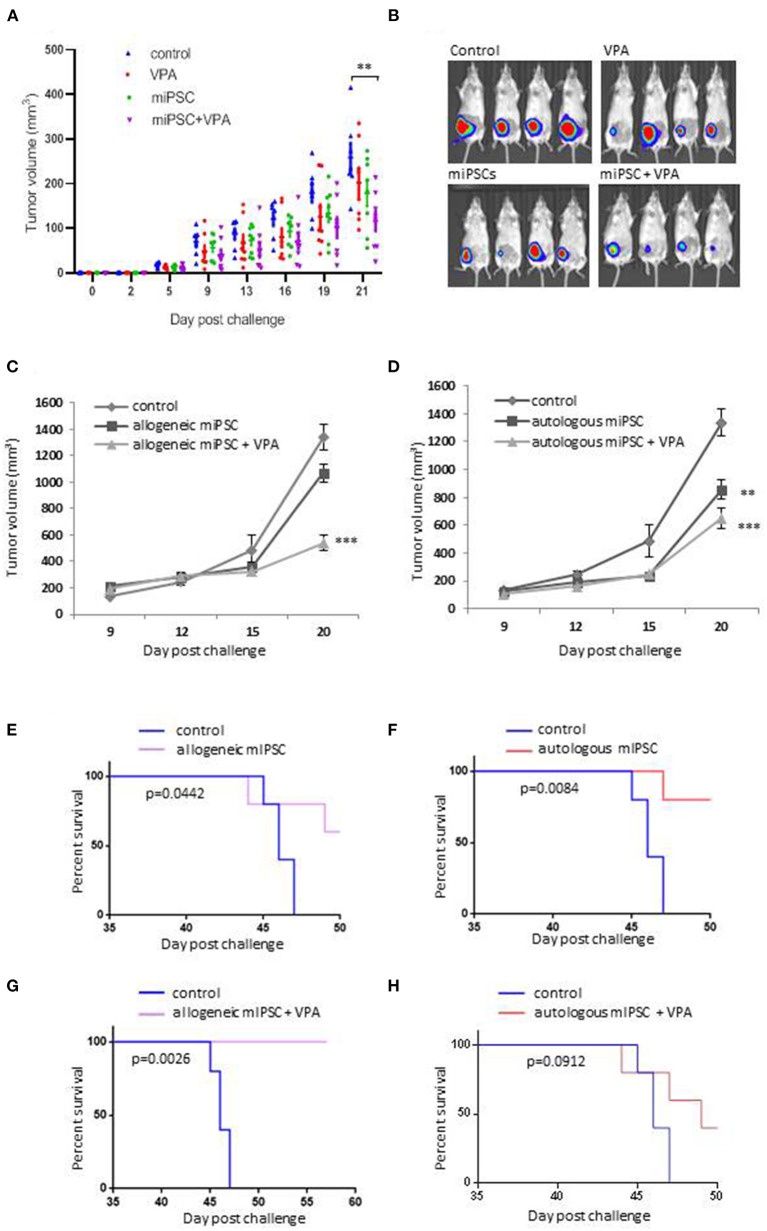
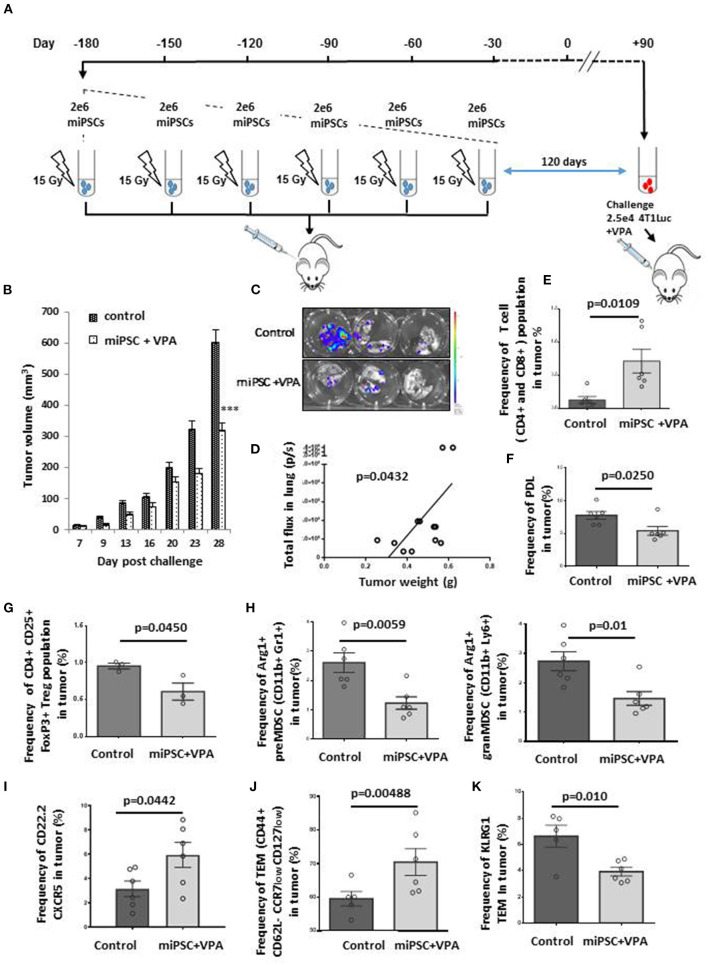
Cancer is maintained by the activity of a rare population of self-renewing "cancer stem cells" (CSCs), which are resistant to conventional therapies. CSCs over-express several proteins shared with induced pluripotent stem cells (iPSCs). We show here that allogenic or autologous murine iPSCs, combined with a histone deacetylase inhibitor (HDACi), are able to elicit major anti-tumor responses in a highly aggressive triple-negative breast cancer, as a relevant cancer stemness model. This immunotherapy strategy was effective in preventing tumor establishment and efficiently targeted CSCs by inducing extensive modifications of the tumor microenvironment. The anti-tumoral effect was correlated with the generation of CD4+, CD8+ T cells, and CD44+ CD62L- CCR7low CD127low T-effector memory cells, and the reduction of CD4+ CD25+FoxP3+ Tregs, Arg1 CD11b+ Gr1+, and Arg1 and CD11b+ Ly6+ myeloid-derived suppressor cell populations within the tumor. The anti-tumoral effect was associated with a reduction in metastatic dissemination and an improvement in the survival rate. These results demonstrate for the first time the clinical relevance of using an off-the-shelf allogeneic iPSC-based vaccine combined with an HDACi as a novel pan-cancer anti-cancer immunotherapy strategy against aggressive tumors harboring stemness features with high metastatic potential.
癌症由一群罕见的自我更新“癌症干细胞”(CSC)维持,这些细胞对传统疗法具有抗性。CSC过度表达几种与诱导多能干细胞(iPSC)共有的蛋白质。我们在此表明,同种异体或自体小鼠iPSC与组蛋白去乙酰化酶抑制剂(HDACi)联合使用,能够在高度侵袭性的三阴性乳腺癌中引发主要的抗肿瘤反应,作为一种相关的癌症干性模型。这种免疫治疗策略在预防肿瘤形成方面有效,并通过诱导肿瘤微环境的广泛改变有效靶向CSC。抗肿瘤作用与CD4 +、CD8 + T细胞以及CD44 + CD62L - CCR7low CD127low T效应记忆细胞的产生相关,并且与肿瘤内CD4 + CD25 + FoxP3 + Treg、Arg1 CD11b + Gr1 +以及Arg1和CD11b + Ly6 +髓系来源抑制细胞群体的减少相关。抗肿瘤作用与转移扩散的减少和存活率的提高相关。这些结果首次证明了使用现成的基于同种异体iPSC的疫苗联合HDACi作为一种新型的泛癌抗癌免疫治疗策略针对具有高转移潜力的具有干性特征的侵袭性肿瘤的临床相关性。