Department of Medical Oncology, Dana-Farber Cancer Institute, Boston, USA.
Department of Biostatistics, Vanderbilt University, Nashville, USA.
Ann Oncol. 2022 Mar;33(3):340-346. doi: 10.1016/j.annonc.2021.12.006. Epub 2021 Dec 24.
Vaccination is an important preventive health measure to protect against symptomatic and severe COVID-19. Impaired immunity secondary to an underlying malignancy or recent receipt of antineoplastic systemic therapies can result in less robust antibody titers following vaccination and possible risk of breakthrough infection. As clinical trials evaluating COVID-19 vaccines largely excluded patients with a history of cancer and those on active immunosuppression (including chemotherapy), limited evidence is available to inform the clinical efficacy of COVID-19 vaccination across the spectrum of patients with cancer.
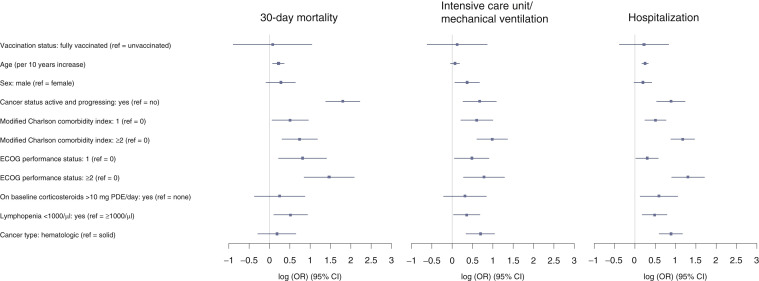
We describe the clinical features of patients with cancer who developed symptomatic COVID-19 following vaccination and compare weighted outcomes with those of contemporary unvaccinated patients, after adjustment for confounders, using data from the multi-institutional COVID-19 and Cancer Consortium (CCC19).
Patients with cancer who develop COVID-19 following vaccination have substantial comorbidities and can present with severe and even lethal infection. Patients harboring hematologic malignancies are over-represented among vaccinated patients with cancer who develop symptomatic COVID-19.
Vaccination against COVID-19 remains an essential strategy in protecting vulnerable populations, including patients with cancer. Patients with cancer who develop breakthrough infection despite full vaccination, however, remain at risk of severe outcomes. A multilayered public health mitigation approach that includes vaccination of close contacts, boosters, social distancing, and mask-wearing should be continued for the foreseeable future.
接种疫苗是预防 COVID-19 症状性和重症感染的重要措施。潜在恶性肿瘤或近期接受抗肿瘤全身治疗导致的免疫受损,可能会使疫苗接种后抗体滴度降低,并可能增加突破性感染的风险。由于评估 COVID-19 疫苗的临床试验大多排除了有癌症病史和正在接受免疫抑制治疗(包括化疗)的患者,因此,关于癌症患者全人群接种 COVID-19 疫苗的临床疗效,目前仅有有限的证据。
我们描述了接种疫苗后发生 COVID-19 症状性感染的癌症患者的临床特征,并利用多机构 COVID-19 和癌症联盟(CCC19)的数据,在调整混杂因素后,将接种疫苗的癌症患者的加权结局与同期未接种疫苗的患者进行比较。
接种疫苗后发生 COVID-19 的癌症患者存在大量合并症,可出现严重甚至致命的感染。在接种疫苗后发生 COVID-19 症状性感染的癌症患者中,血液系统恶性肿瘤患者占比过高。
接种 COVID-19 疫苗仍然是保护弱势群体(包括癌症患者)的重要策略。然而,尽管已完全接种疫苗,仍有发生突破性感染的癌症患者面临严重结局的风险。在可预见的未来,应继续采取多层次的公共卫生缓解措施,包括对密切接触者进行疫苗接种、加强针接种、保持社交距离和佩戴口罩。