Ahmed Shakil, Rahman Tanjina, Ripon Md Sajjadul Haque, Rashid Harun-Ur, Kashem Tasnuva, Md Ali Mohammad Syafiq, Khor Ban-Hock, Khosla Pramod, Karupaiah Tilakavati, Daud Zulfitri Azuan Mat
Department of Food Technology and Nutrition Science, Noakhali Science and Technology University, Sonapur 3814, Bangladesh.
Institute of Nutrition and Food Science, University of Dhaka, Dhaka 1000, Bangladesh.
Nutrients. 2021 Dec 17;13(12):4521. doi: 10.3390/nu13124521.
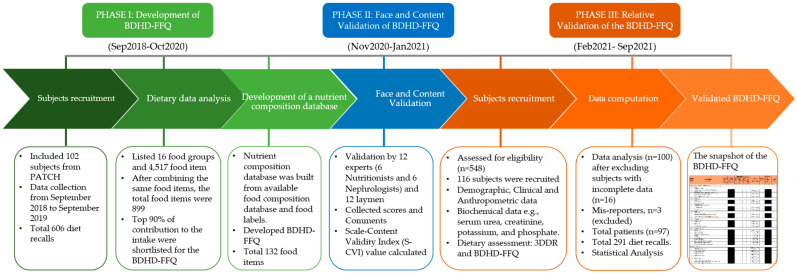
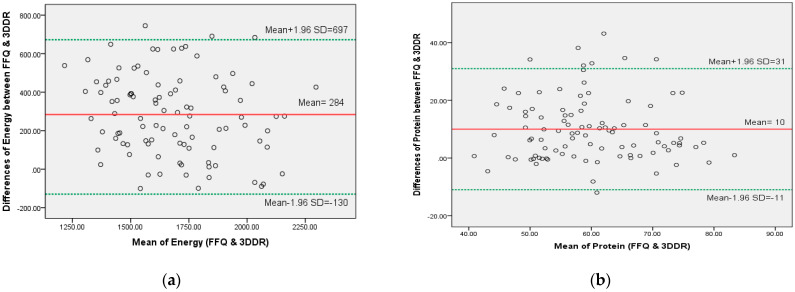
Diet is a recognized risk factor and cornerstone for chronic kidney disease (CKD) management; however, a tool to assess dietary intake among Bangladeshi dialysis patients is scarce. This study aims to validate a prototype Bangladeshi Hemodialysis Food Frequency Questionnaire (BDHD-FFQ) against 3-day dietary recall (3DDR) and corresponding serum biomarkers. Nutrients of interest were energy, macronutrients, potassium, phosphate, iron, sodium and calcium. The BDHD-FFQ, comprising 132 food items, was developed from 606 24-h recalls and had undergone face and content validation. Comprehensive facets of relative validity were ascertained using six statistical tests (correlation coefficient, percent difference, paired -test, cross-quartiles classification, weighted kappa, and Bland-Altman analysis). Overall, the BDHD-FFQ showed acceptable to good correlations ( < 0.05) with 3DDR for the concerned nutrients in unadjusted and energy-adjusted models, but this correlation was diminished when adjusted for other covariates (age, gender, and BMI). Phosphate and potassium intake, estimated by the BDHD-FFQ, also correlated well with the corresponding serum biomarkers ( < 0.01) when compared to 3DDR ( > 0.05). Cross-quartile classification indicated that <10% of patients were incorrectly classified. Weighted kappa statistics showed agreement with all but iron. Bland-Altman analysis showed positive mean differences were observed for all nutrients when compared to 3DDR, whilst energy, carbohydrates, fat, iron, sodium, and potassium had percentage data points within the limit of agreement (mean ± 1.96 SD), above 95%. In summary, the BDHD-FFQ demonstrated an acceptable relative validity for most of the nutrients as four out of the six statistical tests fulfilled the cut-off standard in assessing dietary intake of CKD patients in Bangladesh.
饮食是公认的慢性肾脏病(CKD)管理的风险因素和基石;然而,在孟加拉国透析患者中,用于评估饮食摄入量的工具却很匮乏。本研究旨在针对3日饮食回顾法(3DDR)及相应的血清生物标志物,验证孟加拉国血液透析食物频率问卷(BDHD - FFQ)原型。研究关注的营养素包括能量、宏量营养素、钾、磷、铁、钠和钙。BDHD - FFQ包含132种食物条目,基于606份24小时饮食回顾制定,并经过了表面效度和内容效度验证。使用六种统计检验(相关系数、百分比差异、配对t检验、交叉四分位数分类、加权kappa检验和Bland - Altman分析)确定相对效度的综合方面。总体而言,在未调整和能量调整模型中,BDHD - FFQ与3DDR对相关营养素的相关性在可接受至良好范围内(P < 0.05),但在调整其他协变量(年龄、性别和BMI)后,这种相关性减弱。与3DDR相比,BDHD - FFQ估算的磷和钾摄入量与相应的血清生物标志物也具有良好的相关性(P < 0.01)(P > 0.05)。交叉四分位数分类表明,<10%的患者分类错误。加权kappa统计显示除铁外均具有一致性。Bland - Altman分析表明,与3DDR相比,所有营养素均观察到正的平均差异,而能量、碳水化合物、脂肪、铁、钠和钾的百分比数据点在一致性界限内(均值±1.96 SD),高于95%。总之,BDHD - FFQ对大多数营养素显示出可接受的相对效度,因为六项统计检验中的四项在评估孟加拉国CKD患者饮食摄入量时达到了截断标准。