Gupta Kajal H, Nowicki Christina, Giurini Eileena F, Marzo Amanda L, Zloza Andrew
Division of Hematology, Oncology, and Cell Therapy, Department of Internal Medicine, Rush University Medical Center, Chicago, IL 60612, USA.
Division of Translational and Precision Medicine, Department of Internal Medicine, Rush University Medical Center, Chicago, IL 60612, USA.
Vaccines (Basel). 2021 Dec 18;9(12):1497. doi: 10.3390/vaccines9121497.
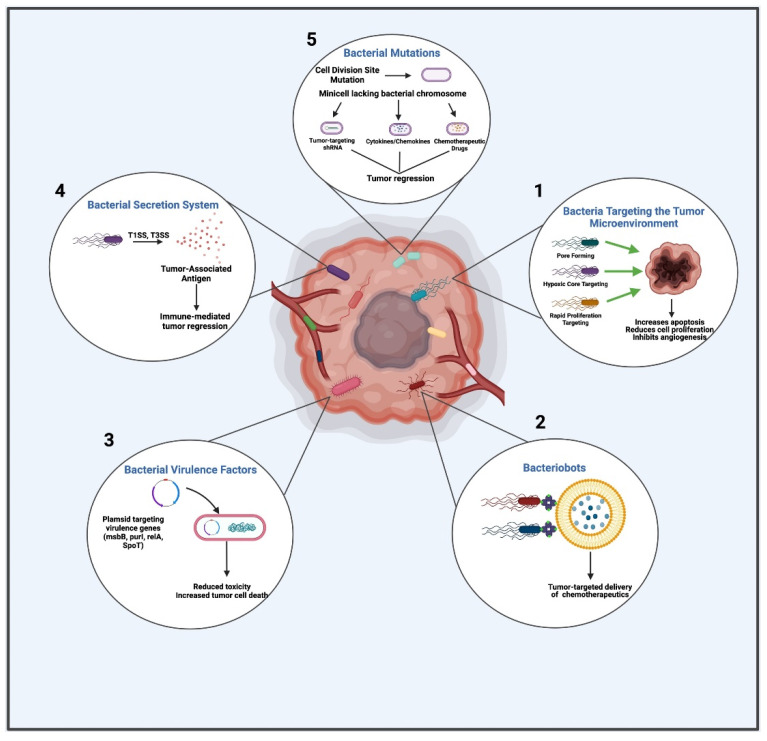
Currently approximately 10 million people die each year due to cancer, and cancer is the cause of every sixth death worldwide. Tremendous efforts and progress have been made towards finding a cure for cancer. However, numerous challenges have been faced due to adverse effects of chemotherapy, radiotherapy, and alternative cancer therapies, including toxicity to non-cancerous cells, the inability of drugs to reach deep tumor tissue, and the persistent problem of increasing drug resistance in tumor cells. These challenges have increased the demand for the development of alternative approaches with greater selectivity and effectiveness against tumor cells. Cancer immunotherapy has made significant advancements towards eliminating cancer. Our understanding of cancer-directed immune responses and the mechanisms through which immune cells invade tumors have extensively helped us in the development of new therapies. Among immunotherapies, the application of bacteria and bacterial-based products has promising potential to be used as treatments that combat cancer. Bacterial targeting of tumors has been developed as a unique therapeutic option that meets the ongoing challenges of cancer treatment. In comparison with other cancer therapeutics, bacterial-based therapies have capabilities for suppressing cancer. Bacteria are known to accumulate and proliferate in the tumor microenvironment and initiate antitumor immune responses. We are currently well-informed regarding various methods by which bacteria can be manipulated by simple genetic engineering or synthetic bioengineering to induce the production of anti-cancer drugs. Further, bacterial-based cancer therapy (BBCT) can be either used as a monotherapy or in combination with other anticancer therapies for better clinical outcomes. Here, we review recent advances, current challenges, and prospects of bacteria and bacterial products in the development of BBCTs.
目前,每年约有1000万人死于癌症,癌症是全球每六例死亡的原因之一。在寻找癌症治疗方法方面已经付出了巨大努力并取得了进展。然而,由于化疗、放疗和其他癌症治疗方法的副作用,面临着诸多挑战,包括对非癌细胞的毒性、药物无法到达深部肿瘤组织以及肿瘤细胞中耐药性不断增加的持续问题。这些挑战增加了对开发对肿瘤细胞具有更高选择性和有效性的替代方法的需求。癌症免疫疗法在消除癌症方面取得了重大进展。我们对癌症导向的免疫反应以及免疫细胞侵入肿瘤的机制的理解,在很大程度上帮助我们开发了新的疗法。在免疫疗法中,细菌和基于细菌的产品的应用具有作为抗癌治疗方法的广阔前景。细菌靶向肿瘤已被开发为一种独特的治疗选择,以应对癌症治疗中不断出现的挑战。与其他癌症治疗方法相比,基于细菌的疗法具有抑制癌症的能力。已知细菌会在肿瘤微环境中积累和增殖,并引发抗肿瘤免疫反应。目前,我们已经充分了解了通过简单的基因工程或合成生物工程操纵细菌以诱导抗癌药物产生的各种方法。此外,基于细菌的癌症疗法(BBCT)既可以作为单一疗法使用,也可以与其他抗癌疗法联合使用,以获得更好的临床效果。在此,我们综述了细菌和细菌产品在基于细菌的癌症疗法开发中的最新进展、当前挑战和前景。