Machine Learning Department, Carnegie Mellon University, Pittsburgh, Pennsylvania, United States of America.
Computer Science Department, Carnegie Mellon University, Pittsburgh, Pennsylvania, United States of America.
PLoS Comput Biol. 2021 Dec 28;17(12):e1009689. doi: 10.1371/journal.pcbi.1009689. eCollection 2021 Dec.
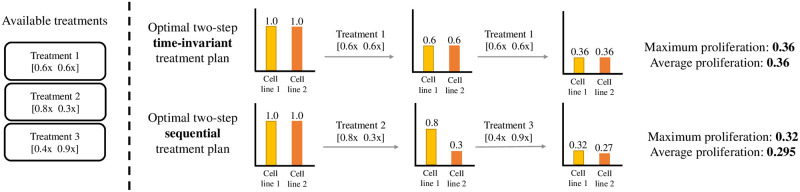
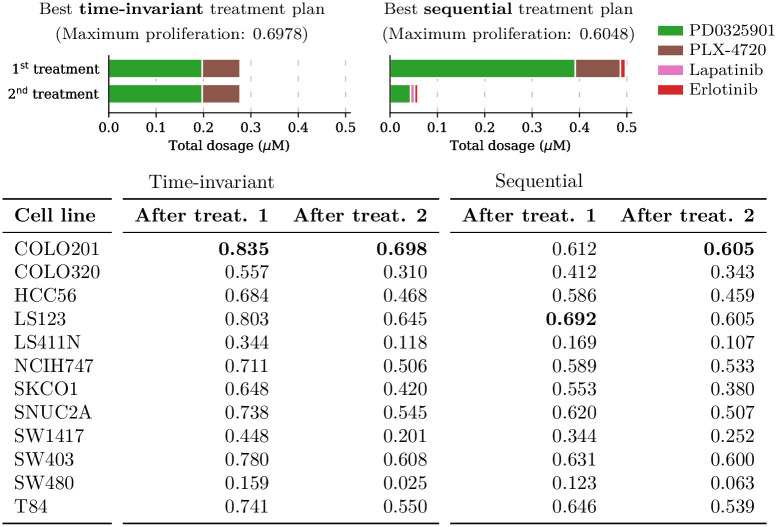
The design of efficient combination therapies is a difficult key challenge in the treatment of complex diseases such as cancers. The large heterogeneity of cancers and the large number of available drugs renders exhaustive in vivo or even in vitro investigation of possible treatments impractical. In recent years, sophisticated mechanistic, ordinary differential equation-based pathways models that can predict treatment responses at a molecular level have been developed. However, surprisingly little effort has been put into leveraging these models to find novel therapies. In this paper we use for the first time, to our knowledge, a large-scale state-of-the-art pan-cancer signaling pathway model to identify candidates for novel combination therapies to treat individual cancer cell lines from various tissues (e.g., minimizing proliferation while keeping dosage low to avoid adverse side effects) and populations of heterogeneous cancer cell lines (e.g., minimizing the maximum or average proliferation across the cell lines while keeping dosage low). We also show how our method can be used to optimize the drug combinations used in sequential treatment plans-that is, optimized sequences of potentially different drug combinations-providing additional benefits. In order to solve the treatment optimization problems, we combine the Covariance Matrix Adaptation Evolution Strategy (CMA-ES) algorithm with a significantly more scalable sampling scheme for truncated Gaussian distributions, based on a Hamiltonian Monte-Carlo method. These optimization techniques are independent of the signaling pathway model, and can thus be adapted to find treatment candidates for other complex diseases than cancers as well, as long as a suitable predictive model is available.
设计高效的联合疗法是治疗癌症等复杂疾病的一个具有挑战性的关键难题。癌症的高度异质性和大量可用药物使得对可能的治疗方法进行详尽的体内甚至体外研究变得不切实际。近年来,已经开发出了复杂的基于机制的、常微分方程的途径模型,这些模型可以在分子水平上预测治疗反应。然而,令人惊讶的是,很少有人努力利用这些模型来寻找新的治疗方法。在本文中,我们首次使用大规模的最先进的泛癌症信号通路模型来识别新的联合治疗候选药物,以治疗来自不同组织的单个癌细胞系(例如,在保持剂量低以避免不良反应的情况下最小化增殖)和异质癌细胞系群体(例如,在保持剂量低的情况下最小化细胞系之间的最大或平均增殖)。我们还展示了如何使用我们的方法来优化序贯治疗计划中使用的药物组合,即优化不同药物组合的潜在序列,从而提供额外的益处。为了解决治疗优化问题,我们将协方差矩阵自适应进化策略(CMA-ES)算法与基于哈密顿蒙特卡罗方法的截断高斯分布的更具可扩展性的采样方案相结合。这些优化技术与信号通路模型无关,因此只要有合适的预测模型,就可以适应于寻找除癌症以外的其他复杂疾病的治疗候选药物。