Beijing Tiantan Hospital, Capital Medical University, No. 119 South 4th Ring West Road, Fengtai District, Beijing, 100070, China.
China National Clinical Research Center for Neurological Diseases, Capital Medical University, Beijing, China.
J Neuroinflammation. 2021 Dec 28;18(1):307. doi: 10.1186/s12974-021-02359-w.
The association of lipoprotein(a) [Lp(a)] and stroke functional outcomes was conflicting. The aim of the study was to clarify whether high Lp(a) is associated with unfavorable functional outcomes in patients with ischemic stroke.
A total of 9709 individuals from the third China National Stroke Registry cohort were recruited. Plasma level of Lp(a) at admission was measured with enzyme-linked immunosorbent assay. The cut-off was set at the median for Lp(a). Functional outcome was assessed using the modified Rankin scale (mRS) at 3 months and 1 year after ischemic stroke. The association between Lp(a) and functional outcomes was evaluated using a logistic regression model.
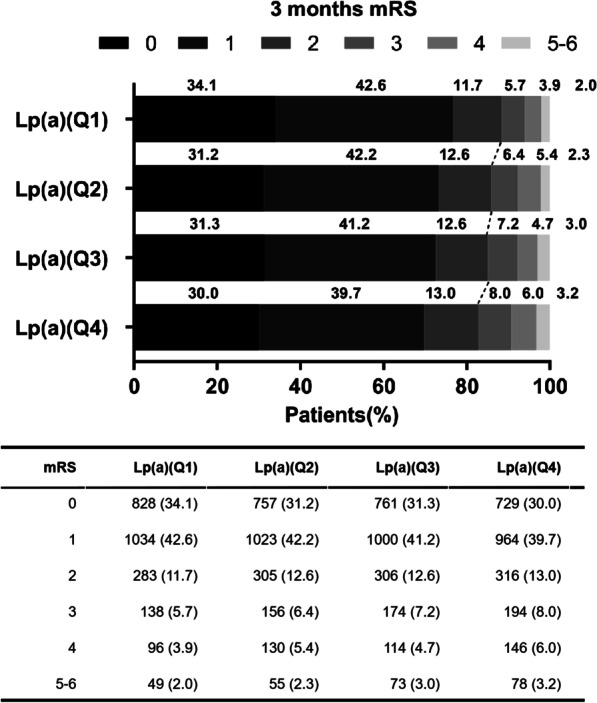
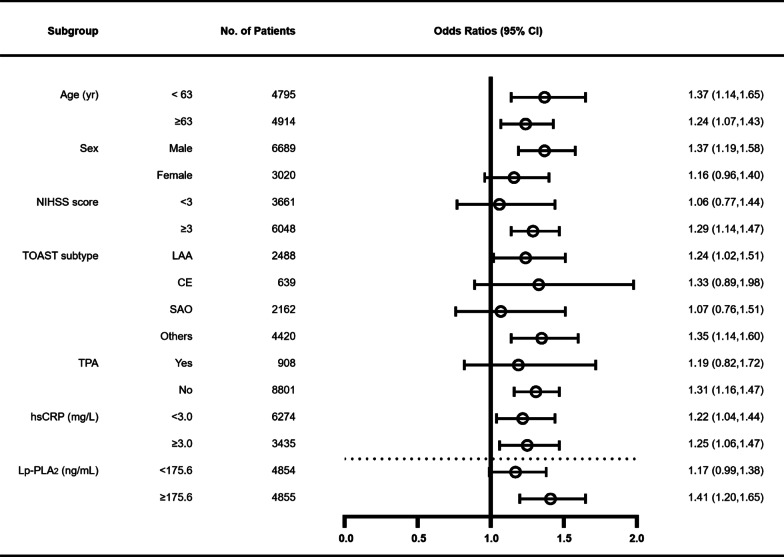
The median age was 63.0 years, and 31.1% participants were women. Patients in higher Lp(a) group had higher incidences of unfavorable functional outcomes at 3 months. In logistic regression model, elevated Lp(a) levels were associated with unfavorable functional outcomes at 3 months (Q4 vs. Q1: odds ratio 1.33, 95% confidence interval 1.11-1.61). Subgroup analysis showed that in the lower Lp-PLA group, Lp(a) level was not associated with functional outcomes, but in the higher Lp-PLA group, Lp(a) level was significantly associated with functional outcomes. After grouped by different levels of Lp(a) and Lp-PLA, the Lp(a) high/ Lp-PLA high group showed the highest incidence of unfavorable functional outcomes at 3 months and 1 year.
Elevated Lp(a) level is associated with unfavorable functional outcomes in patients with ischemic stroke. The increment in both Lp(a) and Lp-PLA are associated with unfavorable functional outcomes at 3 months and 1 year after ischemic stroke.
脂蛋白(a) [Lp(a)] 与中风功能结局的关系存在争议。本研究旨在阐明高 Lp(a) 是否与缺血性中风患者的不良功能结局相关。
共纳入 9709 名来自第三次中国国家卒中登记队列的患者。入院时采用酶联免疫吸附法测定血浆 Lp(a) 水平。以 Lp(a) 的中位数为界进行划分。使用改良 Rankin 量表(mRS)评估缺血性卒中后 3 个月和 1 年的功能结局。采用 logistic 回归模型评估 Lp(a) 与功能结局的关系。
患者的中位年龄为 63.0 岁,31.1%为女性。Lp(a)水平较高组患者 3 个月时不良功能结局发生率较高。在 logistic 回归模型中,升高的 Lp(a)水平与 3 个月时的不良功能结局相关(Q4 与 Q1:比值比 1.33,95%置信区间 1.11-1.61)。亚组分析显示,在较低的 Lp-PLA 组中,Lp(a)水平与功能结局无关,但在较高的 Lp-PLA 组中,Lp(a)水平与功能结局显著相关。按照不同的 Lp(a)和 Lp-PLA 水平分组后,Lp(a)高/Lp-PLA 高组在 3 个月和 1 年时不良功能结局发生率最高。
升高的 Lp(a)水平与缺血性中风患者的不良功能结局相关。Lp(a)和 Lp-PLA 水平同时升高与缺血性卒中后 3 个月和 1 年的不良功能结局相关。