Li Xinyu, Chen Haiyan, Li Huaixing, Chen Jinhua
College of Safety and Environmental Engineering, Shandong University of Science and Technology, Qingdao 266590, P. R. China.
Mine Disaster Prevention and Control-Ministry of State Key Laboratory Breeding Base, Shandong University of Science and Technology, Qingdao 266590, P. R. China.
ACS Omega. 2021 Dec 8;6(50):35112-35123. doi: 10.1021/acsomega.1c05942. eCollection 2021 Dec 21.
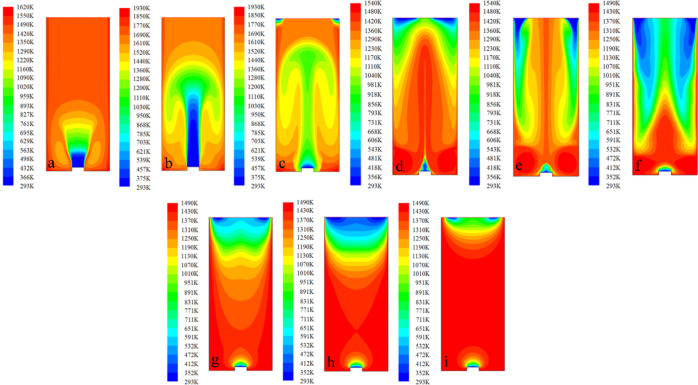
During coal seam mining, a large amount of low-concentration mine gas will be produced, and it is the main utilization way to pass it into a thermal storage oxidation device to obtain heat energy. The thermal storage oxidation process is carried out in an ultra-high temperature environment. The excessive gas concentration not only reduces the production efficiency but also presents an explosion hazard. To solve the abovementioned problems, the lower explosion limit of a low-concentration gas at ultra-high temperatures (900-1200 °C) was studied through a self-developed high-temperature explosion experimental device. Fluent software was used to simulate the reaction of a low-concentration gas in a high-temperature environment, and the experimental results were verified according to the maximum explosion pressure. Through analysis and discussion, the following are found: (1) the relationship between the instantaneous explosion pressure of the low-concentration gas and the gas concentration as well as the relationship between the maximum explosion pressure near the lower explosion limit and the gas concentration are in accordance with the Boltzmann function. (2) When the temperature rises from 900 to 1200 °C, the lower limit of gas explosion obtained from experiments is reduced from 2.33 to 1.36%. (3) The lower limit of gas explosion decreases with increasing temperature at ultra-high temperatures and the downward trend slows down, this is similar to the change rule of the lower limit of gas explosion at temperatures below 200 °C. These findings have certain practical significance for improving the utilization efficiency of the low-concentration gas in heat storage oxidation.
在煤层开采过程中,会产生大量低浓度矿井瓦斯,将其通入蓄热氧化装置获取热能是主要利用方式。蓄热氧化过程在超高温环境下进行。瓦斯浓度过高不仅会降低生产效率,还存在爆炸危险。为解决上述问题,通过自主研发的高温爆炸实验装置,研究了超高温(900 - 1200℃)下低浓度瓦斯的爆炸下限。利用Fluent软件模拟低浓度瓦斯在高温环境下的反应,并根据最大爆炸压力对实验结果进行验证。通过分析讨论,发现如下:(1)低浓度瓦斯的瞬时爆炸压力与瓦斯浓度的关系以及爆炸下限附近的最大爆炸压力与瓦斯浓度的关系符合玻尔兹曼函数。(2)当温度从900℃升至1200℃时,实验得到的瓦斯爆炸下限从2.33%降至1.36%。(3)在超高温下,瓦斯爆炸下限随温度升高而降低,且下降趋势变缓,这与200℃以下瓦斯爆炸下限的变化规律相似。这些发现对提高蓄热氧化中低浓度瓦斯的利用效率具有一定的实际意义。