Department of Otolaryngology & Head and Neck Surgery, Ruijin Hospital, Shanghai Jiao Tong University School of Medicine, Shanghai, China.
Cancer Med. 2022 Feb;11(4):922-930. doi: 10.1002/cam4.4511. Epub 2021 Dec 28.
We aim to review the roles of plasmacytoid dendritic cells (pDCs) in head and neck squamous cell carcinoma (HNSCC) and explore the effects of hypoxia on the tolerogenic transformation of pDCs.
pDCs, best known as professional type I interferon-secreting cells, play key roles in immune surveillance and antitumor immunity. Recently, pDCs have been shown to be tolerogenic and correlate with poor prognosis in a variety of cancers, including HNSCC. However, it remains unclear what drives the tolerogenic transformation of pDCs in the HNSCC microenvironment. Hypoxia, a prominent hallmark of the tumor microenvironment (TME) of HNSCC, can interfere with multiple immune cells and establish an immunosuppressive TME.
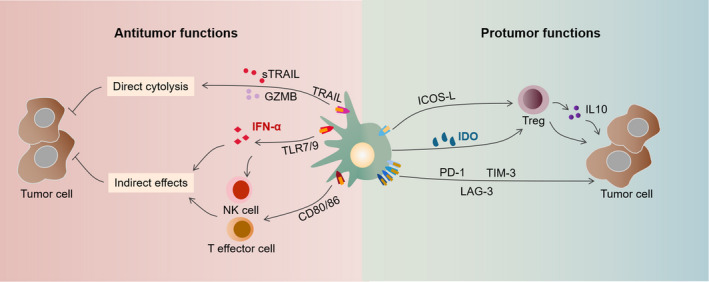
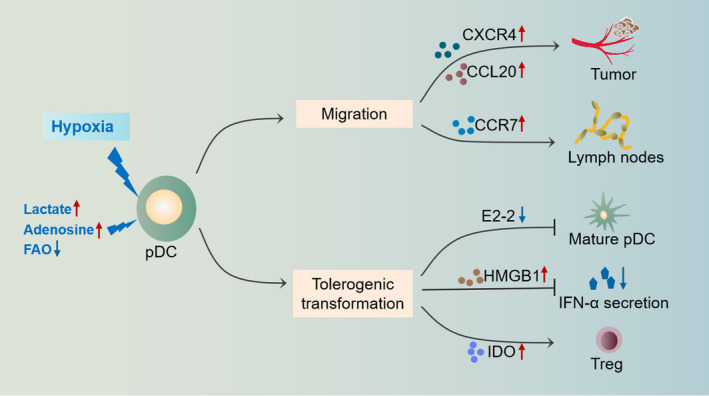
In this review, we summarize the antitumor and protumor functions of pDCs, explore the effects of hypoxia on the migration and maturation of pDCs, and discuss related mechanisms in HNSCC.
pDCs mainly display protumor functions in HNSCC. The hypoxic TME in HNSCC can enhance the migration of pDCs and inhibit the differentiation and maturation of pDCs, promoting the tolerogenic phenotype of pDCs.
我们旨在回顾浆细胞样树突状细胞(pDCs)在头颈部鳞状细胞癌(HNSCC)中的作用,并探讨低氧对 pDCs 耐受转化的影响。
pDCs 作为专业的 I 型干扰素分泌细胞而闻名,在免疫监视和抗肿瘤免疫中发挥关键作用。最近,pDCs 已被证明具有耐受原性,并与多种癌症(包括 HNSCC)的预后不良相关。然而,尚不清楚是什么驱动了 HNSCC 微环境中 pDCs 的耐受原性转化。低氧是 HNSCC 肿瘤微环境(TME)的一个显著特征,它可以干扰多种免疫细胞并建立免疫抑制性 TME。
在本综述中,我们总结了 pDCs 的抗肿瘤和促肿瘤功能,探讨了低氧对 pDCs 迁移和成熟的影响,并讨论了 HNSCC 中的相关机制。
pDCs 在 HNSCC 中主要表现出促肿瘤功能。HNSCC 的低氧 TME 可以增强 pDCs 的迁移,并抑制 pDCs 的分化和成熟,促进 pDCs 的耐受原性表型。