Guilarte Mar, Sala-Cunill Anna, Baeza María Luisa, Cabañas Rosario, Hernández María Dolores, Ibañez Ethel, de Larramendi Carlos Hernando, Lleonart Ramon, Lobera Teófilo, Marqués Luis, de San Pedro Blanca Sáenz, Botha Jaco, Andresen Irmgard, Caballero Teresa
Allergy Section, Medicine Department, Hospital Universitari Vall d'Hebron, Barcelona, Spain.
Spanish Research Network on Allergy (National Allergy Network ARADyAL: Asma, Reacciones Adversas y Alérgicas), Instituto de Salud Carlos III, Madrid, Spain.
Allergy Asthma Clin Immunol. 2021 Dec 29;17(1):137. doi: 10.1186/s13223-021-00641-3.
The Icatibant Outcome Survey (IOS) is an international registry monitoring the use of icatibant, a bradykinin B receptor antagonist indicated for the acute treatment of hereditary angioedema (HAE) attacks. Our goal was to assess disease characteristics and icatibant treatment outcomes in patients with HAE due to C1 inhibitor deficiency (HAE type 1 or 2 (HAE-1/2)) from Spain relative to other countries participating in IOS.
Descriptive retrospective analyses of data are reported from 10 centers in Spain vs 51 centers in 12 other participating countries (July 2009 to January 2019).
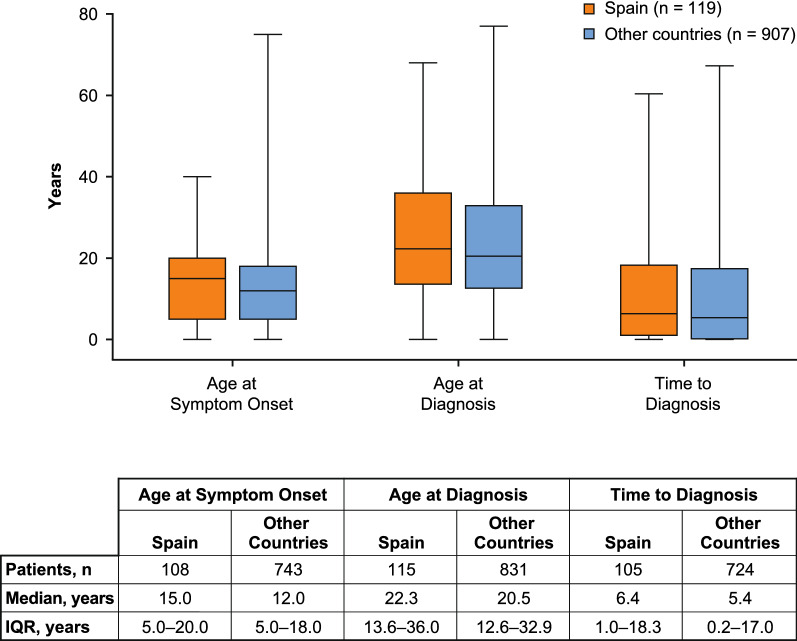
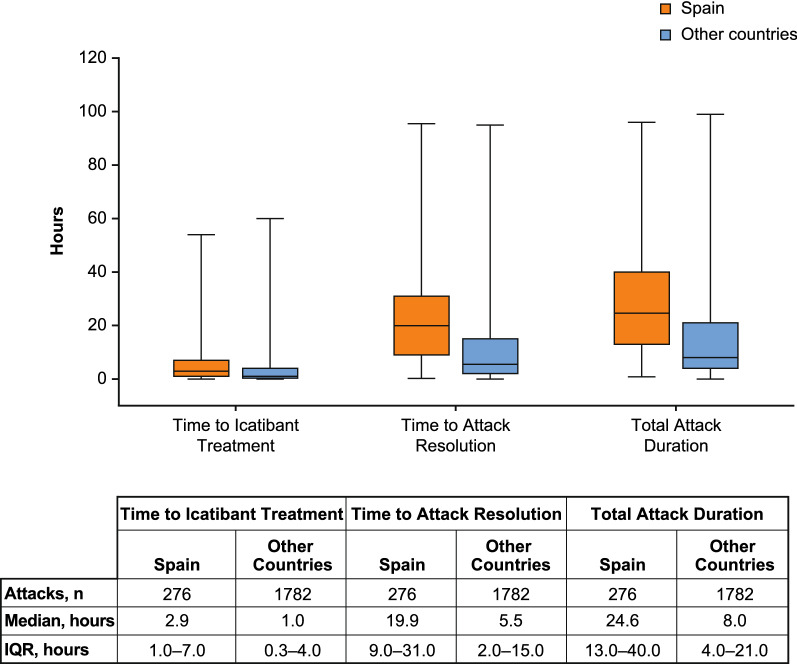
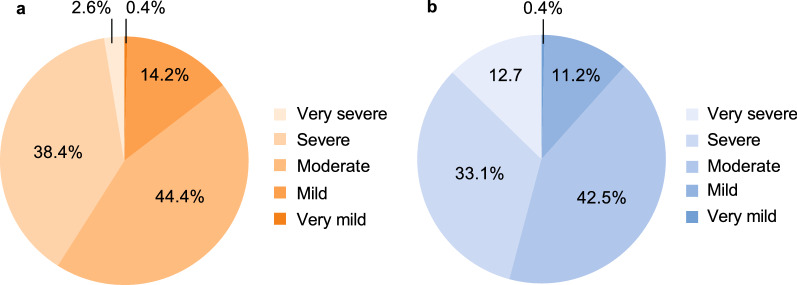
No meaningful differences were identified between patients in Spain (n = 119) and patients across other countries (n = 907) regarding median age at symptom onset (15.0 vs 12.0 years) or diagnosis (22.3 vs 20.5 years). Overall HAE attack rates (total attacks/total years of follow-up) were 2.66 in Spain and 1.46 across other countries. Patients in Spain reported fewer severe/very severe HAE attacks before treatment (41.0% vs 45.9%; P < 0.0001) and, for icatibant-treated attacks, longer median time to treatment (2.9 vs 1.0 h), time to attack resolution (18.0 vs 5.5 h), and total attack duration (24.6 vs 8.0 h). Use of androgens for long-term prophylaxis was higher in Spain (51.2% vs 26.7%).
Patients with HAE-1/2 in Spain reported fewer severe/very severe attacks, administered icatibant later, and had longer-lasting attacks than did patients across other countries in IOS. These differences may indicate varying disease management practices (e.g., delayed icatibant treatment) and reporting. Efforts to raise awareness on the benefits of early on-demand treatment may be warranted.
NCT01034969.
依卡替班疗效调查(IOS)是一项国际注册研究,旨在监测依卡替班的使用情况。依卡替班是一种缓激肽B受体拮抗剂,用于遗传性血管性水肿(HAE)发作的急性治疗。我们的目标是评估西班牙C1抑制剂缺乏型HAE(HAE-1或2型(HAE-1/2))患者相对于参与IOS的其他国家患者的疾病特征和依卡替班治疗效果。
报告了西班牙10个中心与其他12个参与国家的51个中心的数据描述性回顾性分析(2009年7月至2019年1月)。
西班牙患者(n = 119)与其他国家患者(n = 907)在症状发作时的中位年龄(15.0岁对12.0岁)或诊断年龄(22.3岁对20.5岁)方面未发现有意义的差异。西班牙的总体HAE发作率(总发作次数/总随访年数)为2.66,其他国家为1.46。西班牙患者在治疗前报告的严重/非常严重的HAE发作较少(41.0%对45.9%;P < 0.0001),对于接受依卡替班治疗的发作,治疗的中位时间较长(2.9小时对1.0小时)、发作缓解时间较长(18.0小时对5.5小时)以及总发作持续时间较长(24.6小时对8.0小时)。西班牙长期预防性使用雄激素的比例较高(51.2%对26.7%)。
与IOS中其他国家的患者相比,西班牙的HAE-1/2患者报告的严重/非常严重发作较少,依卡替班给药较晚,发作持续时间较长。这些差异可能表明疾病管理做法(如依卡替班治疗延迟)和报告情况有所不同。可能有必要努力提高对早期按需治疗益处的认识。
NCT01034969。