Aberer Werner, Maurer Marcus, Bouillet Laurence, Zanichelli Andrea, Caballero Teresa, Longhurst Hilary J, Perrin Amandine, Andresen Irmgard
Department of Dermatology and Venerology, Medical University of Graz, Auenbruggerplatz 8, A-8036 Graz, Austria.
Department of Dermatology and Allergy, Allergie-Centrum-Charité, Charité-Universitätsmedizin Berlin, Charitéplatz 1, 10117 Berlin, Germany.
Allergy Asthma Clin Immunol. 2017 Jul 5;13:31. doi: 10.1186/s13223-017-0203-z. eCollection 2017.
Patients with hereditary angioedema (HAE) due to C1-inhibitor deficiency (C1-INH-HAE) experience recurrent attacks of cutaneous or submucosal edema that may be frequent and severe; prophylactic treatments can be prescribed to prevent attacks. However, despite the use of long-term prophylaxis (LTP), breakthrough attacks are known to occur. We used data from the Icatibant Outcome Survey (IOS) to evaluate the characteristics of breakthrough attacks and the effectiveness of icatibant as a treatment option.
Data on LTP use, attacks, and treatments were recorded. Attack characteristics, treatment characteristics, and outcomes (time to treatment, time to resolution, and duration of attack) were compared for attacks that occurred with versus without LTP.
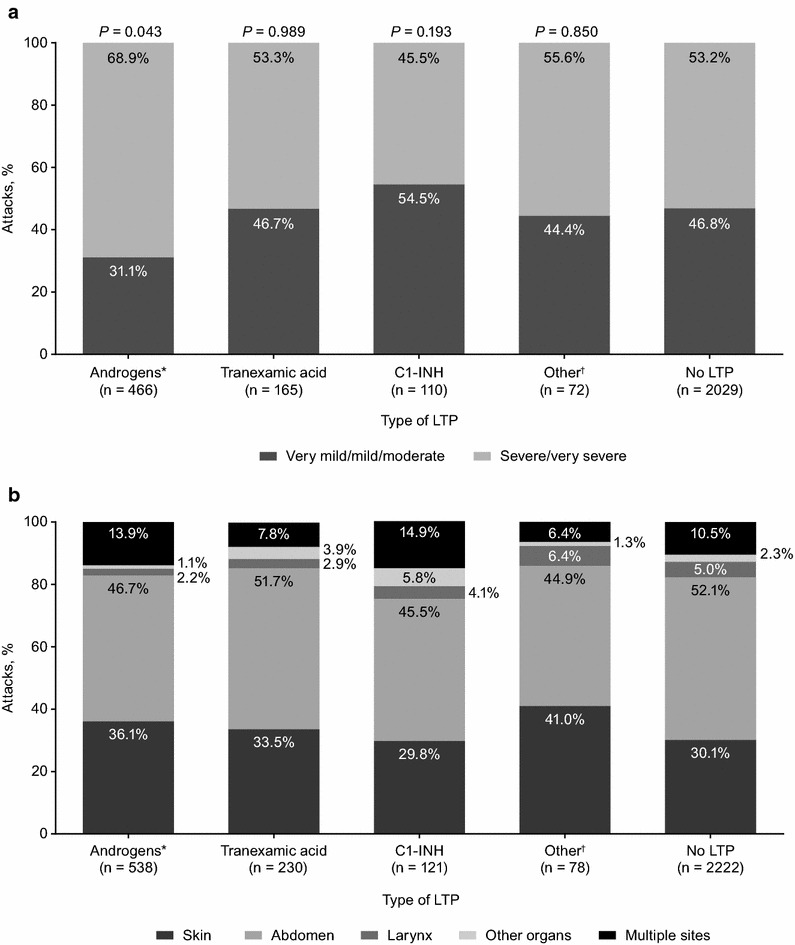
Data on 3228 icatibant-treated attacks from 448 patients with C1-INH-HAE were analyzed; 30.1% of attacks occurred while patients were using LTP. Attack rate, attack severity, and the distribution of attack sites were similar across all types of LTP used, and were comparable to the results found in patients who did not receive LTP. Attacks were successfully treated with icatibant; 82.5% of all breakthrough attacks were treated with a single icatibant injection without C1-INH rescue medication. Treatment outcomes were comparable for breakthrough attacks across all LTP types, and for attacks without LTP.
Patients who use LTP should be aware that breakthrough attacks can occur, and such attacks can be severe. Thus, patients with C1-INH-HAE using LTP should have emergency treatment readily available. Data from IOS show that icatibant is effective for the treatment of breakthrough attacks. NCT01034969.
由于C1抑制剂缺乏导致的遗传性血管性水肿(HAE)患者会经历皮肤或黏膜下水肿的反复发作,发作可能频繁且严重;可开具预防性治疗以预防发作。然而,尽管使用了长期预防措施(LTP),仍已知会发生突破性发作。我们使用依库珠单抗疗效调查(IOS)的数据来评估突破性发作的特征以及依库珠单抗作为一种治疗选择的有效性。
记录有关LTP使用、发作和治疗的数据。比较在使用LTP与未使用LTP情况下发生的发作的发作特征、治疗特征和结局(治疗时间、消退时间和发作持续时间)。
分析了448例C1-INH-HAE患者3228次接受依库珠单抗治疗的发作的数据;30.1%的发作发生在患者使用LTP期间。在所有使用的LTP类型中,发作率、发作严重程度和发作部位分布相似,且与未接受LTP的患者的结果相当。依库珠单抗成功治疗了发作;82.5%的突破性发作通过单次依库珠单抗注射治疗,无需使用C1-INH救援药物。所有LTP类型的突破性发作以及未使用LTP的发作的治疗结局相当。
使用LTP的患者应意识到可能会发生突破性发作,且此类发作可能很严重。因此,使用LTP的C1-INH-HAE患者应随时备有紧急治疗药物。IOS的数据表明,依库珠单抗对治疗突破性发作有效。 临床试验编号:NCT01034969。