Düzenli Neslihan, Ülker Sibel, Şengül Gülgün, Kayhan Buse, Önal Aytül
Department of Medical Pharmacology, Faculty of Medicine, Ege University, Bornova, Izmir, Turkey.
Department of Anatomy, Faculty of Medicine, Ege University, Bornova, Izmir, Turkey.
Korean J Pain. 2022 Jan 1;35(1):66-77. doi: 10.3344/kjp.2022.35.1.66.
Thrombospondin-4 (TSP4) upregulates in the spinal cord following peripheral nerve injury and contributes to the development of neuropathic pain (NP). We investigated the effects of cyanocobalamin alone or in combination with morphine on pain and the relationship between these effects and spinal TSP4 expression in neuropathic rats.
NP was induced by chronic constriction injury (CCI) of the sciatic nerve. Cyanocobalamin (5 and 10 mg/kg/day) was administered 15 days before CCI and then for 4 and 14 postoperative days. Morphine (2.5 and 5 mg/kg/day) was administered only post-CCI. Combination treatment included cyanocobalamin and morphine, 10 and 5 mg/kg/day, respectively. All drugs were administered intraperitoneally. Nociceptive thresholds were detected by esthesiometer, analgesia meter, and plantar test, and TSP4 expression was assessed by western blotting and fluorescence immunohistochemistry.
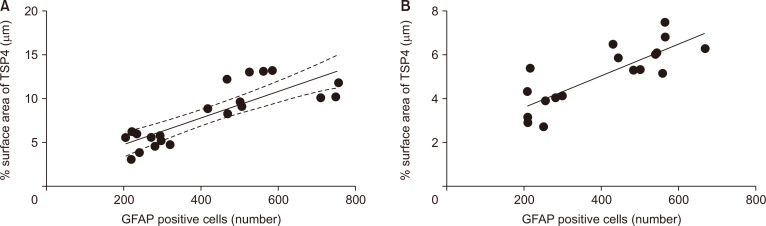
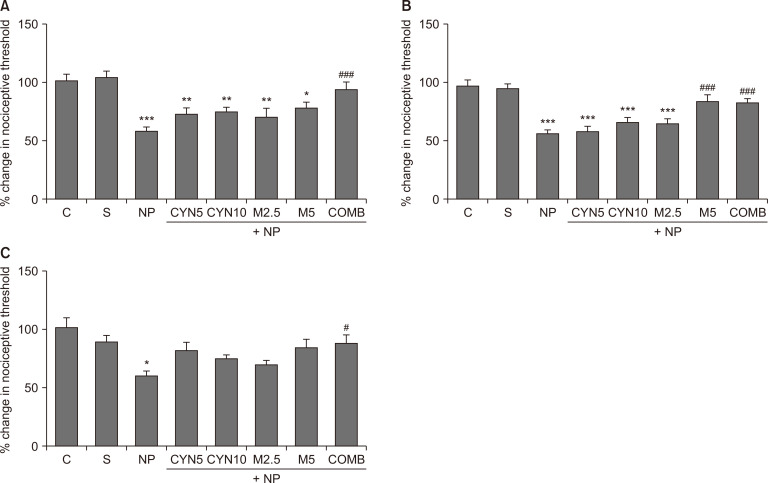
CCI decreased nociceptive thresholds in all tests and induced TSP4 expression on the 4th postoperative day. The decrease in nociceptive thresholds persisted except for the plantar test, and the increased TSP4 expression reversed on the 14th postoperative day. Cyanocobalamin and low-dose morphine alone did not produce any antinociceptive effects. High-dose morphine improved the decreased nociceptive thresholds in the esthesiometer when administered alone but combined with cyanocobalamin in all tests. Cyanocobalamin and morphine significantly induced TSP4 expression when administered alone in both doses for 4 or 14 days. However, this increase was less when the two drugs are combined.
The combination of cyanocobalamin and morphine is more effective in antinociception and partially decreased the induced TSP4 expression compared to the use of either drug alone.
外周神经损伤后,脊髓中的血小板反应蛋白4(TSP4)上调,并促成神经性疼痛(NP)的发展。我们研究了单独使用钴胺素或与吗啡联合使用对神经性大鼠疼痛的影响,以及这些影响与脊髓TSP4表达之间的关系。
通过坐骨神经慢性压迫损伤(CCI)诱导NP。在CCI前15天给予钴胺素(5和10mg/kg/天),然后在术后第4天和第14天给药。吗啡(2.5和5mg/kg/天)仅在CCI后给药。联合治疗包括分别为10和5mg/kg/天的钴胺素和吗啡。所有药物均通过腹腔注射给药。通过触觉测量仪、痛觉测量仪和足底试验检测伤害性阈值,并通过蛋白质免疫印迹和荧光免疫组织化学评估TSP4表达。
在所有测试中,CCI均降低了伤害性阈值,并在术后第4天诱导了TSP4表达。除足底试验外,伤害性阈值的降低持续存在,并且TSP4表达的增加在术后第14天逆转。单独使用钴胺素和低剂量吗啡未产生任何镇痛作用。高剂量吗啡单独给药时可改善触觉测量仪中降低的伤害性阈值,但在所有测试中与钴胺素联合使用。单独使用两种剂量的钴胺素和吗啡4天或14天时,均显著诱导TSP4表达。然而,两种药物联合使用时,这种增加较少。
与单独使用任何一种药物相比,钴胺素和吗啡联合使用在镇痛方面更有效,并且部分降低了诱导的TSP4表达。