Huang Zhi-Xin, Li Yong-Kun, Li Shi-Zhan, Huang Xian-Jun, Chen Ying, Hong Quan-Long, Cai Qian-Kun, Han Yun-Fei
Department of Neurology, Guangdong Second Provincial General Hospital, Guangzhou, China.
Department of Neurology, The Second School of Clinical Medicine, Southern Medical University, Guangzhou, China.
Front Aging Neurosci. 2021 Dec 13;13:796434. doi: 10.3389/fnagi.2021.796434. eCollection 2021.
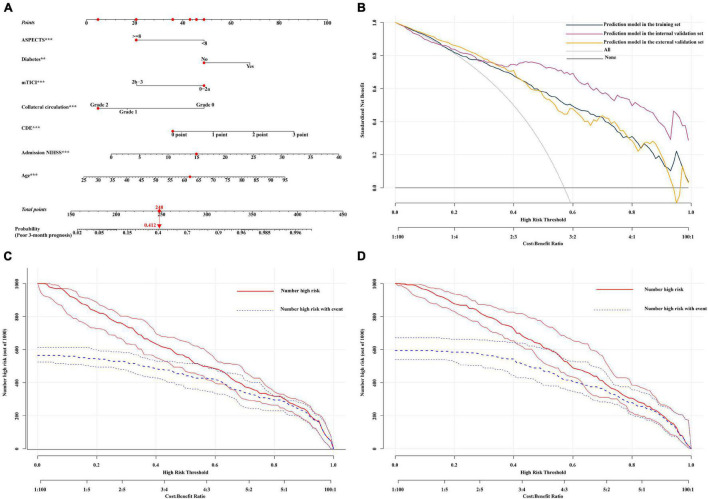
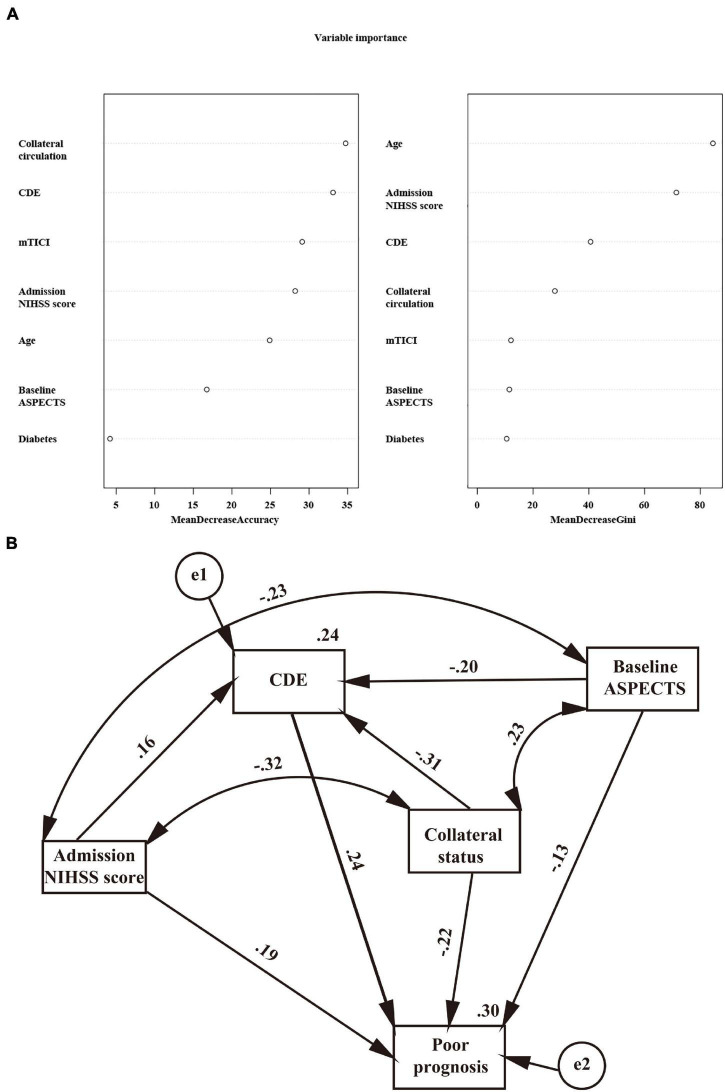
Cerebral edema (CDE) is a common complication in patients with acute ischemic stroke (AIS) and can reduce the benefit of endovascular therapy (EVT). To determine whether certain risk factors are associated with a poor prognosis mediated by CDE after EVT. The 759 patients with anterior circulation stroke treated by EVT at three comprehensive stroke centers in China from January 2014 to October 2020 were analyzed. Patients underwent follow-up for 3 months after inclusion. The primary endpoint was a measure of a poor prognosis (modified Rankin Scale score ≥ 3) at 3 months assessed in all patients receiving EVT. Least absolute shrinkage and selection operator and multivariate logistic regression were used to select variables for the prognostic nomogram. Based on these variables, the nomogram was established and validated. In addition, structural equation modeling was used to explore the pathways linking CDE and a poor prognosis. Seven predictors were identified, namely, diabetes, age, baseline Alberta Stroke Program Early CT score, modified Thrombolysis in Cerebral Infarction score, early angiogenic CDE, National Institutes of Health Stroke Scale score, and collateral circulation. The nomogram consisting of these variables showed the best performance, with a large area under the curve in both the internal validation set (0.850; sensitivity, 0.737; specificity, 0.887) and external validation set (0.875; sensitivity, 0.752; specificity, 0.878). In addition, CDE (total path coefficient = 0.24, < 0.001) served as a significant moderator. A nomogram for predicting a poor prognosis after EVT in AIS patients was established and validated with CDE as a moderator.
脑水肿(CDE)是急性缺血性卒中(AIS)患者的常见并发症,会降低血管内治疗(EVT)的疗效。为了确定某些危险因素是否与EVT后由CDE介导的不良预后相关。对2014年1月至2020年10月在中国三个综合卒中中心接受EVT治疗的759例前循环卒中患者进行了分析。患者纳入后进行3个月的随访。主要终点是在所有接受EVT的患者中评估的3个月时不良预后(改良Rankin量表评分≥3)的指标。使用最小绝对收缩和选择算子以及多变量逻辑回归来选择预后列线图的变量。基于这些变量,建立并验证了列线图。此外,使用结构方程模型来探索连接CDE和不良预后的途径。确定了七个预测因素,即糖尿病、年龄、基线阿尔伯塔卒中项目早期CT评分、改良脑梗死溶栓评分、早期血管生成性CDE、美国国立卫生研究院卒中量表评分和侧支循环。由这些变量组成的列线图表现最佳,在内部验证集(曲线下面积为0.850;敏感性为0.737;特异性为0.887)和外部验证集(曲线下面积为0.875;敏感性为0.752;特异性为0.878)中均有较大的曲线下面积。此外,CDE(总路径系数 = 0.24,<0.001)作为一个显著的调节因子。建立了一个用于预测AIS患者EVT后不良预后的列线图,并以CDE作为调节因子进行了验证。