Rui Xuelin, Li Jiacheng, Yang Ye, Xu Li, Liu Yang, Zhang Mengmeng, Yin Dengke
School of Pharmacy, Anhui University of Chinese Medicine, Hefei 230012, China.
Anhui Provincial Key Laboratory of Research & Development of Chinese Medicine, Hefei 230012, China.
Evid Based Complement Alternat Med. 2021 Dec 20;2021:2810915. doi: 10.1155/2021/2810915. eCollection 2021.
The intestinal barrier decreases in colitis and restores the integrity of the mucosal barriers that could be used for the treatment of colitis. Painong San (PNS), a traditional Chinese compound herbal medicine originally recorded in "Jingui Yaolve" by Zhongjing Zhang in the Later Han Dynasty, is often used in China and Japan to treat various purulent diseases including intestinal carbuncle. This study was to investigate the effect of PNS on mucosal barrier function in mice with DSS-induced colitis and its related mechanisms.
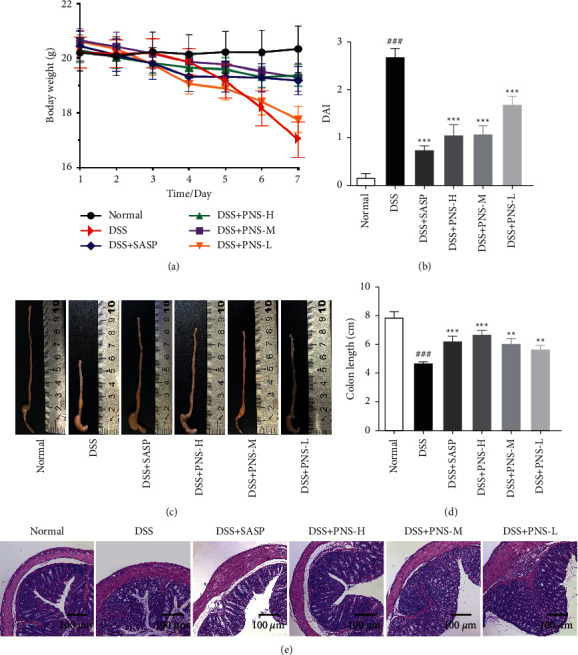
BALB/C mice were given 3% DSS to induce colitis. The body weight and stool status of the mice were recorded daily, and the histopathological changes of the colon were observed after execution. The permeability of the intestinal mucosa was measured by fluorescein isothiocyanate-dextran 4000, the change of intestinal microbiota was measured by 16S rDNA, and the tight junction-related proteins and Muc-2 were investigated by immunohistochemical or immunofluorescence. The possible signaling pathways were detected by western blot.
Compared with the control group, the composition of the microbiota in the PNS group was close to that of the normal group, the number of goblet cells was improved, and the mucosal permeability was significantly reduced. PNS could upregulate the expression of tight junction-related proteins (ZO-1, claudin-1, and occludin) and Muc-2, and at the same time, regulate the Notch pathway.
PNS could effectively improve the mucosal barrier function through multiple ways, including restoring the balance of intestine flora, enhancement of the mucous layer barrier, and mechanical barrier function. These protective effects may relate to inhibiting the Notch signaling pathway activated by DSS.
结肠炎时肠道屏障功能下降,恢复黏膜屏障完整性可用于治疗结肠炎。排脓散(PNS)是东汉张仲景《金匮要略》中记载的传统中药复方,在中国和日本常用于治疗包括肠痈在内的各种化脓性疾病。本研究旨在探讨PNS对葡聚糖硫酸钠(DSS)诱导的小鼠结肠炎黏膜屏障功能的影响及其相关机制。
给BALB/C小鼠饮用3% DSS诱导结肠炎。每天记录小鼠体重和粪便状态,处死小鼠后观察结肠组织病理学变化。用异硫氰酸荧光素标记的葡聚糖4000测定肠黏膜通透性,用16S rDNA测定肠道微生物群变化,通过免疫组织化学或免疫荧光检测紧密连接相关蛋白和Muc-2。用蛋白质免疫印迹法检测可能的信号通路。
与对照组相比,PNS组微生物群组成接近正常组,杯状细胞数量增加,黏膜通透性显著降低。PNS可上调紧密连接相关蛋白(ZO-1、claudin-1和occludin)和Muc-2的表达,同时调节Notch通路。
PNS可通过多种途径有效改善黏膜屏障功能,包括恢复肠道菌群平衡、增强黏液层屏障和机械屏障功能。这些保护作用可能与抑制DSS激活的Notch信号通路有关。