Afach Samer, Buchler Ben C, Budker Dmitry, Dailey Conner, Derevianko Andrei, Dumont Vincent, Figueroa Nataniel L, Gerhardt Ilja, Grujić Zoran D, Guo Hong, Hao Chuanpeng, Hamilton Paul S, Hedges Morgan, Jackson Kimball Derek F, Kim Dongok, Khamis Sami, Kornack Thomas, Lebedev Victor, Lu Zheng-Tian, Masia-Roig Hector, Monroy Madeline, Padniuk Mikhail, Palm Christopher A, Park Sun Yool, Paul Karun V, Penaflor Alexander, Peng Xiang, Pospelov Maxim, Preston Rayshaun, Pustelny Szymon, Scholtes Theo, Segura Perrin C, Semertzidis Yannis K, Sheng Dong, Shin Yun Chang, Smiga Joseph A, Stalnaker Jason E, Sulai Ibrahim, Tandon Dhruv, Wang Tao, Weis Antoine, Wickenbrock Arne, Wilson Tatum, Wu Teng, Wurm David, Xiao Wei, Yang Yucheng, Yu Dongrui, Zhang Jianwei
Helmholtz-Institut Mainz, GSI Helmholtzzentrum für Schwerionenforschung, Darmstadt, Germany.
Johannes Gutenberg-Universität Mainz, Mainz, Germany.
Nat Phys. 2021;17(12):1396-1401. doi: 10.1038/s41567-021-01393-y. Epub 2021 Dec 7.
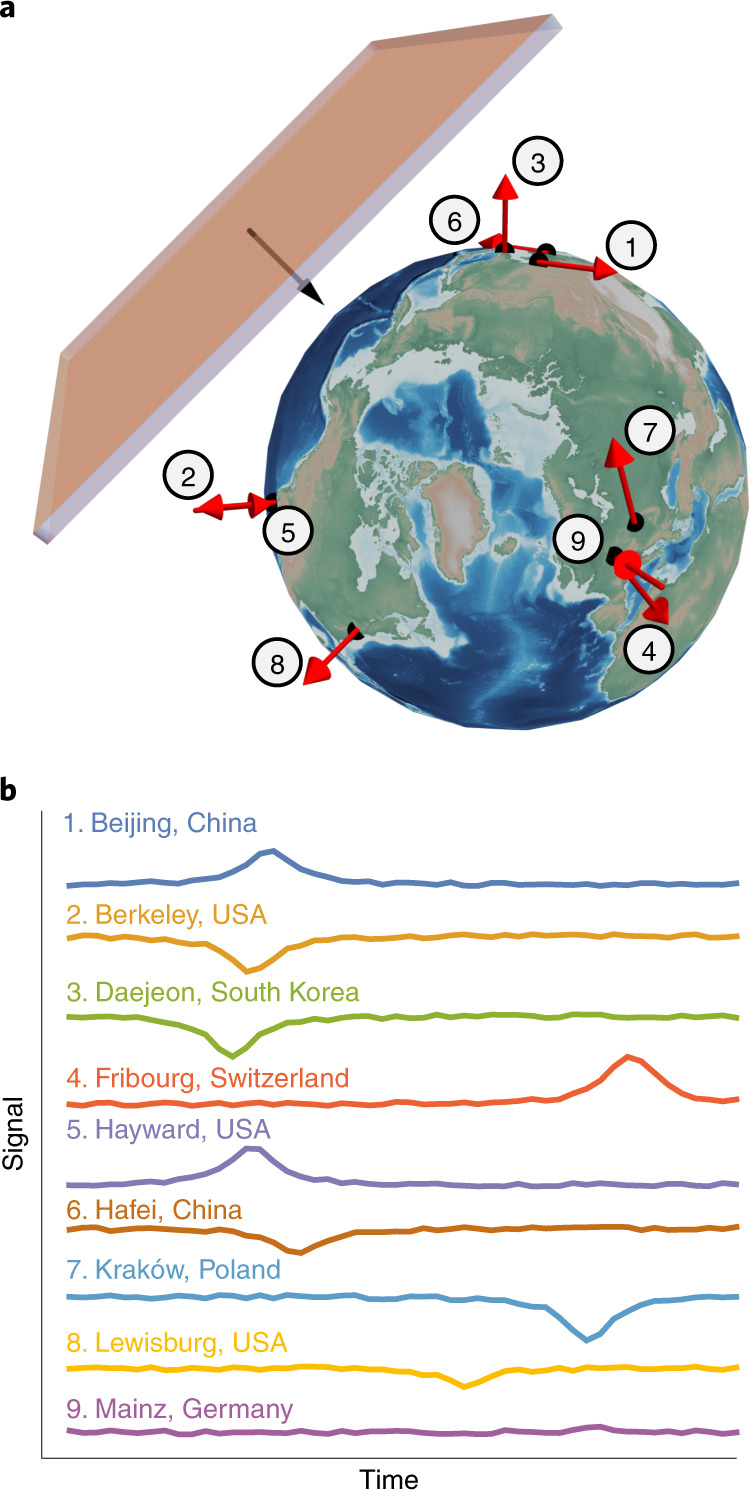
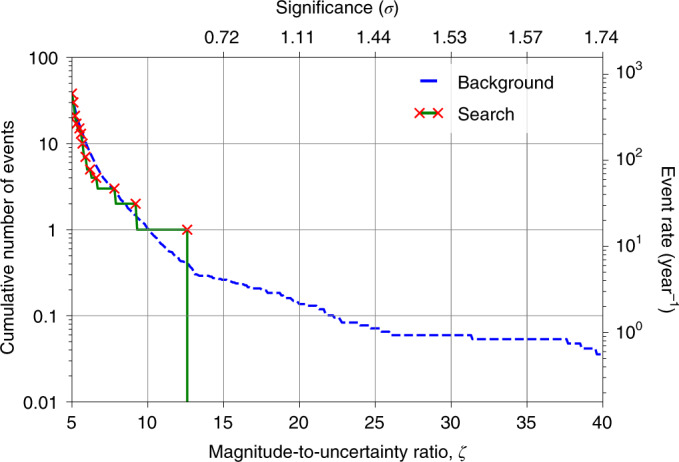
Ultralight bosons such as axion-like particles are viable candidates for dark matter. They can form stable, macroscopic field configurations in the form of topological defects that could concentrate the dark matter density into many distinct, compact spatial regions that are small compared with the Galaxy but much larger than the Earth. Here we report the results of the search for transient signals from the domain walls of axion-like particles by using the global network of optical magnetometers for exotic (GNOME) physics searches. We search the data, consisting of correlated measurements from optical atomic magnetometers located in laboratories all over the world, for patterns of signals propagating through the network consistent with domain walls. The analysis of these data from a continuous month-long operation of GNOME finds no statistically significant signals, thus placing experimental constraints on such dark matter scenarios.
诸如类轴子粒子这样的超轻玻色子是暗物质的可行候选者。它们可以形成拓扑缺陷形式的稳定宏观场构型,这种构型能够将暗物质密度集中到许多不同的紧凑空间区域,这些区域与星系相比很小,但比地球大得多。在此,我们报告了利用用于奇异物理搜索的全球光学磁力计网络(GNOME)寻找类轴子粒子畴壁瞬态信号的结果。我们在由世界各地实验室的光学原子磁力计的相关测量数据组成的数据中,搜索与畴壁一致的通过网络传播的信号模式。对GNOME连续长达一个月运行所获得的这些数据进行分析后,未发现具有统计显著性的信号,从而对这类暗物质情形施加了实验限制。