Department of Biomedical Engineering, College of Future Technology, Peking University, Beijing 100871, China.
Department of Biomedical Engineering, College of Engineering, Peking University, Beijing 100871, China.
Nucleic Acids Res. 2022 May 6;50(8):e44. doi: 10.1093/nar/gkab1282.
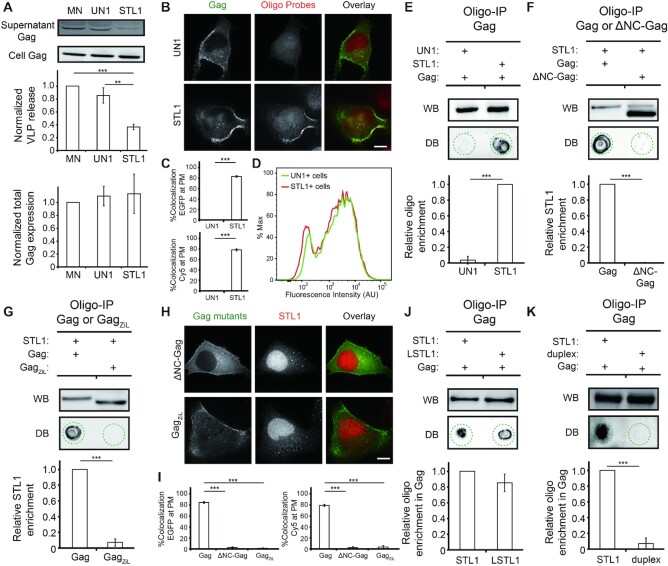
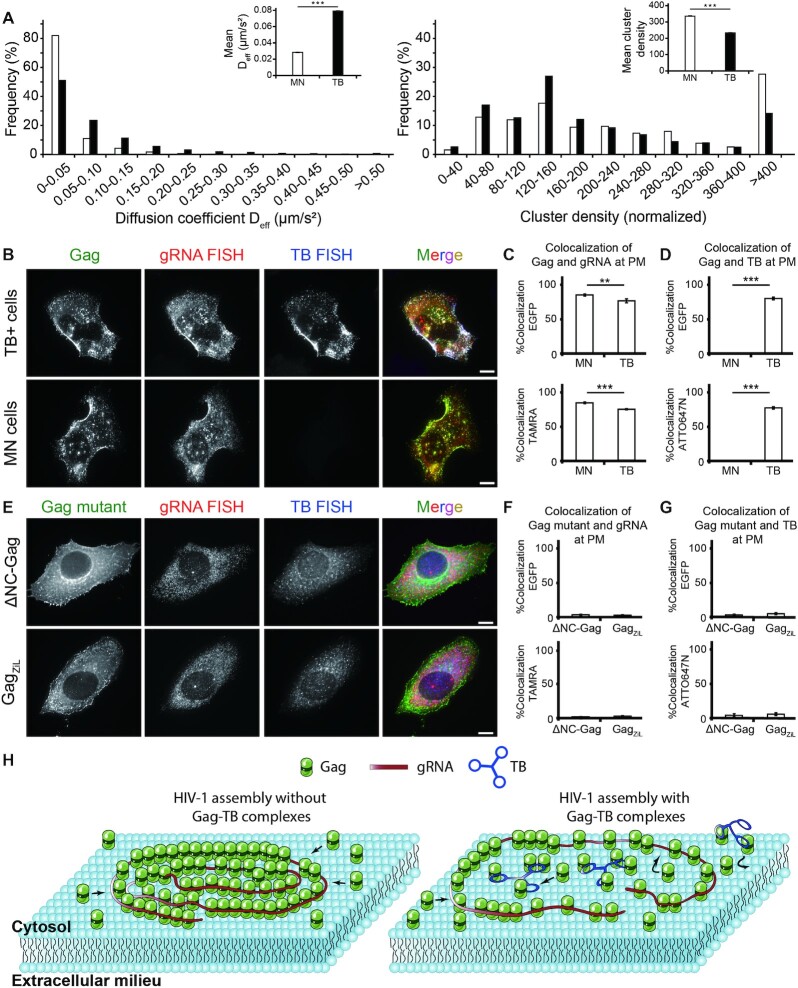
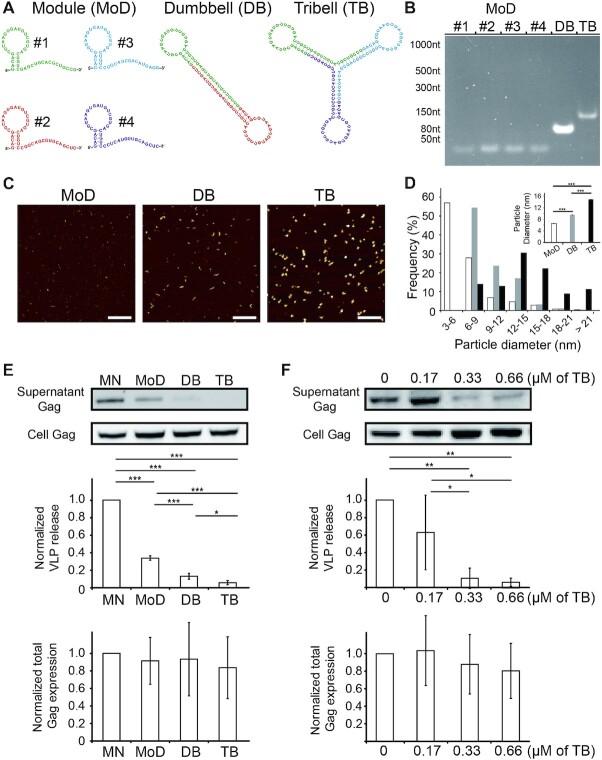
Many pathological processes are driven by RNA-protein interactions, making such interactions promising targets for molecular interventions. HIV-1 assembly is one such process, in which the viral genomic RNA interacts with the viral Gag protein and serves as a scaffold to drive Gag multimerization that ultimately leads to formation of a virus particle. Here, we develop self-assembled RNA nanostructures that can inhibit HIV-1 virus assembly, achieved through hybridization of multiple artificial small RNAs with a stem-loop structure (STL) that we identify as a prominent ligand of Gag that can inhibit virus particle production via STL-Gag interactions. The resulting STL-decorated nanostructures (double and triple stem-loop structures denoted as Dumbbell and Tribell, respectively) can elicit more pronounced viral blockade than their building blocks, with the inhibition arising as a result of nanostructures interfering with Gag multimerization. These findings could open up new avenues for RNA-based therapy.
许多病理过程是由 RNA-蛋白质相互作用驱动的,这使得这些相互作用成为分子干预的有前途的靶点。HIV-1 组装就是这样一个过程,其中病毒基因组 RNA 与病毒 Gag 蛋白相互作用,并作为支架驱动 Gag 多聚化,最终导致病毒颗粒的形成。在这里,我们开发了可以抑制 HIV-1 病毒组装的自组装 RNA 纳米结构,这是通过与我们确定的具有茎环结构(STL)的多个人工小 RNA 杂交来实现的,该 STL 是 Gag 的一个主要配体,可以通过 STL-Gag 相互作用抑制病毒颗粒的产生。由此产生的 STL 修饰的纳米结构(分别表示为哑铃和三链结构的双链和三链结构)可以比其构建块更显著地引发病毒阻断,抑制作用是由于纳米结构干扰 Gag 多聚化而产生的。这些发现可能为基于 RNA 的治疗开辟新途径。