Department of Biomedical Engineering, College of Engineering, Peking University, 100871 Beijing, China.
Wallace H Coulter Department of Biomedical Engineering, Georgia Institute of Technology, Atlanta, GA 30332.
Proc Natl Acad Sci U S A. 2018 Jun 26;115(26):6721-6726. doi: 10.1073/pnas.1805728115. Epub 2018 Jun 11.
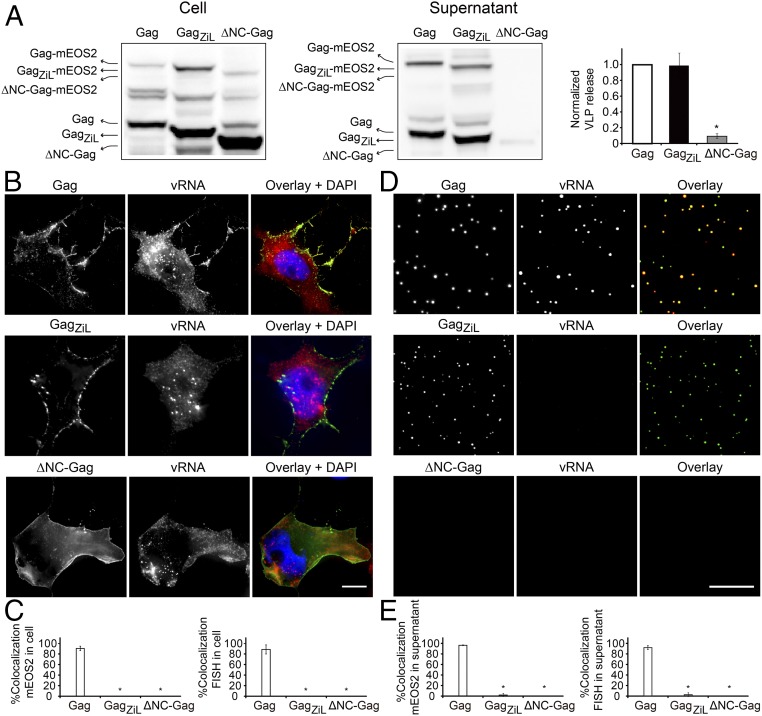
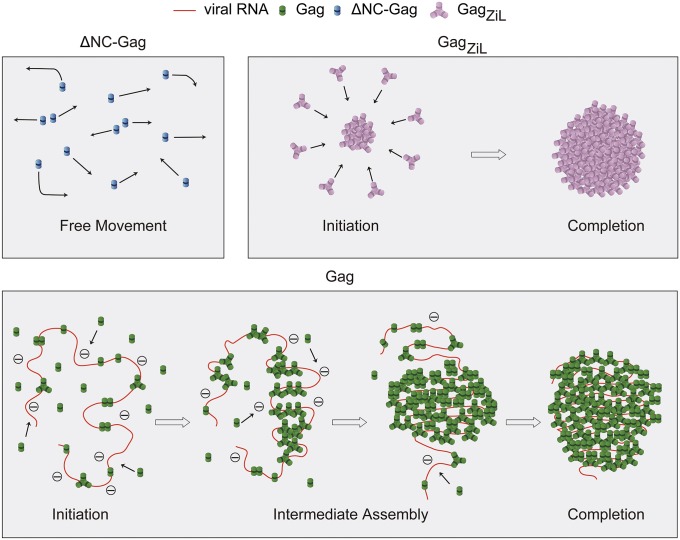
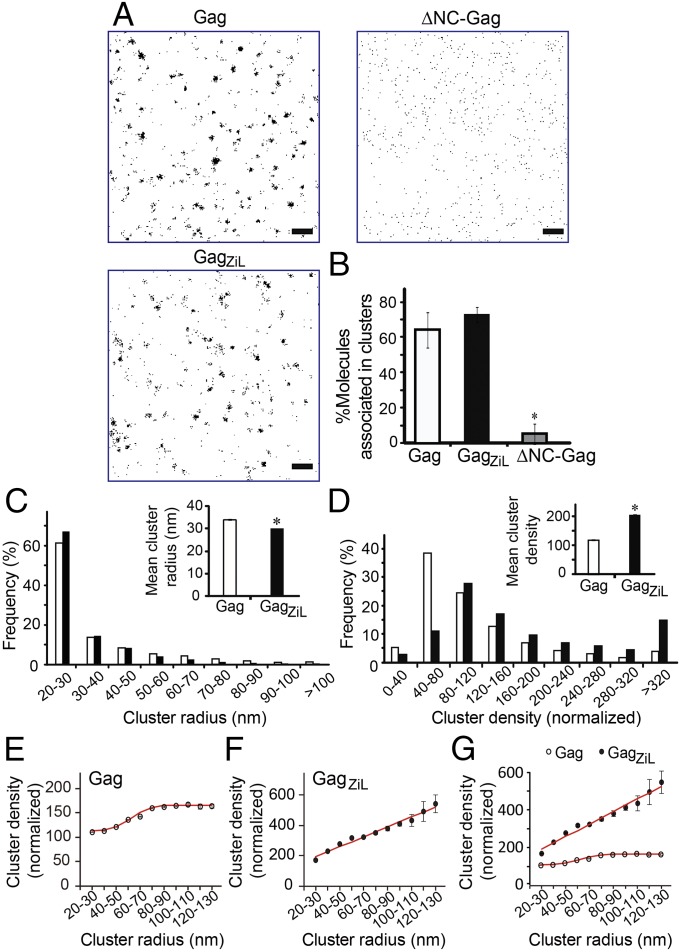
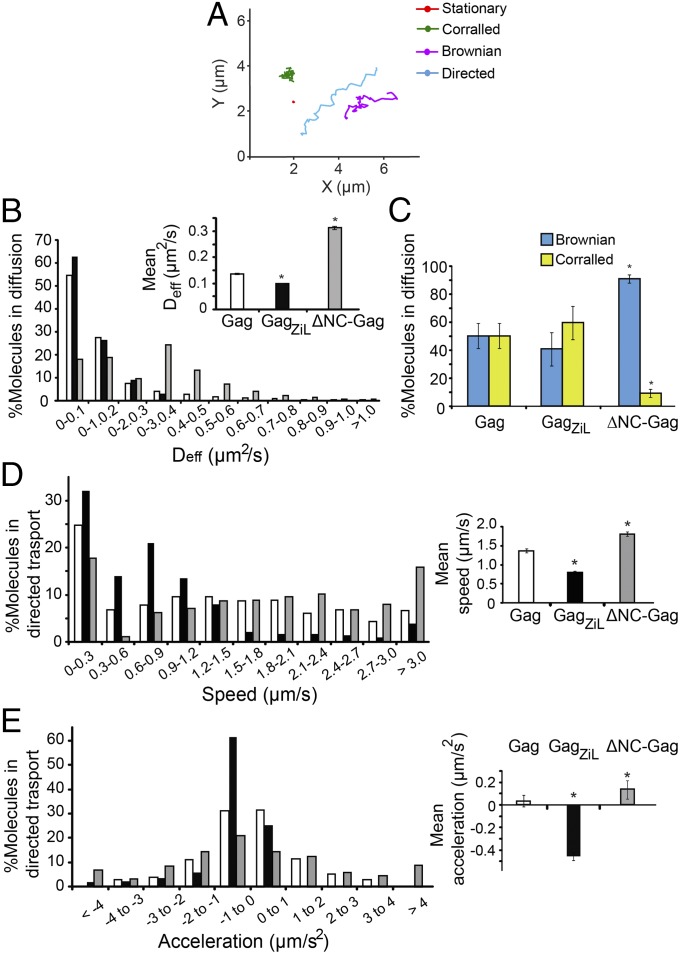
During HIV-1 assembly, the retroviral structural protein Gag forms an immature capsid, containing thousands of Gag molecules, at the plasma membrane (PM). Interactions between Gag nucleocapsid (NC) and viral RNA (vRNA) are thought to drive assembly, but the exact roles of these interactions have remained poorly understood. Since previous studies have shown that Gag dimer- or trimer-forming mutants (Gag) lacking an NC domain can form immature capsids independent of RNA binding, it is often hypothesized that vRNA drives Gag assembly by inducing Gag to form low-ordered multimers, but is dispensable for subsequent assembly. In this study, we examined the role of vRNA in HIV-1 assembly by characterizing the distribution and mobility of Gag and Gag NC mutants at the PM using photoactivated localization microscopy (PALM) and single-particle tracking PALM (spt-PALM). We showed that both Gag and Gag assembly involve a similar basic assembly unit, as expected. Unexpectedly, the two proteins underwent different subsequent assembly pathways, with Gag cluster density increasing asymptotically, while Gag cluster density increased linearly. Additionally, the directed movement of Gag, but not Gag, was maintained at a constant speed, suggesting that the two proteins experience different external driving forces. Assembly was abolished when Gag was rendered monomeric by NC deletion. Collectively, these results suggest that, beyond inducing Gag to form low-ordered multimer basic assembly units, vRNA is essential in scaffolding and maintaining the stability of the subsequent assembly process. This finding should advance the current understanding of HIV-1 and, potentially, other retroviruses.
在 HIV-1 组装过程中,逆转录病毒结构蛋白 Gag 在质膜 (PM) 上形成包含数千个 Gag 分子的不成熟衣壳。Gag 核衣壳 (NC) 和病毒 RNA (vRNA) 之间的相互作用被认为驱动组装,但这些相互作用的确切作用仍知之甚少。由于先前的研究表明,缺乏 NC 结构域的 Gag 二聚体或三聚体形成突变体 (Gag) 可以在不结合 RNA 的情况下独立形成不成熟衣壳,因此人们通常假设 vRNA 通过诱导 Gag 形成低阶多聚体来驱动 Gag 组装,但对于随后的组装是可有可无的。在这项研究中,我们通过使用光激活定位显微镜 (PALM) 和单粒子跟踪 PALM (spt-PALM) 来研究 vRNA 在 HIV-1 组装中的作用,对 Gag 和 Gag NC 突变体在 PM 上的分布和迁移进行了表征。我们表明,Gag 和 Gag 组装都涉及到一个相似的基本组装单元,这是意料之中的。出乎意料的是,这两种蛋白质经历了不同的后续组装途径,Gag 簇密度呈渐近增加,而 Gag 簇密度呈线性增加。此外,Gag 的定向运动(但不是 Gag)以恒定速度保持,这表明这两种蛋白质经历了不同的外部驱动力。当 NC 缺失使 Gag 变成单体时,组装就被废除了。总的来说,这些结果表明,除了诱导 Gag 形成低阶多聚体基本组装单元外,vRNA 对于支架的形成和后续组装过程的稳定性是必不可少的。这一发现应该会推进对 HIV-1 以及其他可能的逆转录病毒的现有认识。