
倾向评分匹配分析腹腔镜与开放手术治疗非转移性直肠癌的效果。
Propensity Score-Matched Analysis of Laparoscopic versus Open Surgery for Non-Metastatic Rectal Cancer.
机构信息
Department of Surgery, Songklanagarind Hospital, Faculty of Medicine, Prince of Songkla University, Songkhla, Thailand.
Department of Surgical Nursing, Faculty of Nursing, Prince of Songkla University, Songkhla, Thailand.
出版信息
Asian Pac J Cancer Prev. 2021 Dec 1;22(12):3967-3975. doi: 10.31557/APJCP.2021.22.12.3967.
BACKGROUND
Rectal cancer is a pervasive type of malignancy that accounts for one-third of colorectal cancers worldwide. Several studies have assessed the use of laparoscopic surgery as a treatment option. However, there is an ongoing debate regarding its oncological safety.
METHODS
This retrospective study included 270 patients with non-metastatic rectal cancer who underwent either laparoscopic resection (LR, n = 93) or open resection (OR, n = 177) in an academic medical center. The primary outcomes were overall survival (OS) and disease-free survival (DFS), whereas the secondary outcome was postoperative complications. We performed propensity score analyses and compared outcomes. Univariate survival analyses using Kaplan-Meier plots and Cox proportional hazard regression models were also conducted.
RESULTS
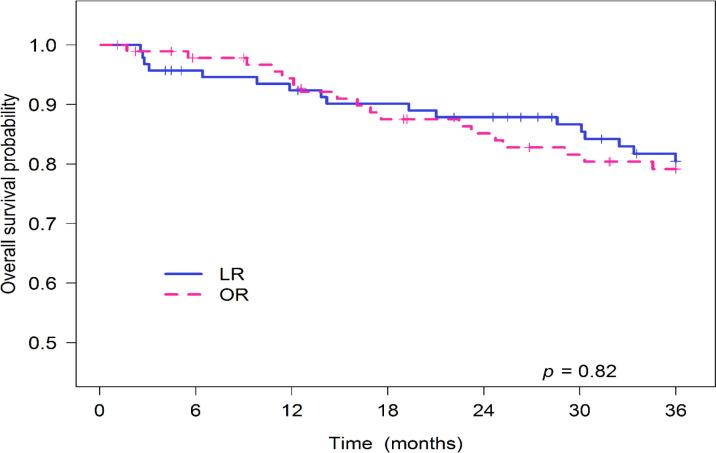
In the propensity score matching analyses, 93 LR- and 93 OR-matched patients were compared. The overall median follow-up time was 3.95 years (range, 1.98‒5.55 years). The 3-year OS was similar between the groups (LR 79.1% vs OR 79.2%, p = 0.82). Meanwhile, the DFS rate was also comparable between the groups (LR 77.8% vs OR 73.2%, p = 0.53). No significant differences in operative blood loss or hospital stay between the groups were observed (150 vs 150 mL, p = 0.74; 9 vs 10 days, p = 0.077, respectively). Also, no difference was found in postoperative complications between the groups (p = 0.23). However, LR was associated with a longer operative time than OR (455 vs 356 min, p < 0.001) and the number of lymph nodes harvested in LR was slightly fewer than OR (10 vs 11, p = 0.045).
CONCLUSION
LR of rectal cancer is safe, feasible, and comparable to standard OR in terms of the oncologic outcomes. However, LR required longer operative times. A well-designed prospective study with a large number of participants and long follow-up period is needed to show significant differences between the two groups.
.
背景
直肠癌是一种普遍存在的恶性肿瘤,占全球结直肠癌的三分之一。几项研究评估了腹腔镜手术作为一种治疗选择。然而,其肿瘤学安全性仍存在争议。
方法
本回顾性研究纳入了在一家学术医疗中心接受腹腔镜切除术(LR,n=93)或开放切除术(OR,n=177)治疗的 270 例非转移性直肠癌患者。主要结局是总生存(OS)和无病生存(DFS),次要结局是术后并发症。我们进行了倾向评分分析,并比较了结果。使用 Kaplan-Meier 图和 Cox 比例风险回归模型进行了单变量生存分析。
结果
在倾向评分匹配分析中,比较了 93 例 LR 和 93 例 OR 匹配患者。总体中位随访时间为 3.95 年(范围,1.98-5.55 年)。两组的 3 年 OS 相似(LR 为 79.1%,OR 为 79.2%,p=0.82)。同时,两组的 DFS 率也相似(LR 为 77.8%,OR 为 73.2%,p=0.53)。两组之间的手术失血量或住院时间无显著差异(150 与 150mL,p=0.74;9 与 10 天,p=0.077)。此外,两组之间的术后并发症发生率也无差异(p=0.23)。然而,LR 的手术时间长于 OR(455 与 356 分钟,p<0.001),LR 中采集的淋巴结数量略少于 OR(10 与 11 个,p=0.045)。
结论
LR 治疗直肠癌安全、可行,在肿瘤学结局方面与标准 OR 相当。然而,LR 需要更长的手术时间。需要一项设计良好的、有大量参与者和长期随访的前瞻性研究来显示两组之间的显著差异。


 Zotero 插件