Interdisciplinary Faculty of Toxicology, Texas A&M University, College Station, TX 77843, USA; Department of Veterinary Integrative Biosciences, Texas A&M University, College Station, TX 77843, USA.
Interdisciplinary Faculty of Toxicology, Texas A&M University, College Station, TX 77843, USA; Department of Environmental and Occupational Health, Texas A&M University, College Station, TX 77843, USA.
J Environ Sci (China). 2022 May;115:350-362. doi: 10.1016/j.jes.2021.08.004. Epub 2021 Aug 22.
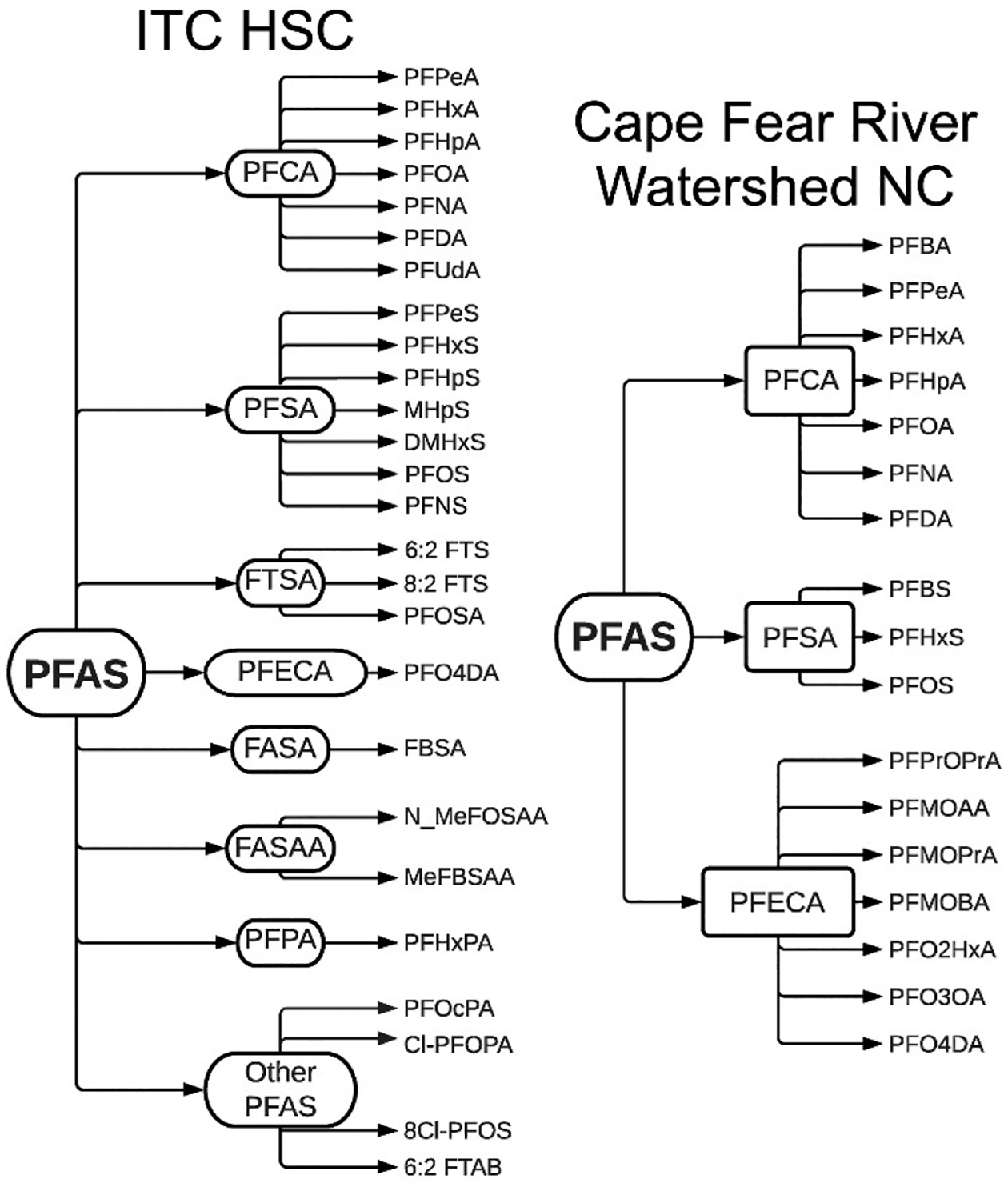
Per- and polyfluoroalkyl substances (PFAS) are persistent organic pollutants of concern because of their ubiquitous presence in surface and ground water; analytical methods that can be used for rapid comprehensive exposure assessment and fingerprinting of PFAS are needed. Following the fires at the Intercontinental Terminals Company (ITC) in Deer Park, TX in 2019, large quantities of PFAS-containing firefighting foams were deployed. The release of these substances into the Houston Ship Channel/Galveston Bay (HSC/GB) prompted concerns over the extent and level of PFAS contamination. A targeted liquid chromatography-tandem mass spectrometry (LC-MS/MS)-based study of temporal and spatial patterns of PFAS associated with this incident revealed presence of 7 species; their levels gradually decreased over a 6-month period. Because the targeted LC-MS/MS analysis was focused on about 30 PFAS molecules, it may have missed other PFAS compounds present in firefighting foams. Therefore, we utilized untargeted LC-ion mobility spectrometry-mass spectrometry (LC-IMS-MS)-based analytical approach for a more comprehensive characterization of PFAS in these water samples. We analyzed 31 samples from 9 sites in the HSC/GB that were collected over 5 months after the incident. Our data showed that additional 19 PFAS were detected in surface water of HSC/GB, most of them decreased gradually after the incident. PFAS features detected by LC-MS/MS correlated well in abundance with LC-IMS-MS data; however, LC-IMS-MS identified a number of additional PFAS, many known to be components of firefighting foams. These findings therefore illustrate that untargeted LC-IMS-MS improved our understanding of PFAS presence in complex environmental samples.
全氟和多氟烷基物质(PFAS)是持久性有机污染物,由于它们普遍存在于地表水和地下水中,因此受到关注;需要能够用于快速全面暴露评估和 PFAS 指纹分析的分析方法。2019 年,德克萨斯州迪尔帕克的洲际码头公司(ITC)发生火灾后,大量含有 PFAS 的消防泡沫被部署。这些物质释放到休斯顿航道/加尔维斯顿湾(HSC/GB)中,引发了对 PFAS 污染程度和水平的担忧。一项针对与该事件相关的 PFAS 的时间和空间模式的基于液相色谱-串联质谱(LC-MS/MS)的靶向研究揭示了 7 种物质的存在;它们的水平在 6 个月的时间内逐渐降低。由于靶向 LC-MS/MS 分析集中在大约 30 种 PFAS 分子上,因此它可能错过了消防泡沫中存在的其他 PFAS 化合物。因此,我们利用基于非靶向液相离子迁移谱-质谱(LC-IMS-MS)的分析方法对这些水样中的 PFAS 进行更全面的表征。我们分析了 HSC/GB 9 个地点的 31 个样本,这些样本是在事件发生后 5 个月采集的。我们的数据表明,在 HSC/GB 的地表水检测到了另外 19 种 PFAS,其中大多数在事件发生后逐渐减少。LC-MS/MS 检测到的 PFAS 特征与 LC-IMS-MS 数据在丰度上相关性很好;然而,LC-IMS-MS 鉴定出了许多其他的 PFAS,其中许多是消防泡沫的组成部分。这些发现因此表明,非靶向 LC-IMS-MS 提高了我们对复杂环境样品中 PFAS 存在的理解。