Clinical Effectiveness Group, Centre for Primary Care, Wolfson Institute of Population Health, Barts and the London School of Medicine and Dentistry, Queen Mary, University of London.
Endeavour Health Charity.
Int J Popul Data Sci. 2021 Dec 8;6(1):1674. doi: 10.23889/ijpds.v6i1.1674. eCollection 2021.
Linking places to people is a core element of the UK government's geospatial strategy. Matching patient addresses in electronic health records to their Unique Property Reference Numbers (UPRNs) enables spatial linkage for research, innovation and public benefit. Available algorithms are not transparent or evaluated for use with addresses recorded by health care providers.
To describe and quality assure the open-source deterministic ASSIGN address-matching algorithm applied to general practitioner-recorded patient addresses.
Best practice standards were used to report the ASSIGN algorithm match rate, sensitivity and positive predictive value using gold-standard datasets from London and Wales. We applied the ASSIGN algorithm to the recorded addresses of a sample of 1,757,018 patients registered with all general practices in north east London. We examined bias in match results for the study population using multivariable analyses to estimate the likelihood of an address-matched UPRN by demographic, registration, and organisational variables.
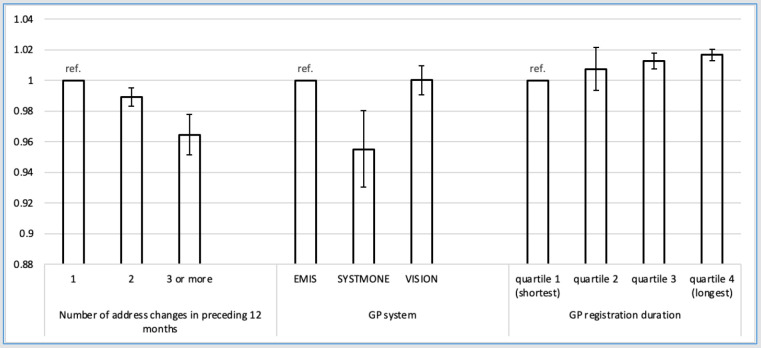
We found a 99.5% and 99.6% match rate with high sensitivity (0.999,0.998) and positive predictive value (0.996,0.998) for the Welsh and London gold standard datasets respectively, and a 98.6% match rate for the study population.The 1.4% of the study population without a UPRN match were more likely to have changed registered address in the last 12 months (match rate: 95.4%), be from a Chinese ethnic background (95.5%), or registered with a general practice using the SystmOne clinical record system (94.4%). Conversely, people registered for more than 6.5 years with their general practitioner were more likely to have a match (99.4%) than those with shorter registration durations.
ASSIGN is a highly accurate open-source address-matching algorithm with a high match rate and minimal biases when evaluated against a large sample of general practice-recorded patient addresses. ASSIGN has potential to be used in other address-based datasets including those with information relevant to the wider determinants of health.
将地点与人员联系起来是英国政府地理空间战略的核心要素。将电子健康记录中的患者地址与他们的独特属性参考编号 (UPRN) 相匹配,可为研究、创新和公共利益提供空间联系。现有的算法对于医疗保健提供者记录的地址不透明或评估其使用情况。
描述并保证应用于一般实践记录的患者地址的开源确定性 ASSIGN 地址匹配算法的质量。
使用最佳实践标准报告 ASSIGN 算法的匹配率、敏感性和阳性预测值,使用来自伦敦和威尔士的黄金标准数据集。我们将 ASSIGN 算法应用于注册在伦敦东北部所有全科医生的 1,757,018 名患者的记录地址。我们使用多变量分析来检查研究人群的匹配结果中的偏差,以估计根据人口统计学、注册和组织变量,地址匹配 UPRN 的可能性。
我们发现威尔士和伦敦黄金标准数据集的匹配率分别为 99.5%和 99.6%,具有高敏感性(0.999,0.998)和阳性预测值(0.996,0.998),而研究人群的匹配率为 98.6%。在研究人群中,1.4%的患者没有 UPRN 匹配,他们更有可能在过去 12 个月内更改了注册地址(匹配率:95.4%),来自中国少数民族背景(95.5%),或注册使用 SystmOne 临床记录系统的全科医生(94.4%)。相反,与注册时间较短的人相比,在他们的全科医生那里注册超过 6.5 年的人更有可能匹配(99.4%)。
ASSIGN 是一种高度准确的开源地址匹配算法,在评估大量一般实践记录的患者地址时,具有高匹配率和最小的偏差。ASSIGN 有可能用于其他基于地址的数据集,包括与健康的更广泛决定因素相关的信息。