Kelly John R, Gillan Claire M, Prenderville Jack, Kelly Clare, Harkin Andrew, Clarke Gerard, O'Keane Veronica
Department of Psychiatry, Trinity College, Dublin, Ireland.
Department of Psychiatry, Tallaght University Hospital, Dublin, Ireland.
Front Psychiatry. 2021 Dec 17;12:800072. doi: 10.3389/fpsyt.2021.800072. eCollection 2021.
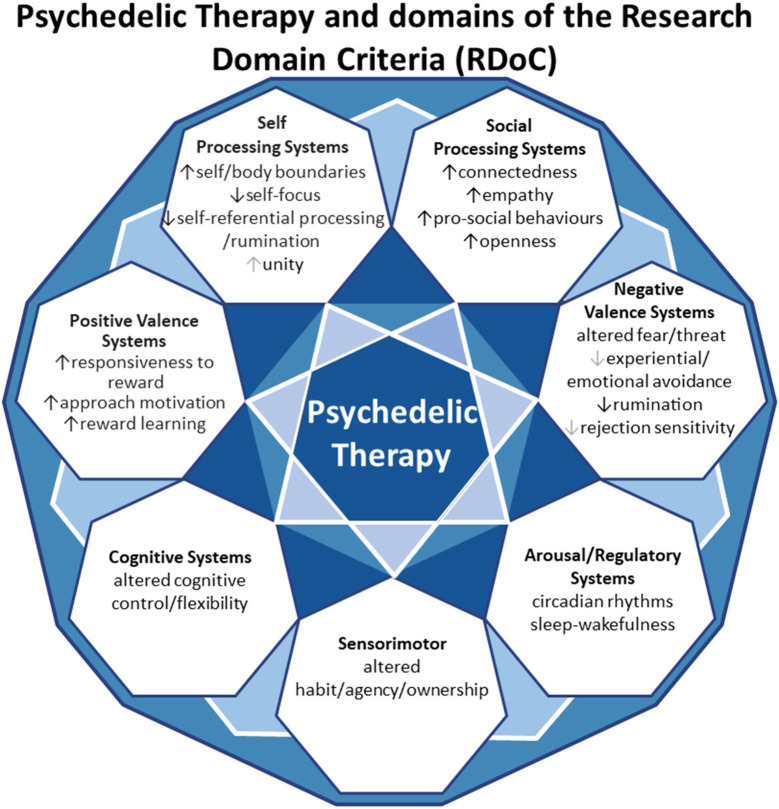
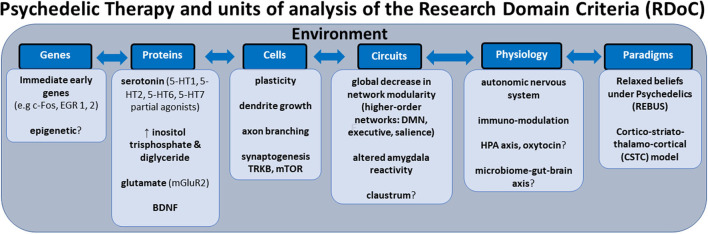
Accumulating clinical evidence shows that psychedelic therapy, by synergistically combining psychopharmacology and psychological support, offers a promising transdiagnostic treatment strategy for a range of disorders with restricted and/or maladaptive habitual patterns of emotion, cognition and behavior, notably, depression (MDD), treatment resistant depression (TRD) and addiction disorders, but perhaps also anxiety disorders, obsessive-compulsive disorder (OCD), Post-Traumatic Stress Disorder (PTSD) and eating disorders. Despite the emergent transdiagnostic evidence, the specific clinical dimensions that psychedelics are efficacious for, and associated underlying neurobiological pathways, remain to be well-characterized. To this end, this review focuses on pre-clinical and clinical evidence of the acute and sustained therapeutic potential of psychedelic therapy in the context of a transdiagnostic dimensional systems framework. Focusing on the Research Domain Criteria (RDoC) as a template, we will describe the multimodal mechanisms underlying the transdiagnostic therapeutic effects of psychedelic therapy, traversing molecular, cellular and network levels. These levels will be mapped to the RDoC constructs of negative and positive valence systems, arousal regulation, social processing, cognitive and sensorimotor systems. In summarizing this literature and framing it transdiagnostically, we hope we can assist the field in moving toward a mechanistic understanding of how psychedelics work for patients and eventually toward a precise-personalized psychedelic therapy paradigm.
越来越多的临床证据表明,迷幻疗法通过将心理药理学与心理支持协同结合,为一系列存在情绪、认知和行为受限及/或适应不良习惯模式的疾病提供了一种有前景的跨诊断治疗策略,特别是抑郁症(MDD)、难治性抑郁症(TRD)和成瘾性疾病,但也可能包括焦虑症、强迫症(OCD)、创伤后应激障碍(PTSD)和饮食失调症。尽管出现了跨诊断证据,但迷幻药有效的具体临床维度以及相关的潜在神经生物学途径仍有待充分表征。为此,本综述聚焦于在跨诊断维度系统框架下,迷幻疗法急性和持续治疗潜力的临床前和临床证据。以研究领域标准(RDoC)为模板,我们将描述迷幻疗法跨诊断治疗效果背后的多模式机制,涵盖分子、细胞和网络层面。这些层面将映射到RDoC的负性和正性效价系统、唤醒调节、社会加工、认知和感觉运动系统的构建模块。在总结这些文献并从跨诊断角度进行阐述时,我们希望能够帮助该领域朝着对迷幻药如何作用于患者的机制性理解迈进,并最终走向精确的个性化迷幻疗法范式。