Department of Neurological Rehabilitation, Hebei Children's Hospital, Shijiazhuang 050031, Hebei, China.
Department of Neurology Shijiazhuang the Third Hospital, Hebei Children's Hospital, Shijiazhuang 050031, Hebei, China.
J Healthc Eng. 2021 Dec 23;2021:1220368. doi: 10.1155/2021/1220368. eCollection 2021.
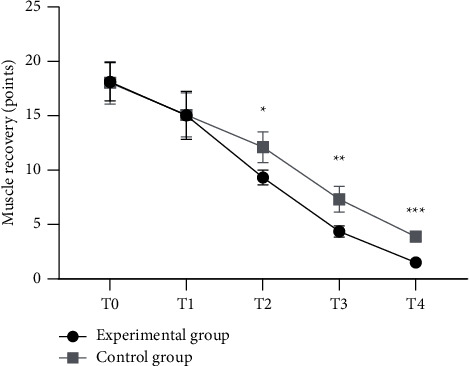
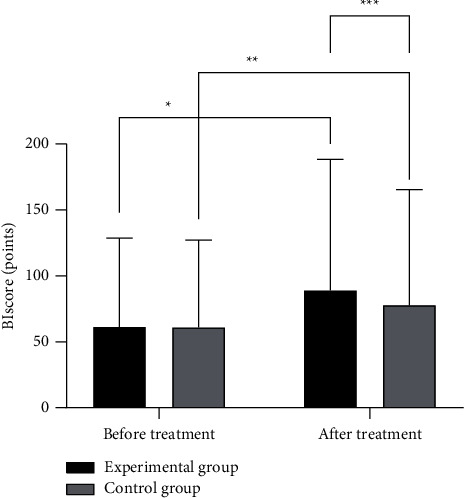
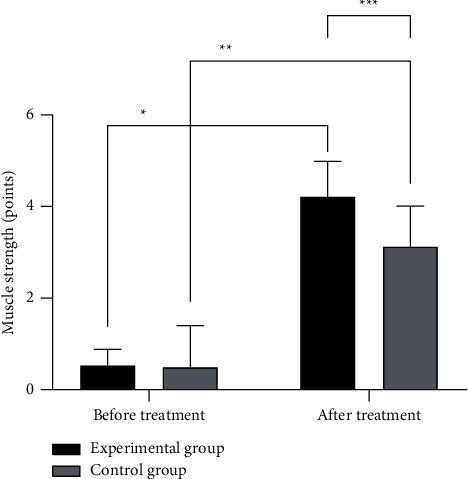
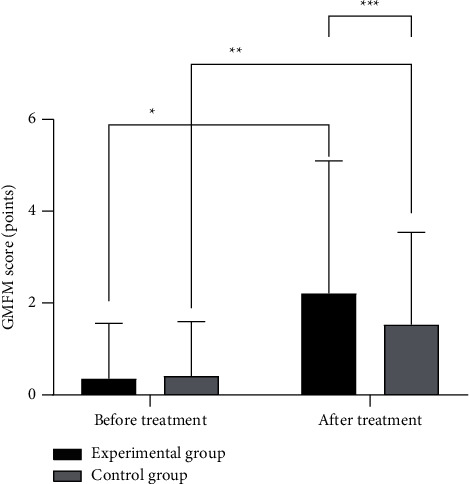
GBS, as an immune-mediated acute inflammatory peripheral neuropathy (Tan and Halpin et al.), with the characteristics of acute onset and rapid progression, is mainly manifested with damages in nerve root and peripheral nerve. The purpose of the study was to investigate the effect of electromyographic biofeedback therapy on muscle strength recovery in children with Guillain-Barré syndrome (GBS). A total of 62 GBS children patients admitted to our hospital from June 2014 to December 2018 were selected and divided into control group ( = 30) and experimental group ( = 32) according to the order of admission. The children patients in the control group received physical therapy combined with occupational therapy (PT + OT), while based on the treatment in the control group, the experimental group children patients were treated with electromyographic biofeedback therapy. After that, the recovery of nerve and muscle at different time points, muscle strength score, gross motor function measure (GMFM) score, and Barthel index (BI) score of the children patients before and after treatment were compared between the two groups. There were no significant differences in the recovery of nerve and muscle of the children patients between the two groups at and ( > 0.05), and the recovery of nerve and muscle of the children patients in the experimental group was significantly better than that in the control group at , , and ( < 0.001); the muscle strength score, GMFM score, and BI score of the children patients in the experimental group were significantly better than those in the control group after treatment ( < 0.001). The application of electromyographic biofeedback therapy for the treatment of GBS can effectively relieve clinical symptoms, promote rapid recovery, and improve treatment efficacy in children patients, which is worthy of application and promotion.
GBS 是一种免疫介导的急性炎性周围神经病(Tan 和 Halpin 等人),具有急性发作和快速进展的特点,主要表现为神经根和周围神经损伤。本研究旨在探讨肌电图生物反馈疗法对小儿格林-巴利综合征(GBS)患儿肌力恢复的影响。选取 2014 年 6 月至 2018 年 12 月我院收治的 GBS 患儿 62 例,按入院顺序分为对照组(n=30)和观察组(n=32)。对照组患儿给予物理治疗联合作业治疗(PT+OT),观察组患儿在对照组治疗的基础上给予肌电图生物反馈治疗。比较两组患儿不同时间点神经、肌肉恢复情况、肌力评分、粗大运动功能测量量表(GMFM)评分及治疗前后日常生活活动能力量表(Barthel 指数,BI)评分。两组患儿神经、肌肉恢复情况在 、 时差异无统计学意义(>0.05),观察组患儿在 、 、 时神经、肌肉恢复情况均明显优于对照组(<0.001);治疗后观察组患儿肌力评分、GMFM 评分、BI 评分均明显优于对照组(<0.001)。肌电图生物反馈疗法治疗 GBS 可有效缓解临床症状,促进患儿快速恢复,提高治疗效果,值得应用和推广。