Cardone Daniela, Perpetuini David, Di Nicola Marta, Merla Arcangelo, Morone Giovanni, Ciancarelli Irene, Moretti Antimo, Gimigliano Francesca, Cichelli Alice, De Flaviis Francesco, Martino Cinnera Alex, Paolucci Teresa
Department of Engineering and Geology, University "G. d'Annunzio" of Chieti-Pescara, Pescara, Italy.
Department of Oral Medical Science and Biotechnology, Physical and Rehabilitation Medicine, BIND, CARES, University "G. d'Annunzio" of Chieti-Pescara, Chieti, Italy.
Front Neurol. 2025 Jan 6;15:1499249. doi: 10.3389/fneur.2024.1499249. eCollection 2024.
Cerebral palsy (CP) is a group of permanent disorders of movement development that may cause activity limitations. In this context, robot-assisted therapy might play a key role in clinical management. This comprehensive systematic review aimed to investigate the efficacy of robotic systems in improving upper limb (UL) functions in children with CP.
PubMed, EMBASE, Scopus, and PEDro were searched from inception to February 2024. The risk of bias was assessed with the Joanna Briggs Institute critical appraisal tools battery.
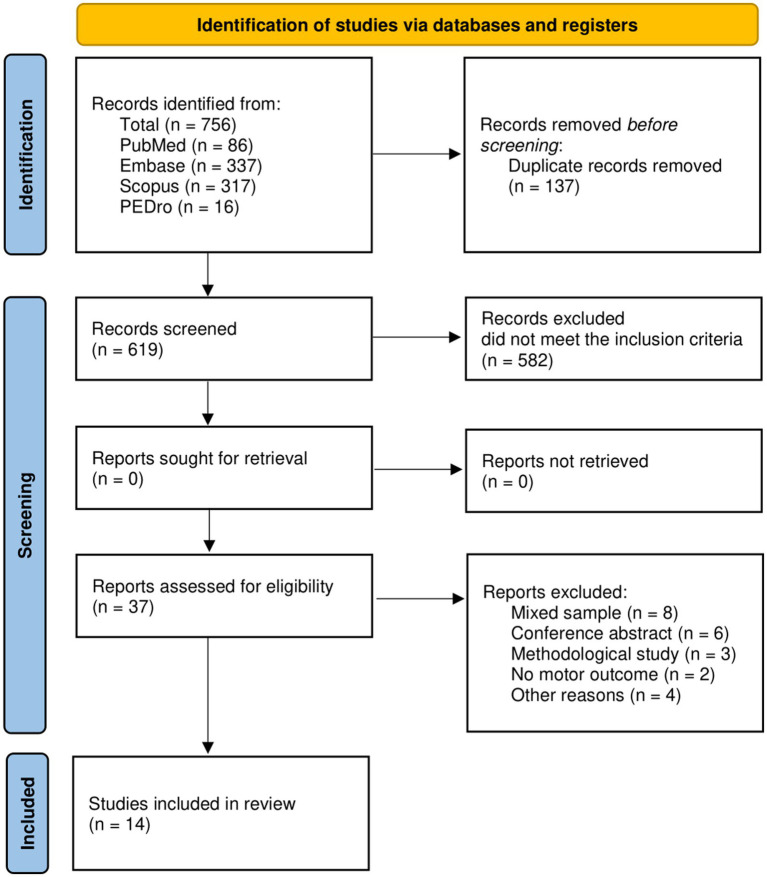
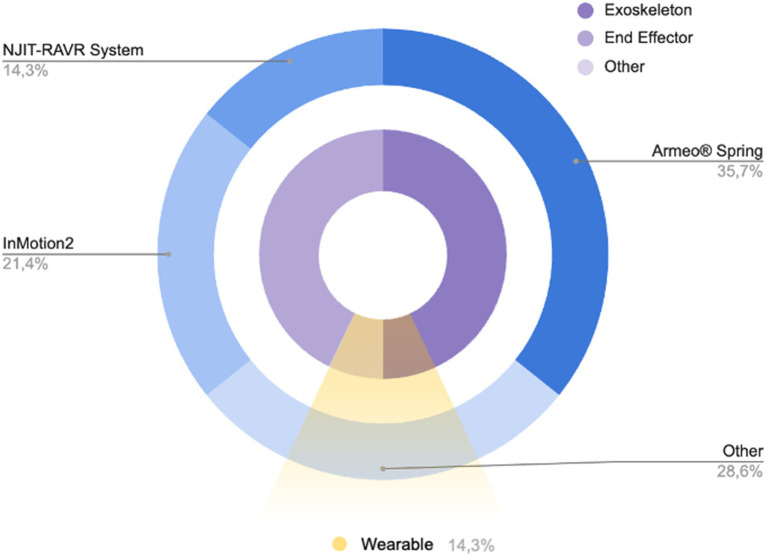
Of 756 articles identified, 14 studies involving 193 children with CP with a judged to be of good methodological quality, but with a lack in the study design, were included in the final synthesis. In the included studies a wide range of devices was used, both exoskeletons and end-effectors, both wearable and non-wearable. The CP children who underwent robot-assisted therapy reported a significant overall increase in clinical assessment, specifically in UL movements and manual dexterity. The clinical improvement was often accompanied by a gain also in instrumental assessments (i.e., kinematic analysis, EMG).
The present review suggested that robot-assisted therapy can improve UL motor functions in children with CP. Moreover, the availability of different devices with adjustable parameters can represent an important resource in proposing patient-centered-personalized rehabilitation protocols to enhance the efficacy of rehabilitation and integration into daily life. However, the limited sample size and lack of standardized and clearly reproducible protocols impose to recommend the use of robot-assisted therapy as an integration to usual rehabilitation and not as a replacement.
脑瘫(CP)是一组运动发育的永久性障碍,可能导致活动受限。在此背景下,机器人辅助治疗可能在临床管理中发挥关键作用。本全面的系统评价旨在研究机器人系统对改善脑瘫儿童上肢(UL)功能的疗效。
检索了从数据库建库至2024年2月的PubMed、EMBASE、Scopus和PEDro数据库。使用乔安娜·布里格斯研究所的批判性评价工具组评估偏倚风险。
在识别出的756篇文章中,最终纳入了14项研究,涉及193名脑瘫儿童,这些研究的方法学质量被判定为良好,但研究设计存在不足。在纳入的研究中,使用了广泛的设备,包括外骨骼和末端执行器,既有可穿戴的,也有不可穿戴的。接受机器人辅助治疗的脑瘫儿童在临床评估中总体上有显著改善,特别是在上肢运动和手部灵巧性方面。临床改善通常还伴随着仪器评估(即运动学分析、肌电图)的改善。
本综述表明,机器人辅助治疗可以改善脑瘫儿童的上肢运动功能。此外,具有可调节参数的不同设备的可用性可以成为制定以患者为中心的个性化康复方案以提高康复效果并融入日常生活的重要资源。然而,样本量有限以及缺乏标准化且可清晰重现的方案,使得建议将机器人辅助治疗作为常规康复的补充而非替代方法使用。