Rabbani Ramin, Saeedi Sima, Nazimuddin Md, Barbero Héctor, Kyritsakas Nathalie, White Travis A, Masson Eric
Department of Chemistry and Biochemistry, Ohio University Athens Ohio 45701 USA
GIR MIOMeT, IU CINQUIMA/Química Inorgánica, Facultad de Ciencias, Universidad de Valladolid Valladolid E47011 Spain.
Chem Sci. 2021 Nov 4;12(46):15347-15352. doi: 10.1039/d1sc03743a. eCollection 2021 Dec 1.
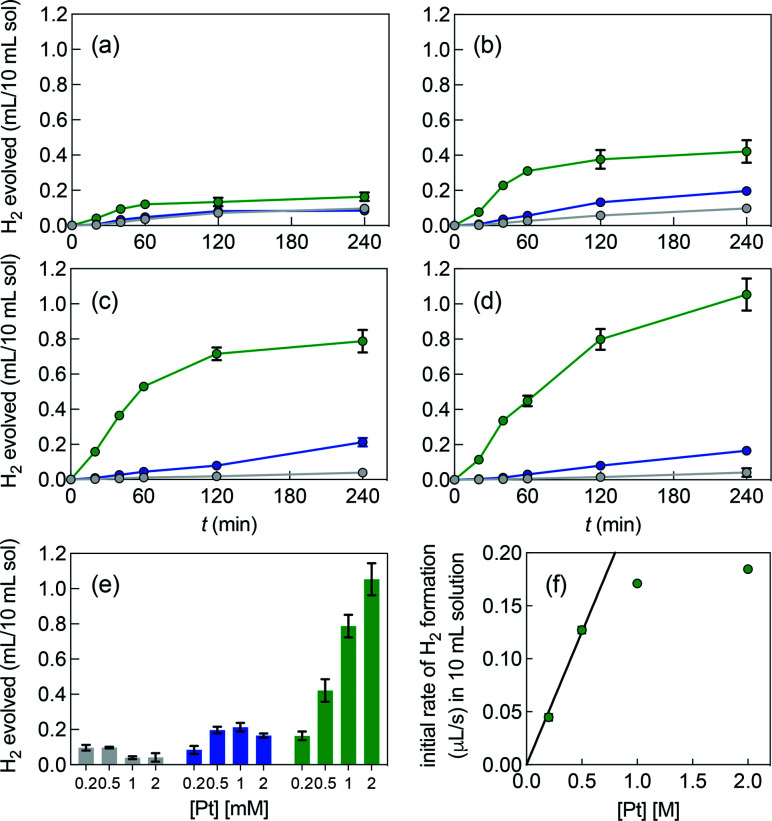
A cucurbit[8]uril (CB[8])-secured platinum terpyridyl chloride dimer was used as a photosensitizer and hydrogen-evolving catalyst for the photoreduction of water. Volumes of produced hydrogen were up to 25 and 6 times larger than those obtained with the corresponding free and cucurbit[7]uril-bound platinum monomer, respectively, at equal Pt concentration. The thermodynamics of the proton-coupled electron transfer from the Pt(ii)-Pt(ii) dimer to the corresponding Pt(ii)-Pt(iii)-H hydride key intermediate, as quantified by density functional theory, suggest that CB[8] secures the Pt(ii)-Pt(ii) dimer in a particularly reactive conformation that promotes hydrogen formation.
一种由葫芦[8]脲(CB[8])固定的二氯化铂三联吡啶二聚体被用作光敏剂和析氢催化剂,用于水的光还原反应。在铂浓度相等的情况下,产生氢气的体积分别比相应的游离铂单体和与葫芦[7]脲结合的铂单体所产生氢气的体积大25倍和6倍。通过密度泛函理论量化的从Pt(II)-Pt(II)二聚体到相应的Pt(II)-Pt(III)-H氢化关键中间体的质子耦合电子转移的热力学表明,CB[8]将Pt(II)-Pt(II)二聚体固定在一种特别有利于反应的构象中,从而促进氢的形成。