INSERM U1124, CNRS ERL3649, Université de Paris, Paris, France.
INSERM U1133, CNRS UMR8251, Université de Paris, Paris, France.
Front Public Health. 2021 Dec 17;9:763962. doi: 10.3389/fpubh.2021.763962. eCollection 2021.
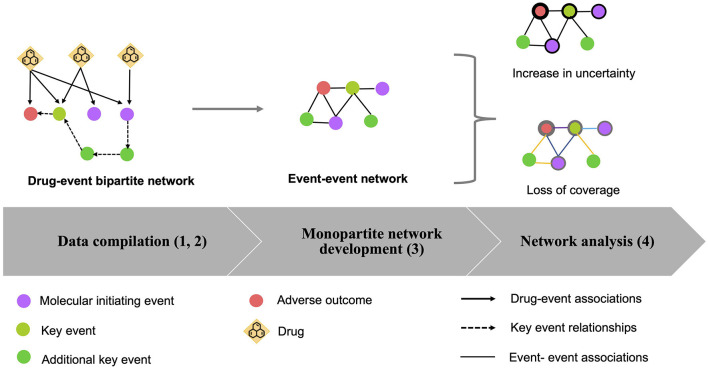
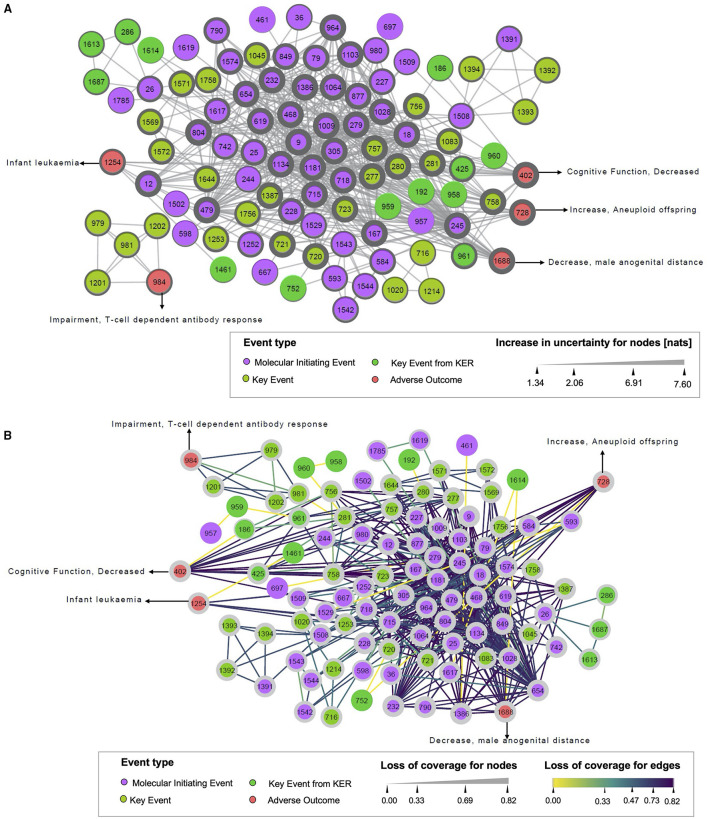
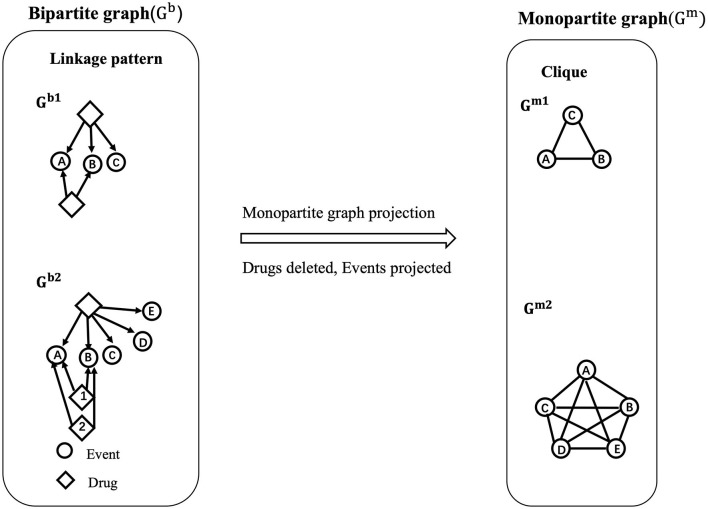
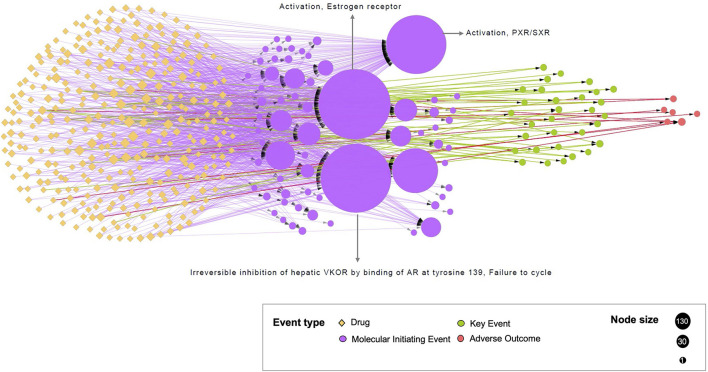
The chemical part of the exposome, including drugs, may explain the increase of health effects with outcomes such as infertility, allergies, metabolic disorders, which cannot be only explained by the genetic changes. To better understand how drug exposure can impact human health, the concepts of adverse outcome pathways (AOPs) and AOP networks (AONs), which are representations of causally linked events at different biological levels leading to adverse health, could be used for drug safety assessment. To explore the action of drugs across multiple scales of the biological organization, we investigated the use of a network-based approach in the known AOP space. Considering the drugs and their associations to biological events, such as molecular initiating event and key event, a bipartite network was developed. This bipartite network was projected into a monopartite network capturing the event-event linkages. Nevertheless, such transformation of a bipartite network to a monopartite network had a huge risk of information loss. A way to solve this problem is to quantify the network reduction. We calculated two scoring systems, one measuring the uncertainty and a second one describing the loss of coverage on the developed event-event network to better investigate events from AOPs linked to drugs. This AON analysis allowed us to identify biological events that are highly connected to drugs, such as events involving nuclear receptors (ER, AR, and PXR/SXR). Furthermore, we observed that the number of events involved in a linkage pattern with drugs is a key factor that influences information loss during monopartite network projection. Such scores have the potential to quantify the uncertainty of an event involved in an AON, and could be valuable for the weight of evidence assessment of AOPs. A case study related to infertility, more specifically to "decrease, male agenital distance" is presented. This study highlights that computational approaches based on network science may help to understand the complexity of drug health effects, with the aim to support drug safety assessment.
暴露组的化学部分,包括药物,可能解释了与生育能力下降、过敏、代谢紊乱等结果相关的健康影响的增加,而这些影响不能仅用遗传变化来解释。为了更好地了解药物暴露如何影响人类健康,可以使用不良结局途径(AOP)和 AOP 网络(AON)的概念,这些概念代表了导致不良健康的不同生物学水平上因果相关事件的表达。为了探索药物在多个生物学组织尺度上的作用,我们研究了在已知 AOP 空间中使用基于网络的方法。考虑到药物及其与生物事件的关联,如分子起始事件和关键事件,开发了一个二分网络。这个二分网络被投影到一个捕获事件-事件链接的单分网络中。然而,这种将二分网络转换为单分网络的方法存在巨大的信息丢失风险。解决这个问题的一种方法是量化网络减少。我们计算了两个评分系统,一个测量不确定性,另一个描述在开发的事件-事件网络上的覆盖范围损失,以更好地研究与药物相关的 AOP 链接的事件。 这种 AON 分析使我们能够识别与药物高度相关的生物事件,如涉及核受体(ER、AR 和 PXR/SXR)的事件。此外,我们观察到,与药物相关的链接模式中涉及的事件数量是影响单分网络投影过程中信息丢失的关键因素。这些分数有可能量化 AON 中涉及事件的不确定性,并可用于 AOP 证据权重评估。提出了一个与生育能力下降相关的案例研究,更具体地说是与“男性生殖器距离减小”相关的案例。 该研究强调,基于网络科学的计算方法可能有助于理解药物健康影响的复杂性,旨在支持药物安全评估。