He Falin, Yang Rulai, Huang Xinwen, Tian Yaping, Pei Xiaofang, Bohn Mary Kathryn, Zou Lin, Wang Yan, Li Haibo, Wang Ting, Gu Maosheng, Jiang Tao, Chen Xigui, Zou Hui, Wei Hongwei, Tian Weibing, Tang Tian, Adeli Khosrow, Wang Zhiguo
National Center for Clinical Laboratories, Beijing Engineering Research Center of Laboratory Medicine, Beijing Hospital, National Center of Gerontology, Institute of Geriatric Medicine, Chinese Academy of Medical Sciences, Beijing, China.
Department of Genetics and Metabolism, Children's Hospital of Zhejiang University School of Medicine, National Clinical Research Center for Child Health, Hangzhou, China.
Front Mol Biosci. 2021 Dec 16;8:719866. doi: 10.3389/fmolb.2021.719866. eCollection 2021.
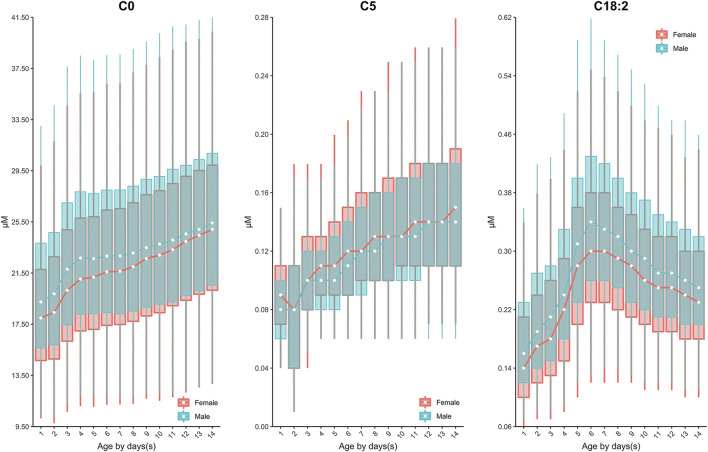
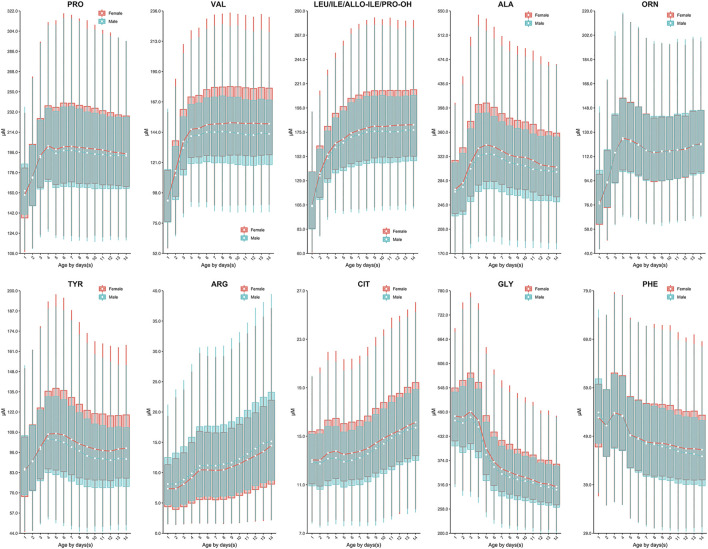
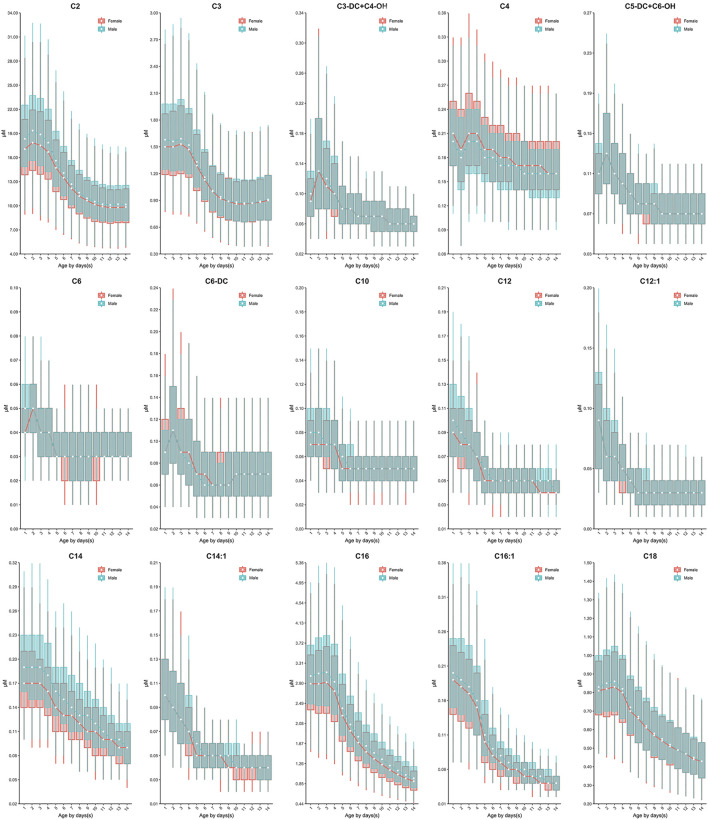
The major clinical problem presently confronting the Chinese newborn screening (NBS) programs by tandem mass spectrometry (MS/MS) is the lack of comprehensive reference intervals (RIs) for disease biomarkers. To close this gap, the Chinese National Center for Clinical Laboratories (NCCL) launched a nationwide study to investigate the dynamic pattern of 35 MS/MS NBS biomarkers and establish accurate and robust RIs. Blood spot samples from 4,714,089 Chinese neonates were tested in participating centers/laboratories and used for study analysis. MS/MS NBS biomarker trends were visually assessed by their concentrations over age. Specific partitions were determined arbitrarily by each day and sex or by the statistical method of Harris and Boyd. RIs, corresponding to the 2.5th and 97.5th percentiles, as well as the 1th, 25th, 75th and 99th percentiles were calculated for each reference partition using a non-parametric rank approach. Most MS/MS NBS biomarkers fluctuated during the first week of life, followed by a relatively stable concentration. Age and sex-specific RIs were established and presented an improved specificity over the RIs used in participating centers/laboratories. Females demonstrated higher 2.5th and 97.5th percentiles in all amino acids except arginine and ornithine than males, whereas males showed higher 2.5th and 97.5th percentiles in most acylcarnitines. The present study determined the dynamic trends of 35 MS/MS biomarkers and established age and sex-specific RIs, valuably contributing to the current literature and timely evaluation of neonatal health and disease.
目前,中国串联质谱新生儿筛查(NBS)项目面临的主要临床问题是缺乏疾病生物标志物的综合参考区间(RIs)。为填补这一空白,中国国家临床检验中心(NCCL)开展了一项全国性研究,以调查35种串联质谱新生儿筛查生物标志物的动态模式,并建立准确可靠的参考区间。来自4,714,089名中国新生儿的血斑样本在参与的中心/实验室进行检测,并用于研究分析。通过串联质谱新生儿筛查生物标志物的浓度随年龄变化情况进行直观评估。具体划分由每天和性别任意确定,或采用哈里斯和博伊德的统计方法。使用非参数秩方法为每个参考划分计算对应第2.5和第97.5百分位数以及第1、第25、第75和第99百分位数的参考区间。大多数串联质谱新生儿筛查生物标志物在出生后第一周内波动,随后浓度相对稳定。建立了年龄和性别特异性参考区间,与参与的中心/实验室使用的参考区间相比,特异性有所提高。除精氨酸和鸟氨酸外,女性在所有氨基酸中的第2.5和第97.5百分位数均高于男性,而男性在大多数酰基肉碱中的第2.5和第97.5百分位数更高。本研究确定了35种串联质谱生物标志物的动态趋势,并建立了年龄和性别特异性参考区间,为当前文献以及新生儿健康和疾病的及时评估做出了宝贵贡献。