Department of Environmental Health; National Institute of Public Health 2-3-6 Minami; Wako, Saitama, 351-0197, Japan.
Meiji Pharmaceutical University, 2-522-1 Noshio, Kiyose, Tokyo, 204-8588, Japan.
J Radiat Res. 2022 Mar 17;63(2):183-191. doi: 10.1093/jrr/rrab122.
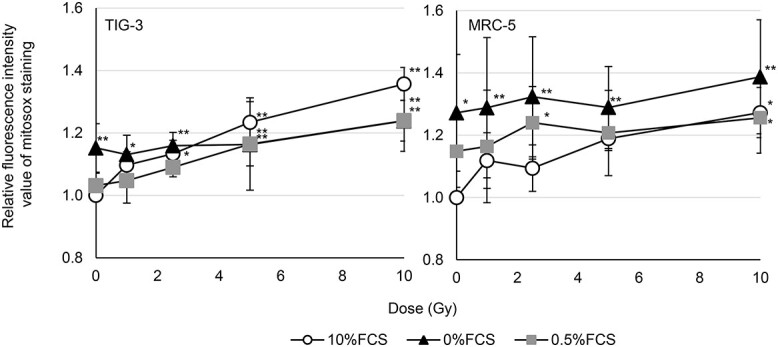
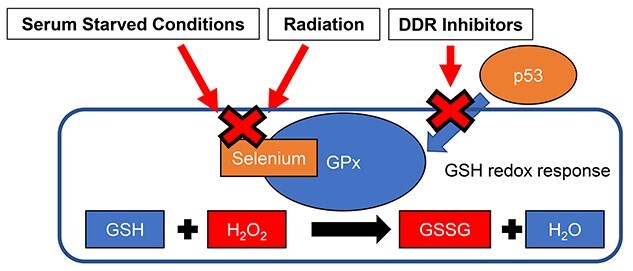
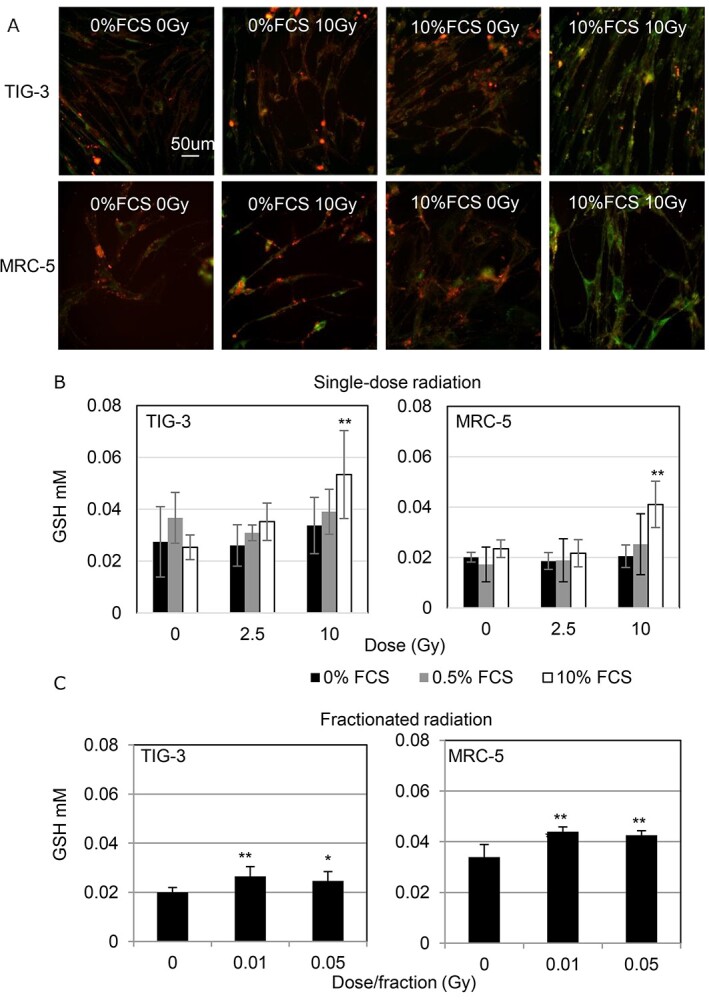
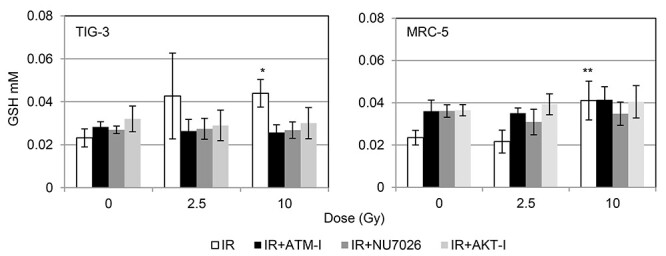
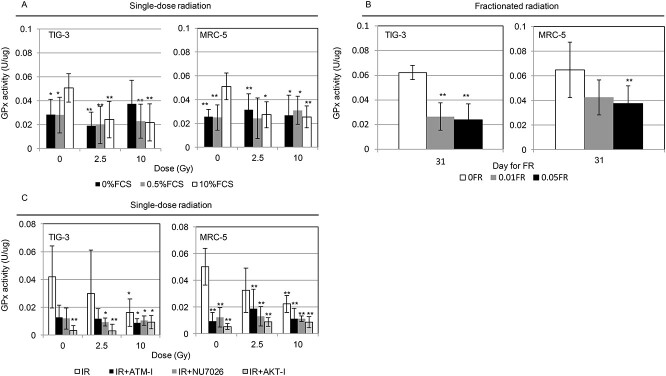
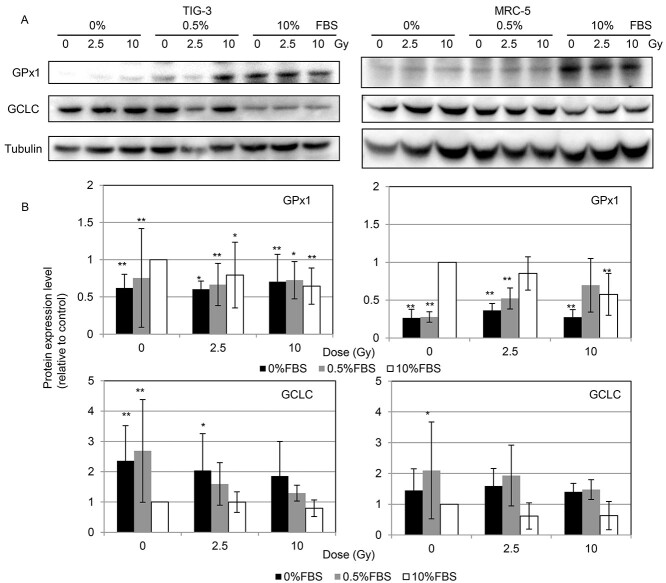
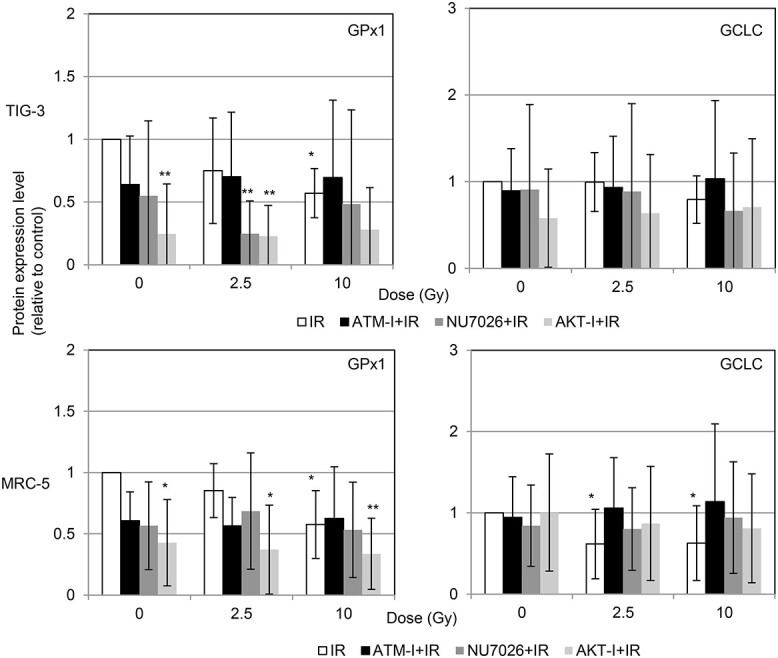
The glutathione (GSH) redox control is critical to maintain redox balance in the body's internal environment, and its perturbation leads to a dramatic increase in reactive oxygen species (ROS) levels and oxidative stress which have negative impacts on human health. Although ionizing radiation increases mitochondrial ROS generation, the mechanisms underlying radiation-induced late ROS accumulation are not fully understood. Here we investigated the radiation effect on GSH redox reactions in normal human diploid lung fibroblasts TIG-3 and MRC-5. Superoxide anion probe MitoSOX-red staining and measurement of GSH peroxidase (GPx) activity revealed that high dose single-radiation (SR) exposure (10 Gy) increased mitochondrial ROS generation and overall oxidative stress in parallel with decrease in GSH peroxidase (GPx) activity, while GSH redox control was effective after exposure to moderate doses under standard serum conditions. We used different serum conditions to elucidate the role of serum on GSH redox reaction. Serum starvation, serum deprivation and DNA damage response (DDR) inhibitors-treatment reduced the GPx activity and increased mitochondrial ROS generation regardless of radiation exposure. Fractionated-radiation was used to evaluate the radiation effect on GSH reactions. Repeated fractionated-radiation induced prolonged oxidative stress by down-regulation of GPx activity. In conclusion, radiation affects GSH usage according to radiation dose, irradiation methods and serum concentration. Radiation affected the GPx activity to disrupt fibroblast redox homeostasis.
谷胱甘肽 (GSH) 氧化还原调控对于维持体内环境的氧化还原平衡至关重要,其失衡会导致活性氧 (ROS) 水平急剧升高和氧化应激,从而对人体健康产生负面影响。尽管电离辐射会增加线粒体 ROS 的产生,但辐射诱导晚期 ROS 积累的机制尚不完全清楚。在这里,我们研究了正常人类二倍体肺成纤维细胞 TIG-3 和 MRC-5 中的辐射对 GSH 氧化还原反应的影响。超氧阴离子探针 MitoSOX-red 染色和 GSH 过氧化物酶 (GPx) 活性测量表明,高剂量单次照射 (SR)(10Gy)会增加线粒体 ROS 的产生和整体氧化应激,同时降低 GPx 活性,而在标准血清条件下接受中等剂量照射后,GSH 氧化还原控制仍然有效。我们使用不同的血清条件来阐明血清对 GSH 氧化还原反应的作用。血清饥饿、血清剥夺和 DNA 损伤反应 (DDR) 抑制剂处理会降低 GPx 活性并增加线粒体 ROS 的产生,而无论是否受到辐射。分次照射用于评估辐射对 GSH 反应的影响。重复的分次照射通过下调 GPx 活性导致氧化应激的持续时间延长。总之,辐射会根据辐射剂量、照射方法和血清浓度影响 GSH 的使用。辐射会影响 GPx 活性,从而破坏成纤维细胞的氧化还原平衡。