Department of Cardiac Surgery, Medical University of Vienna, Vienna, Austria.
Ludwig Boltzmann Institute for Cardiovascular Research, Vienna, Austria.
Artif Organs. 2022 Jun;46(6):1149-1157. doi: 10.1111/aor.14165. Epub 2022 Jan 9.
A relation between the left ventricular assist device inflow cannula (IC) malposition and pump thrombus has been reported. This study aimed to investigate if the pump position, derived from chest X-rays in HeartMate 3 (HM3) patients, correlates with neurological dysfunction (ND), ischemic stroke (IS), hemorrhagic stroke (HS) and survival.
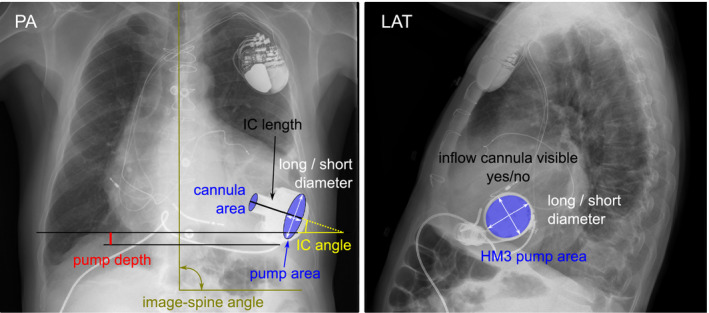
This analysis was performed on routinely acquired X-rays of 42 patients implanted with a HM3 between 2014 and 2017. Device position was quantified in patients with and without ND from frontal and lateral X-rays characterizing the IC and pump in relation to spine, diaphragm or horizontal line. The primary end-point was freedom from stroke and survival one-year after HM3 implantation stratified by pump position.
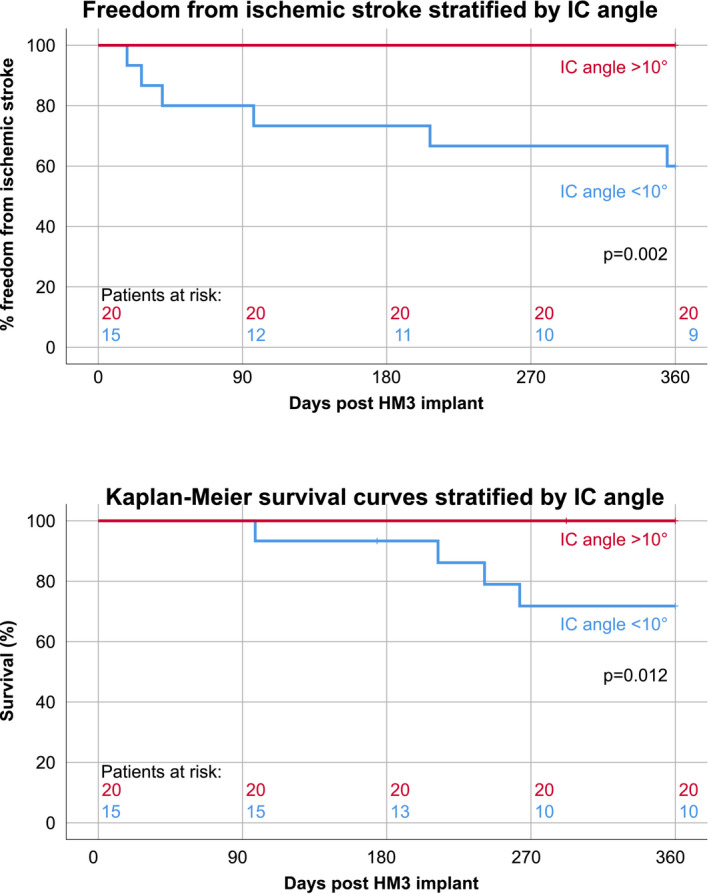
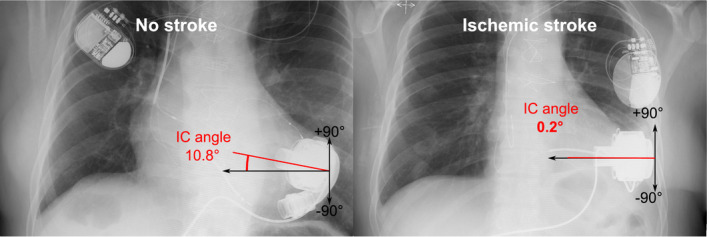
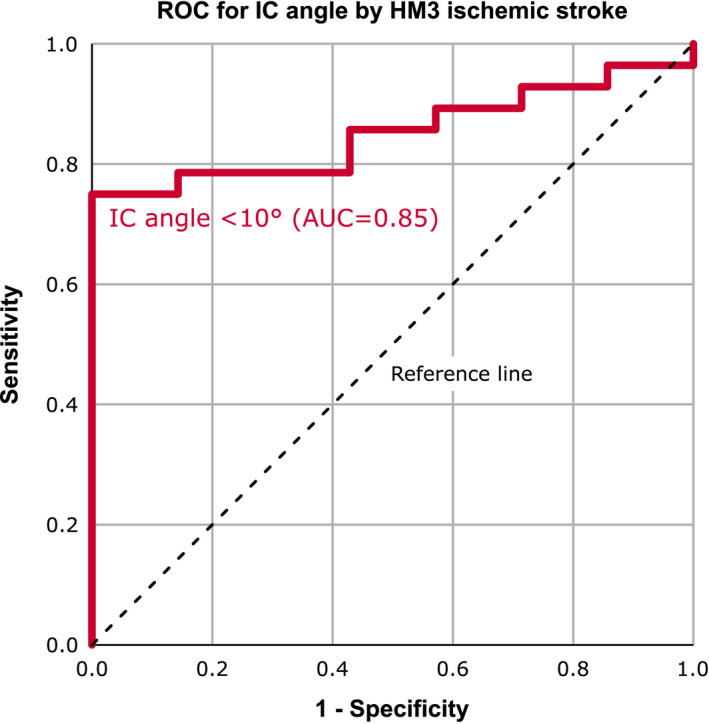
The analysis of X-rays, 33.5 (41.0) days postoperative, revealed a significant smaller IC angle of HM3 patients with ND versus no ND (0.1° ± 14.0° vs. 12.9° ± 10.1°, p = 0.005). Additionally, the IC angle in the frontal view, IS: 4.1 (20.9)° versus no IS: 13.8 (7.5)°, p = 0.004 was significantly smaller for HM3 patients with IS. Using receiver operating characteristics derived cut-off, IC angle <10° provided 75% sensitivity and 100% specificity (C-statistic = 0.85) for predicting IS. Stratified by IC angle, freedom from IS at 12 months was 100% (>10°) and 60% (<10°) respectively (p = 0.002). No significant differences were found in any end-point between patients with and without HS. One-year survival was significantly higher in patients with IC angle >10° versus <10° (100% vs. 71.8%, p = 0.012).
IC malposition derived from standard chest X-rays serves as a risk factor for ND, IS and worse survival in HM3 patients.
左心室辅助装置(LVAD)流入管(IC)位置不当与泵血栓之间存在相关性。本研究旨在探讨 HeartMate 3(HM3)患者的泵位置与神经功能障碍(ND)、缺血性卒中(IS)、出血性卒中(HS)和生存率之间的关系。
对 2014 年至 2017 年间植入 HM3 的 42 例患者的常规胸部 X 射线进行了分析。从正面和侧面 X 射线对有和无 ND 的患者的设备位置进行定量分析,以描述 IC 和泵与脊柱、膈肌或水平线的关系。主要终点是根据 HM3 植入后泵位置分层的卒中无复发和 1 年生存率。
术后 33.5(41.0)天的 X 射线分析显示,ND 患者的 HM3 IC 角度明显小于无 ND 患者(0.1°±14.0° vs. 12.9°±10.1°,p=0.005)。此外,HM3 患者 IS 的 IC 角度在正面视图中更小(IS:4.1(20.9)° vs. 无 IS:13.8(7.5)°,p=0.004)。使用接收者操作特征曲线(ROC)得出的截断值,IC 角度<10°对预测 IS 的灵敏度为 75%,特异性为 100%(C 统计量=0.85)。按 IC 角度分层,12 个月时无 IS 的发生率为 100%(>10°)和 60%(<10°)(p=0.002)。在有和无 HS 的患者之间,任何终点均无显著差异。IC 角度>10°的患者 1 年生存率明显高于<10°的患者(100% vs. 71.8%,p=0.012)。
标准胸部 X 射线显示的 IC 错位是 HM3 患者 ND、IS 和生存率降低的危险因素。