Department of Breast Surgery, The First Affiliated Hospital of Xi'an Jiaotong University, Xi'an, Shaanxi, 710061, PR China.
School of Public Health, Xi'an Jiaotong University Health Science Center, Key Laboratory of Environment and Gene Related Diseases of Ministry of Education, Key Laboratory of Trace Elements and Endemic Diseases of Ministry of Health, Xi'an, Shaanxi, 710061, PR China.
BMC Musculoskelet Disord. 2022 Jan 3;23(1):3. doi: 10.1186/s12891-021-04952-9.
The etiology of Kashin-Beck disease (KBD), an endemic osteochondropathy, is largely unknown. Matrix metalloproteinase-3 (MMP-3) plays a central role in the initiation and progression of cartilage destruction, however, no study has reported on the relationship between KBD and MMP-3. The objective of this study was to explore the polymorphism of MMP-3 gene and expression of MMP-3 / TIMP-1(Tissue inhibitors of matrixmetalloproteinases-1) in the pathogenesis of KBD.
Single nucleotide polymorphism (SNP) genotyping was conducted in 274 KBD cases and 248 healthy controls for eight SNPs in MMP-3 using the Sequenom MassARRAY system. Additionally, the expression of MMP-3、TIMP-1 in different layers of the articular cartilage was analyzed by immunohistochemistry for 22 KBD patients, 15 osteoarthritis (OA) patients and 21 controls.
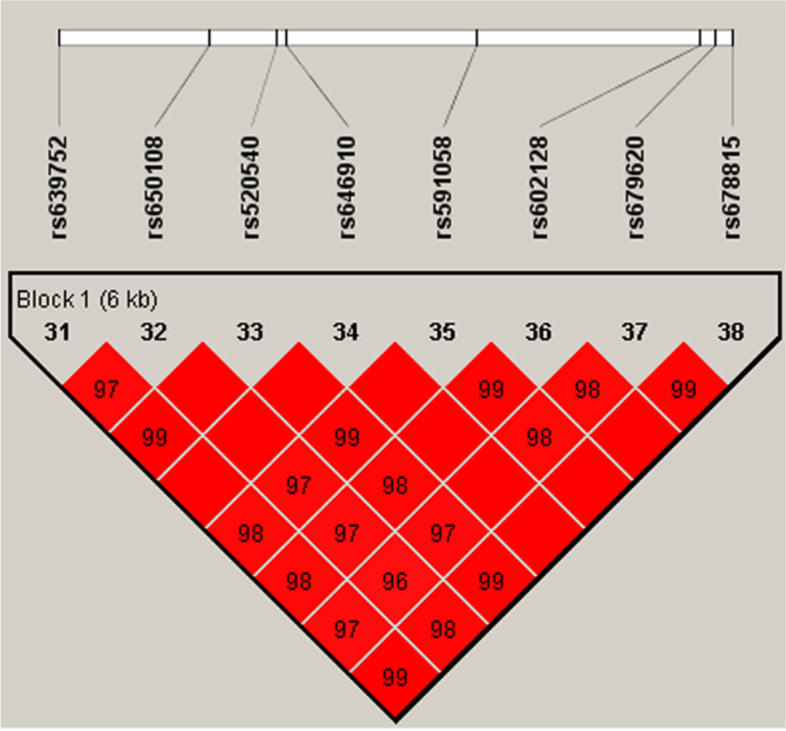
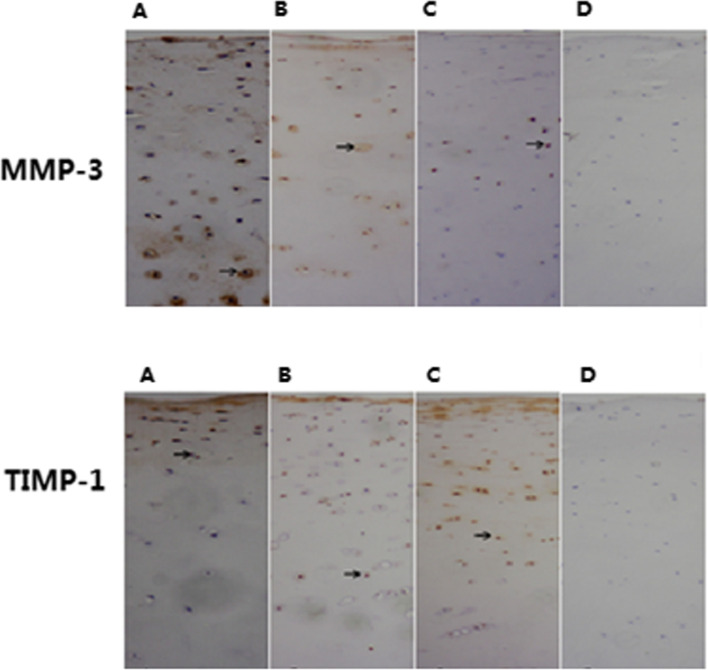
The results showed that six SNPs (rs520540、rs591058、rs679620、rs602128、rs639752 and rs678815) in MMP-3 were associated with the increased risk of KBD, however, after Bonferroni correction, only the SNP rs679620 in the recessive model remained significant difference (OR = 2.31, 95%CI = 1.29-4.14, P = 0.0039), homozygous for "T" allele have a risk for KBD than "C" allele carriers. Moreover, the percentages of cells expressing MMP-3 in articular cartilage were significantly higher in the KBD and OA groups than in the controls (t = 5.37 and 4.19, P<0.01). While the KBD and OA groups had lower levels of TIMP-1 positive staining compared with the controls (t = 5.23and 5.06, P<0.01). And there was no significant different between KBD and OA for the levels of MMP-3 and TIMP-1 positive staining (t = 0.05and 0.28, P>0.05).
MMP-3 is associated with the susceptibility of KBD, and the imbalance expression of MMPs / TIMPs leading to cartilage degradation may play an important role in cartilage degradation and osteoarthritis formation in OA and KBD.
地方性骨软骨病(KBD)是一种病因不明的骨软骨病。基质金属蛋白酶-3(MMP-3)在软骨破坏的发生和进展中起核心作用,然而,尚无研究报道 KBD 与 MMP-3 之间的关系。本研究旨在探讨 MMP-3 基因多态性及其在 KBD 发病机制中的表达。
采用Sequenom MassARRAY 系统对 274 例 KBD 病例和 248 例健康对照者的 MMP-3 中的 8 个单核苷酸多态性(SNP)进行 SNP 基因分型。此外,通过免疫组织化学法分析 22 例 KBD 患者、15 例骨关节炎(OA)患者和 21 例对照者关节软骨不同层的 MMP-3、TIMP-1 的表达。
结果表明,MMP-3 中的 6 个 SNP(rs520540、rs591058、rs679620、rs602128、rs639752 和 rs678815)与 KBD 发病风险增加相关,但经 Bonferroni 校正后,仅隐性模型中的 SNP rs679620 仍具有显著差异(OR=2.31,95%CI=1.29-4.14,P=0.0039),“T”等位基因纯合子比“C”等位基因携带者患 KBD 的风险更高。此外,与对照组相比,KBD 和 OA 组关节软骨中 MMP-3 表达细胞的百分比明显更高(t=5.37 和 4.19,P<0.01)。而 KBD 和 OA 组 TIMP-1 阳性染色水平均低于对照组(t=5.23 和 5.06,P<0.01)。且 KBD 和 OA 组 MMP-3 和 TIMP-1 阳性染色水平无显著差异(t=0.05 和 0.28,P>0.05)。
MMP-3 与 KBD 的易感性相关,MMPs/TIMPs 的失衡表达导致软骨降解,可能在 OA 和 KBD 中软骨降解和骨关节炎形成中发挥重要作用。