Laboratories of Neuroimmunology, Department of Symptom Research, The University of Texas, Houston, Texas, USA.
Department of Pharmacology, College of Medicine, The University of Arizona, Tucson, Arizona, USA.
Channels (Austin). 2022 Dec;16(1):1-8. doi: 10.1080/19336950.2021.2023383.
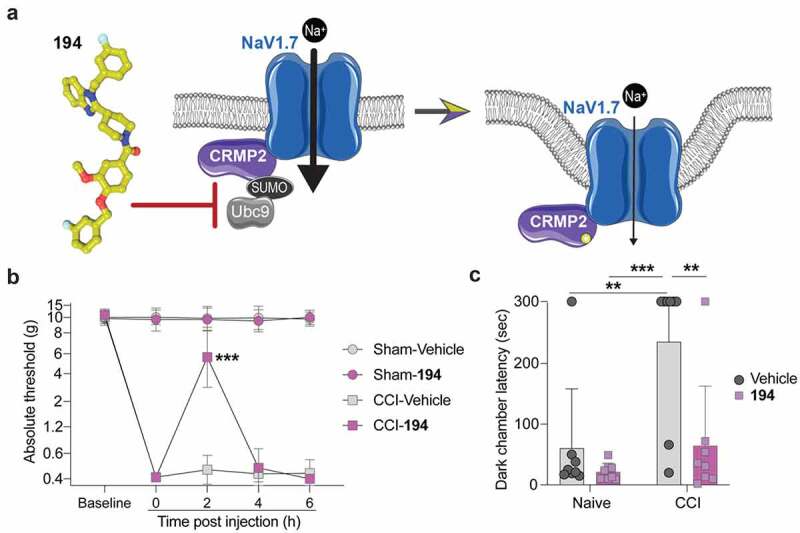
The voltage-gated sodium channel isoform NaV1.7 is a critical player in the transmission of nociceptive information. This channel has been heavily implicated in human genetic pain disorders and is a validated pain target. However, targeting this channel directly has failed, and an indirect approach - disruption of interactions with accessory protein partners - has emerged as a viable alternative strategy. We recently reported that a small-molecule inhibitor of CRMP2 SUMOylation, compound , selectively reduces NaV1.7 currents in DRG neurons across species from mouse to human. This compound also reversed mechanical allodynia in a spared nerve injury and chemotherapy-induced model of neuropathic pain. Here, we show that oral administration of reverses mechanical allodynia in a chronic constriction injury (CCI) model of neuropathic pain. Furthermore, we show that orally administered reverses the increased latency to cross an aversive barrier in a mechanical conflict-avoidance task following CCI. These two findings, in the context of our previous report, support the conclusion that is a robust inhibitor of NaV1.7 function with the ultimate effect of profoundly ameliorating mechanical allodynia associated with nerve injury. The fact that this was observed using both traditional, evoked measures of pain behavior as well as the more recently developed operator-independent mechanical conflict-avoidance assay increases confidence in the efficacy of -induced anti-nociception.
电压门控钠离子通道亚型 NaV1.7 是痛觉信息传递的关键参与者。该通道与人类遗传性疼痛疾病密切相关,是一个经过验证的疼痛靶点。然而,直接靶向该通道的方法已经失败,一种间接的方法——破坏与辅助蛋白伴侣的相互作用——已经成为一种可行的替代策略。我们最近报道,一种 CRMP2 SUMOylation 的小分子抑制剂 ,在从鼠到人等多种物种的 DRG 神经元中选择性地减少 NaV1.7 电流。该化合物还逆转了 spared 神经损伤和化疗诱导的神经性疼痛模型中的机械性痛觉过敏。在这里,我们表明,口服 可逆转慢性缩窄性损伤(CCI)模型中神经性疼痛的机械性痛觉过敏。此外,我们表明,口服给药可逆转 CCI 后机械性冲突回避任务中穿过厌恶障碍的潜伏期延长。这两项发现,结合我们之前的报告,支持这样的结论,即 是一种强效的 NaV1.7 功能抑制剂,最终可显著改善与神经损伤相关的机械性痛觉过敏。事实上,这不仅通过传统的、诱发的疼痛行为测量得到了观察,而且还通过最近开发的、不依赖操作者的机械冲突回避测定得到了观察,这增加了对 诱导的抗伤害感受的疗效的信心。