Center for Innovative Drug Development and Therapeutic Trials for Africa (CDT-Africa), College of Health Sciences, Addis Ababa University, Addis Ababa, Ethiopia.
School of Public Health, College of Health Science and Medicine, Dilla University, Dilla, Ethiopia.
Malar J. 2022 Jan 4;21(1):4. doi: 10.1186/s12936-021-04032-2.
The efficacies of artemisinin based combinations have been excellent in Africa, but also comprehensive evidence regarding their safety would be important. The aim of this review was to synthesize available evidence on the safety of dihydroartemisinin-piperaquine (DHA-PQ) compared to artemether-lumefantrine (AL) for the treatment of uncomplicated Plasmodium falciparum malaria among children in Africa.
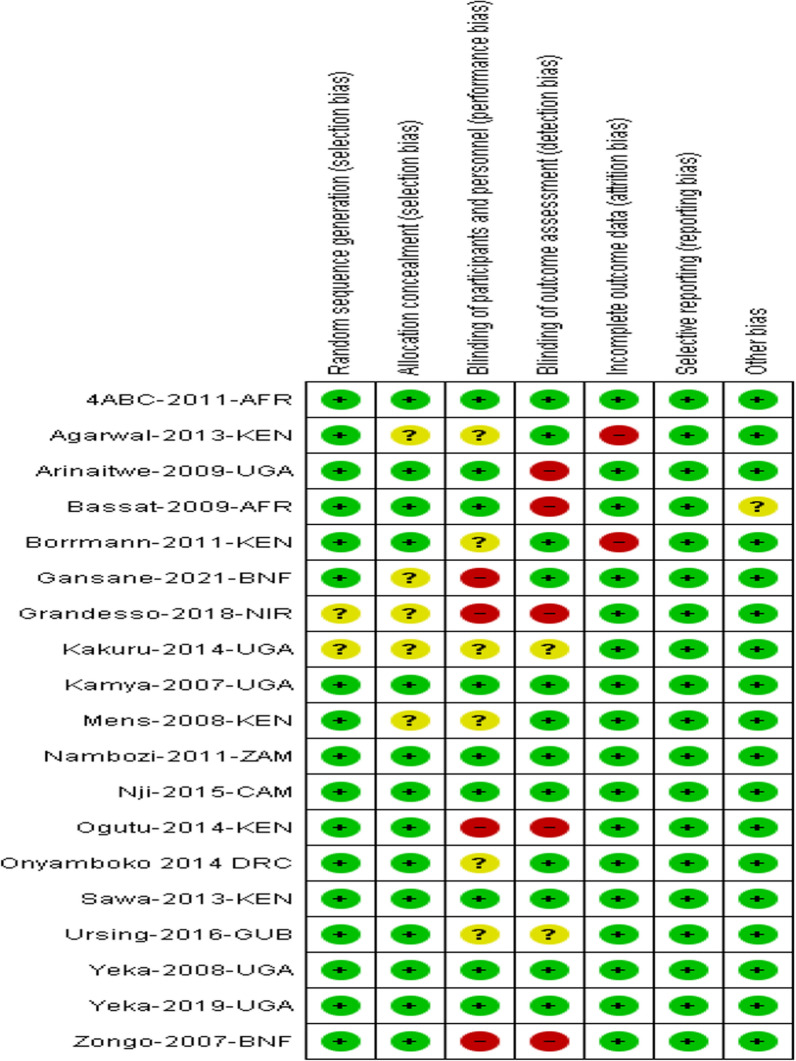
A systematic literature search was done to identify relevant articles from online databases PubMed/ MEDLINE, Embase, and Cochrane Center for Clinical Trial database (CENTRAL) for retrieving randomized control trials comparing safety of DHA-PQ and AL for treatment of uncomplicated P. falciparum malaria among children in Africa. The search was performed from August 2020 to 30 April 2021. Using Rev-Man software (V5.4.1), the extracted data from eligible studies were pooled as risk ratio (RR) with 95% confidence interval (CI).
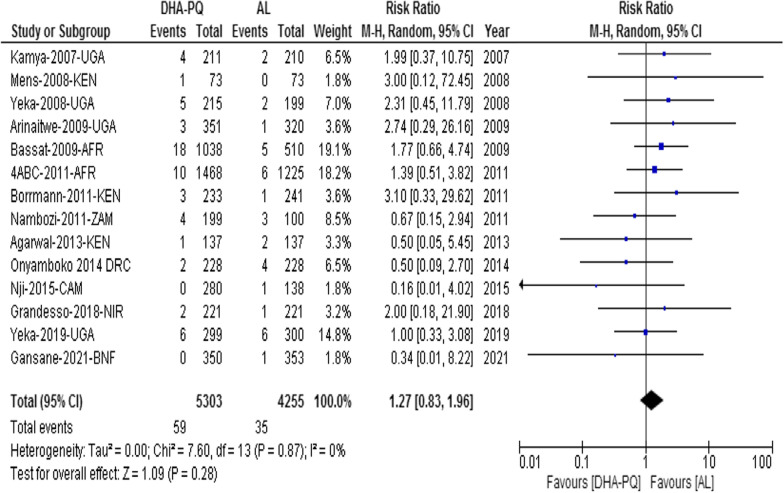
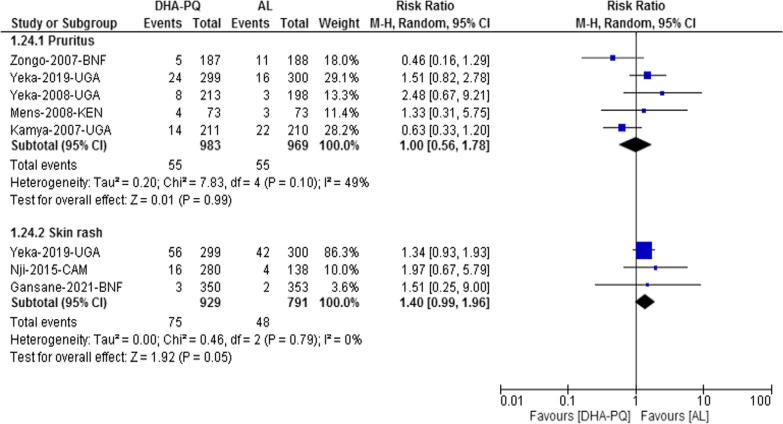
In this review, 18 studies were included, which involved 10,498 participants were included. Compared to AL, DHA-PQ was associated with a slightly higher frequency of early vomiting (RR 2.26, 95% CI 1.46 to 3.50; participants = 7796; studies = 10; I = 0%, high quality of evidence), cough (RR 1.06, 95% CI 1.01 to 1.11; participants = 8013; studies = 13; I = 0%, high quality of evidence), and diarrhoea (RR 1.16, 95% CI 1.03 to 1.31; participants = 6841; studies = 11; I = 8%, high quality of evidence) were more frequent in DHA-PQ treatment arm.
From this review, it can be concluded that early vomiting, diarrhoea, and cough were common were significantly more frequent in patients who were treated with the DHA-PQ than that of AL, and both drugs are well tolerated. More studies comparing AL with DHA-PQ are needed to determine the comparative safety of these drugs.
青蒿素类复方在非洲的疗效非常显著,但全面的安全性证据也同样重要。本综述的目的是综合现有证据,评估双氢青蒿素-哌喹(DHA-PQ)与青蒿琥酯-阿莫地喹(AL)治疗非洲儿童无并发症恶性疟原虫疟疾的安全性。
从在线数据库 PubMed/MEDLINE、Embase 和 Cochrane 临床试验中心数据库(CENTRAL)中进行系统文献检索,检索比较 DHA-PQ 和 AL 治疗非洲儿童无并发症恶性疟原虫疟疾安全性的随机对照试验。检索时间为 2020 年 8 月至 2021 年 4 月 30 日。使用 RevMan 软件(V5.4.1),对符合条件的研究中提取的数据进行汇总,以风险比(RR)和 95%置信区间(CI)表示。
本综述纳入了 18 项研究,共涉及 10498 名参与者。与 AL 相比,DHA-PQ 治疗组患儿的早期呕吐(RR 2.26,95%CI 1.46 至 3.50;参与者=7796;研究=10;I²=0%,高质量证据)、咳嗽(RR 1.06,95%CI 1.01 至 1.11;参与者=8013;研究=13;I²=0%,高质量证据)和腹泻(RR 1.16,95%CI 1.03 至 1.31;参与者=6841;研究=11;I²=8%,高质量证据)的发生率稍高。
本综述表明,DHA-PQ 治疗组患儿早期呕吐、腹泻和咳嗽的发生率明显高于 AL 治疗组,且两种药物均具有良好的耐受性。需要更多比较 AL 与 DHA-PQ 的研究来确定这两种药物的相对安全性。