Intensive Care Department, CHU Amiens-Picardie, 1 Rue du Professeur Christian Cabrol, 80000, Amiens, France.
Crit Care. 2022 Jan 4;26(1):12. doi: 10.1186/s13054-021-03876-z.
In the context of acute respiratory distress syndrome (ARDS), the response to lung recruitment maneuvers (LRMs) varies considerably from one patient to another and so is difficult to predict. The aim of the study was to determine whether or not the recruitment-to-inflation (R/I) ratio could differentiate between patients according to the change in lung mechanics during the LRM.
We evaluated the changes in gas exchange and respiratory mechanics induced by a stepwise LRM at a constant driving pressure of 15 cmHO during pressure-controlled ventilation. We assessed lung recruitability by measuring the R/I ratio. Patients were dichotomized with regard to the median R/I ratio.
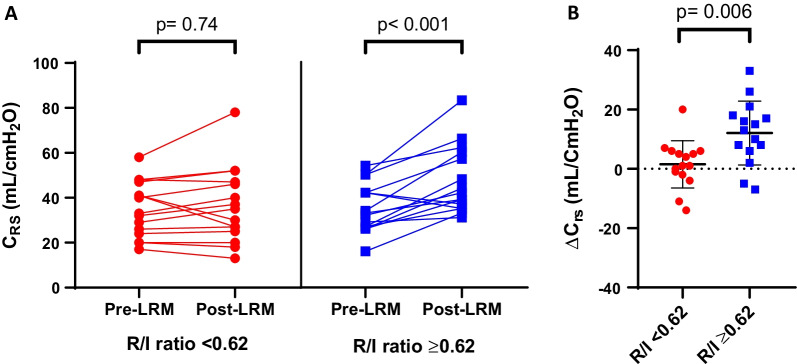
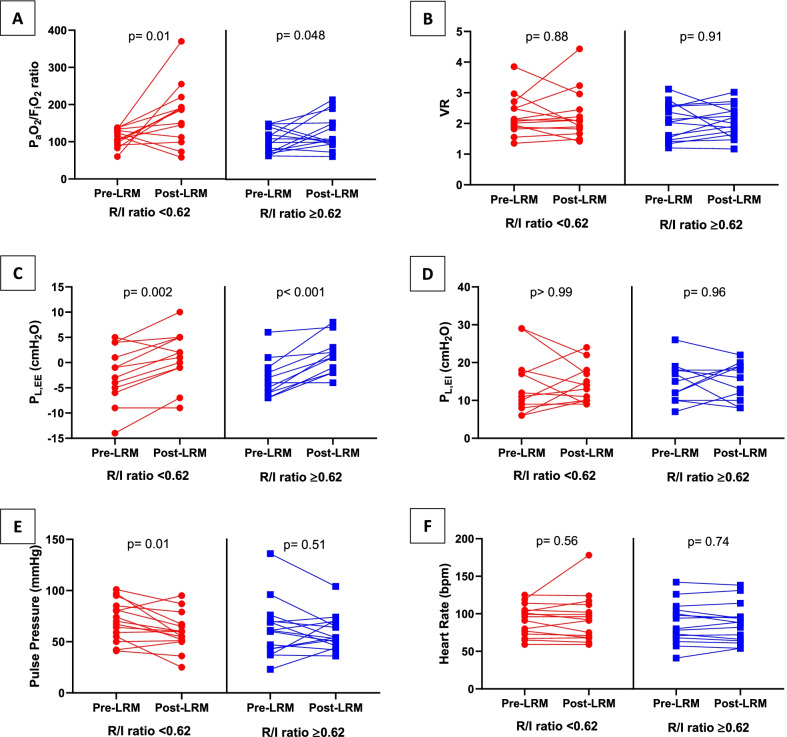
We included 30 patients with moderate-to-severe ARDS and a median [interquartile range] R/I ratio of 0.62 [0.42-0.83]. After the LRM, patients with high recruitability (R/I ratio ≥ 0.62) presented an improvement in the PO/FO ratio, due to significant increase in respiratory system compliance (33 [27-42] vs. 42 [35-60] mL/cmHO; p < 0.001). In low recruitability patients (R/I < 0.62), the increase in PO/FO ratio was associated with a significant decrease in pulse pressure as a surrogate of cardiac output (70 [55-85] vs. 50 [51-67] mmHg; p = 0.01) but not with a significant change in respiratory system compliance (33 [24-47] vs. 35 [25-47] mL/cmHO; p = 0.74).
After the LRM, patients with high recruitability presented a significant increase in respiratory system compliance (indicating a gain in ventilated area), while those with low recruitability presented a decrease in pulse pressure suggesting a drop in cardiac output and therefore in intrapulmonary shunt.
在急性呼吸窘迫综合征(ARDS)的背景下,肺复张手法(LRM)的反应在不同患者之间差异很大,因此难以预测。本研究旨在确定招募-膨胀(R/I)比率是否可以根据 LRM 期间肺力学的变化来区分患者。
我们评估了在压力控制通气下,以 15cmH2O 的恒定驱动压力进行逐步 LRM 时引起的气体交换和呼吸力学的变化。我们通过测量 R/I 比率来评估肺可复张性。根据中位数 R/I 比率将患者分为两组。
我们纳入了 30 例中重度 ARDS 患者,中位数[四分位间距]R/I 比率为 0.62[0.42-0.83]。在 LRM 后,高可复张性(R/I 比率≥0.62)患者由于呼吸系统顺应性显著增加(33[27-42] vs. 42[35-60]mL/cmH2O;p<0.001),PO/FO 比值得到改善。在低可复张性患者(R/I<0.62)中,PO/FO 比值的增加与作为心输出量替代指标的脉压显著下降相关(70[55-85] vs. 50[51-67]mmHg;p=0.01),但呼吸系统顺应性无显著变化(33[24-47] vs. 35[25-47]mL/cmH2O;p=0.74)。
在 LRM 后,高可复张性患者的呼吸系统顺应性显著增加(表明通气面积增加),而低可复张性患者的脉压下降提示心输出量下降,从而导致肺内分流增加。