Lai Christopher, Shi Rui, Jelinski Ludwig, Lardet Florian, Fasan Marta, Ayed Soufia, Belotti Hugo, Biard Nicolas, Guérin Laurent, Fage Nicolas, Fossé Quentin, Gobé Thibaut, Pavot Arthur, Roger Guillaume, Yhuel Alex, Teboul Jean-Louis, Pham Tai, Monnet Xavier
AP-HP, Service de médecine intensive-réanimation, Hôpital de Bicêtre, Hôpitaux Universitaires Paris-Saclay, DMU CORREVE, FHU SEPSIS, Groupe de recherche clinique CARMAS, Université Paris-Saclay, 78 rue du Général Leclerc, 94270, Le Kremlin-Bicêtre, France.
Inserm UMR S_999, Pulmonary Hypertension: Pathophysiology and Novel Therapies, University Paris-Saclay, Hôpital Marie Lannelongue, Le Plessis-Robinson, France.
Ann Intensive Care. 2024 Sep 18;14(1):146. doi: 10.1186/s13613-024-01375-2.
Improvements in oxygenation and lung mechanics with prone position (PP) in patients with acute respiratory distress syndrome (ARDS) are inconstant. The objectives of the study were (i) to identify baseline variables, including the recruitment-to-inflation ratio (R/I), associated with a positive response to PP in terms of oxygenation (improvement of the ratio of arterial oxygen partial pressure over the inspired oxygen fraction (PaO/FiO) ≥ 20 mmHg) and lung mechanics; (ii) to evaluate whether the response to the previous PP session is associated with the response to the next session.
In this prospective, observational, single-center study in patients who underwent PP for ARDS due to COVID-19, respiratory variables were assessed just before PP and at the end of the session. Respiratory variables included mechanical ventilation settings and respiratory mechanics variables, including R/I, an estimate of the potential for lung recruitment compared to lung overinflation.
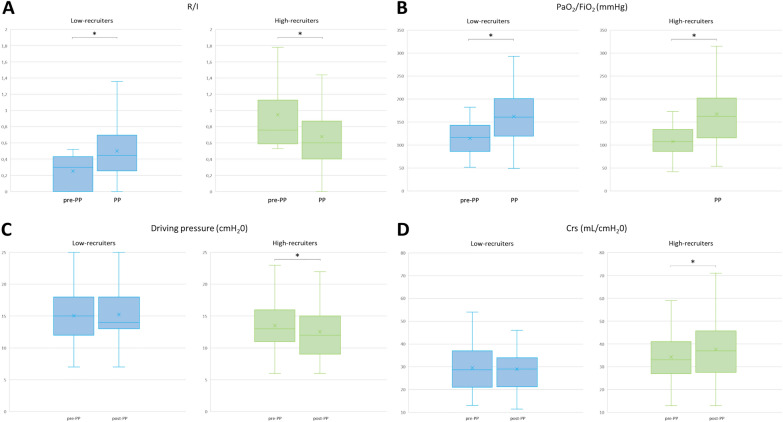
In 50 patients, 201 PP sessions lasting 19 ± 3 h were evaluated. Neuromuscular blockades were used in 116 (58%) sessions. The PaO/FiO ratio increased from 109 ± 31 mmHg to 165 ± 65 mmHg, with an increase ≥ 20 mmHg in 142 (71%) sessions. In a mixed effect logistic regression, only pre-PP PaO/FiO (OR 1.12 (95% CI [1.01-1.24])/every decrease of 10 mmHg, p = 0.034) in a first model and improvement in oxygenation at the previous PP session (OR 3.69 (95% CI [1.27-10.72]), p = 0.017) in a second model were associated with an improvement in oxygenation with PP. The R/I ratio (n = 156 sessions) was 0.53 (0.30-0.76), separating lower- and higher-recruiters. Whereas PaO/FiO improved to the same level in both subgroups, driving pressure and respiratory system compliance improved only in higher-recruiters (from 14 ± 4 to 12 ± 4 cmHO, p = 0.027, and from 34 ± 11 to 38 ± 13 mL/cmHO, respectively, p = 0.014).
A lower PaO/FiO at baseline and a positive O-response at the previous PP session are associated with a PP-induced improvement in oxygenation. In higher-recruiters, lung mechanics improved along with oxygenation. Benefits of PP could thus be greater in these patients.
急性呼吸窘迫综合征(ARDS)患者采用俯卧位(PP)时,氧合和肺力学的改善并不稳定。本研究的目的是:(i)确定与PP在氧合(动脉血氧分压与吸入氧分数之比(PaO₂/FiO₂)提高≥20 mmHg)和肺力学方面的阳性反应相关的基线变量,包括复张与充气比(R/I);(ii)评估对上一次PP治疗的反应是否与下一次治疗的反应相关。
在这项针对因COVID-19导致ARDS而接受PP治疗的患者的前瞻性、观察性、单中心研究中,在PP治疗前和治疗结束时评估呼吸变量。呼吸变量包括机械通气设置和呼吸力学变量,包括R/I,这是与肺过度充气相比肺复张潜力的估计值。
对50例患者进行了评估,共201次PP治疗,持续时间为19±3小时。116次(58%)治疗使用了神经肌肉阻滞剂。PaO₂/FiO₂比值从109±31 mmHg增加到165±65 mmHg,142次(71%)治疗增加≥20 mmHg。在混合效应逻辑回归中,在第一个模型中,仅PP治疗前的PaO₂/FiO₂(每降低10 mmHg,比值比(OR)为1.12(95%置信区间[1.01-1.24]),p = 0.034),在第二个模型中,上一次PP治疗时的氧合改善(OR为3.69(95%置信区间[1.27-10.72]),p = 0.017)与PP治疗时的氧合改善相关。R/I比值(n =