Kobayashi Hiroshi, Otani Koji, Nikaido Takuya, Watanabe Kazuyuki, Kato Kinshi, Handa Junichi, Yabuki Shoji, Konno Shin-Ichi
Department of Orthopaedic Surgery, Fukushima Medical University School of Medicine, Fukushima, Japan.
Int J Gen Med. 2021 Dec 18;14:9863-9872. doi: 10.2147/IJGM.S336541. eCollection 2021.
Early diagnosis of degenerative cervical spondylosis (DCM) is desirable because late treatment can lead to irreversible sequelae. No screening method has yet been established. Grip strength is commonly used in primary care settings to evaluate disease activity and diagnose sarcopenia. This single-center, cross-sectional study aimed to determine the diagnostic accuracy of grip strength for cervical myelopathy (DCM) and cutoff values for primary care DCM screening using area under the curve (AUC) and sensitivity values.
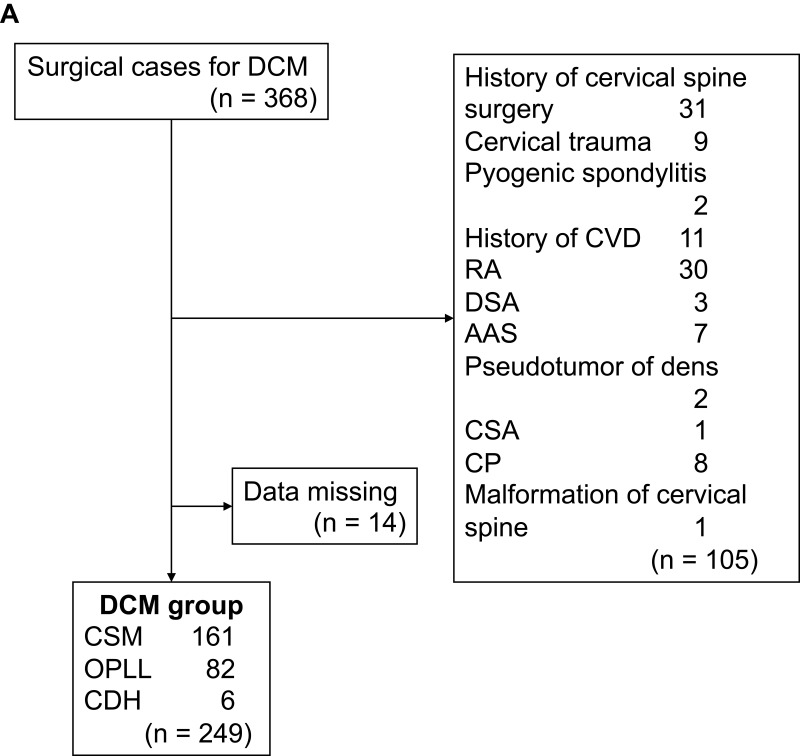
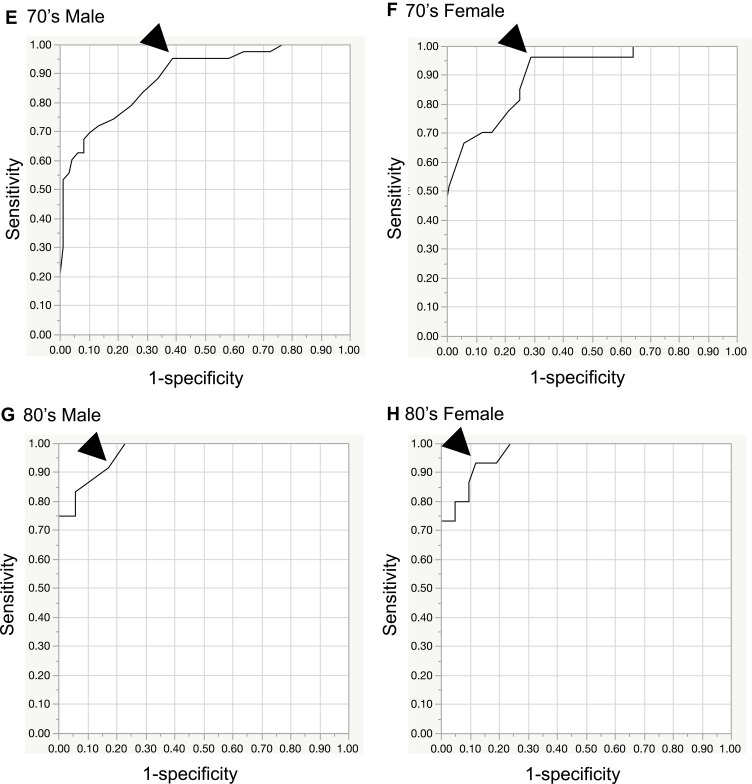
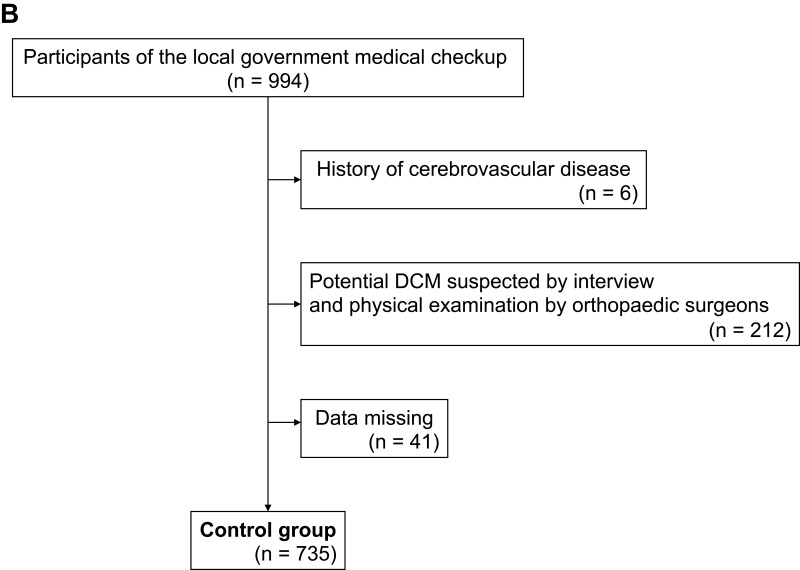
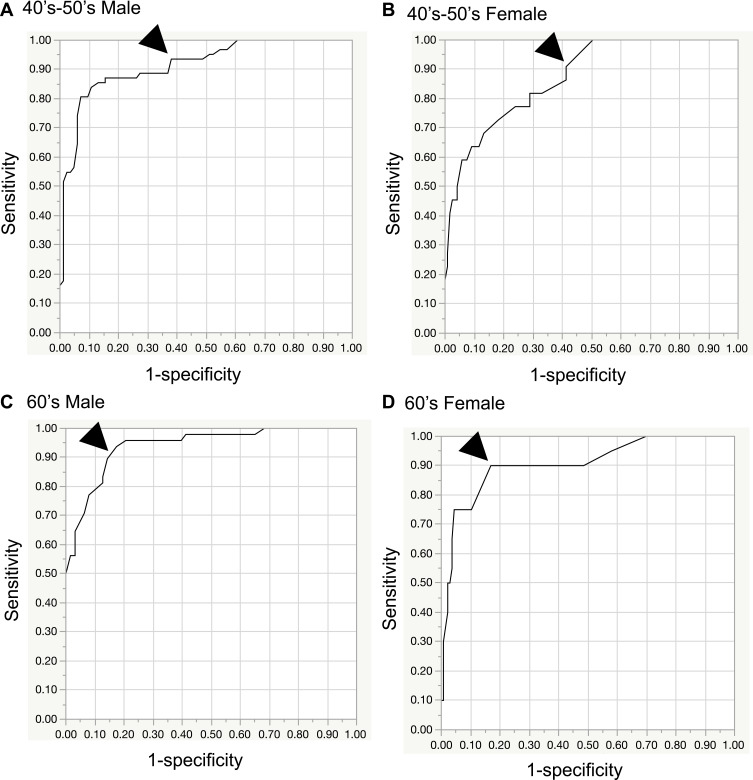
The DCM group comprised 249 consecutive participants (165 males, 84 females; mean age, 65.1 years) with DCM who had undergone surgery at the affiliated hospital. The control group comprised 735 (280 males, 455 females; mean age, 65.8 years) participants undertaking a local government health checkup. Stratifying by age and sex, receiver operating characteristic (ROC) analyses were constructed for each group using minimum grip strength values for both hands. Based on ROC analysis, cut-off values were established so that the screening sensitivity would be 90% for either sex or age group, respectively.
According to age group and sex (males/females [M/F]), AUC values for a diagnosis of DCM in M/F were as follows: 40-59 years, 0.92/0.87; 60-69 years, 0.94/0.89; 70-79 years, 0.89/0.91; and 80-89 years, 0.97/0.97. Calculated M/F cutoff values were 41/24.5, 27/16, 27/15, and 20/10 kg, which were similar to cutoff scores for sarcopenia in M/F patients aged 60-69 and 70-79 years. M/F sensitivities in each age groups were 0.94/0.91, 0.92/0.90, 0.95/0.96, and 0.92/0.93. M/F specificities were 0.62/0.59, 0.84/0.83, 0.61/0.71, and 0.83/0.88.
Grip strength had moderate-to-high diagnostic accuracy for DCM between participants in the control and DCM groups. We developed easily applicable cutoff values for primary care DCM screening with ≥90% sensitivity. In patients with sarcopenia, DCM should be differentially diagnosed in primary care.
退行性颈椎病(DCM)的早期诊断很有必要,因为延迟治疗可能导致不可逆转的后遗症。目前尚未建立筛查方法。握力在初级保健机构中常用于评估疾病活动度和诊断肌肉减少症。这项单中心横断面研究旨在通过曲线下面积(AUC)和敏感度值来确定握力对脊髓型颈椎病(DCM)的诊断准确性以及初级保健中DCM筛查的临界值。
DCM组包括249例在附属医院接受手术的连续DCM患者(男性165例,女性84例;平均年龄65.1岁)。对照组包括735例(男性280例,女性455例;平均年龄65.8岁)参加当地政府健康检查的参与者。按年龄和性别分层,使用双手的最小握力值为每组构建受试者操作特征(ROC)分析。基于ROC分析,确定临界值,使各性别或年龄组的筛查敏感度分别达到90%。
根据年龄组和性别(男性/女性[M/F]),M/F诊断DCM的AUC值如下:40 - 59岁,0.92/0.87;60 - 69岁,0.94/0.89;70 - 79岁,0.89/0.91;80 - 89岁,0.97/0.97。计算出的M/F临界值分别为41/24.5、27/16、27/15和20/10 kg,这与60 - 69岁和70 - 79岁M/F患者的肌肉减少症临界评分相似。各年龄组的M/F敏感度分别为0.94/0.91、0.92/0.90、0.95/0.96和0.92/0.93。M/F特异度分别为0.62/0.59,、0.84/0.83、0.61/0.71和0.83/0.88。
握力对对照组和DCM组参与者之间的DCM具有中到高的诊断准确性。我们制定了易于应用的初级保健DCM筛查临界值,敏感度≥90%。在肌肉减少症患者中,初级保健应鉴别诊断DCM。