The Population Health Research Institute McMaster University and Hamilton Health Sciences Hamilton ON Canada.
Health Action by People, 'Chemmanam', Navarangam Lane Medical College Post Office Trivandrum India.
J Cachexia Sarcopenia Muscle. 2016 Dec;7(5):535-546. doi: 10.1002/jcsm.12112. Epub 2016 Apr 12.
The measurement of handgrip strength (HGS) has prognostic value with respect to all-cause mortality, cardiovascular mortality and cardiovascular disease, and is an important part of the evaluation of frailty. Published reference ranges for HGS are mostly derived from Caucasian populations in high-income countries. There is a paucity of information on normative HGS values in non-Caucasian populations from low- or middle-income countries. The objective of this study was to develop reference HGS ranges for healthy adults from a broad range of ethnicities and socioeconomically diverse geographic regions.
HGS was measured using a Jamar dynamometer in 125,462 healthy adults aged 35-70 years from 21 countries in the Prospective Urban Rural Epidemiology (PURE) study.
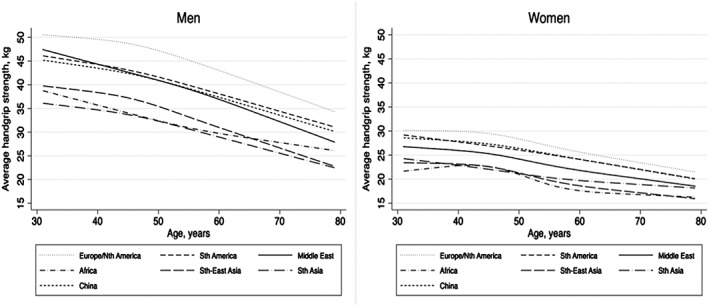
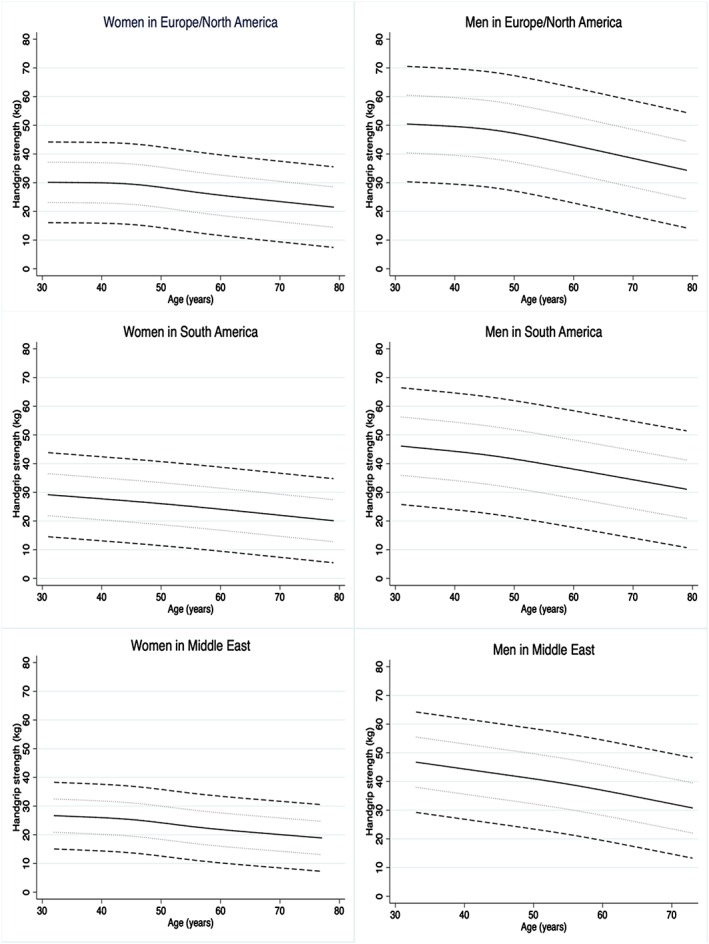
HGS values differed among individuals from different geographic regions. HGS values were highest among those from Europe/North America, lowest among those from South Asia, South East Asia and Africa, and intermediate among those from China, South America, and the Middle East. Reference ranges stratified by geographic region, age, and sex are presented. These ranges varied from a median (25-75 percentile) 50 kg (43-56 kg) in men <40 years from Europe/North America to 18 kg (14-20 kg) in women >60 years from South East Asia. Reference ranges by ethnicity and body-mass index are also reported.
Individual HGS measurements should be interpreted using region/ethnic-specific reference ranges.
手握力(HGS)的测量对于全因死亡率、心血管死亡率和心血管疾病具有预后价值,是评估虚弱的重要组成部分。发表的 HGS 参考范围主要来自高收入国家的白种人群体。来自中低收入国家的非白种人群体的 HGS 正常值信息很少。本研究的目的是为来自不同种族和社会经济背景广泛的健康成年人制定 HGS 参考范围。
在来自 21 个国家的 Prospective Urban Rural Epidemiology(PURE)研究中,使用 Jamar 握力计测量了 125462 名 35-70 岁的健康成年人的 HGS。
来自不同地理区域的个体的 HGS 值存在差异。HGS 值在来自欧洲/北美的个体中最高,在来自南亚、东南亚和非洲的个体中最低,在来自中国、南美洲和中东的个体中居中。按地理区域、年龄和性别分层呈现的参考范围。这些范围从欧洲/北美的男性<40 岁的中位数(25-75 百分位)50kg(43-56kg)到东南亚女性>60 岁的中位数 18kg(14-20kg)不等。还报告了按种族和体重指数划分的参考范围。
应使用特定地区/种族的参考范围来解释个体的 HGS 测量值。