Unim Brigid, Mattei Eugenio, Carle Flavia, Tolonen Hanna, Bernal-Delgado Enrique, Achterberg Peter, Zaletel Metka, Seeling Stefanie, Haneef Romana, Lorcy Anne-Charlotte, Van Oyen Herman, Palmieri Luigi
Department of Cardiovascular, Endocrine-metabolic Diseases and Aging, Istituto Superiore di Sanità, Via Giano della Bella 34, 00162, Rome, Italy.
Center of Epidemiology, Biostatistics and Medical Information, Marche Polytechnic University, Ancona, Italy.
Arch Public Health. 2022 Jan 5;80(1):17. doi: 10.1186/s13690-021-00780-4.
Health-related data are collected from a variety of sources for different purposes, including secondary use for population health monitoring (HM) and health system performance assessment (HSPA). Most of these data sources are not included in databases of international organizations (e.g., WHO, OECD, Eurostat), limiting their use for research activities and policy making. This study aims at identifying and describing collection methods, quality assessment procedures, availability and accessibility of health data across EU Member States (MS) for HM and HSPA.
A structured questionnaire was developed and administered through an online platform to partners of the InfAct consortium form EU MS to investigate data collections applied in HM and HSPA projects, as well as their methods and procedures. A descriptive analysis of the questionnaire results was performed.
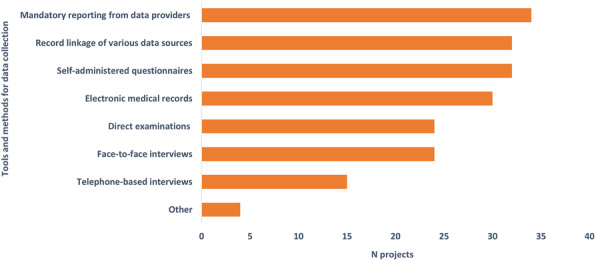
Information on 91 projects from 18 EU MS was collected. In these projects, data were mainly collected through administrative sources, population health interview or health examination surveys and from electronic medical records. Tools and methods used for data collection were mostly mandatory reports, self-administered questionnaires, or record linkage of various data sources. One-third of the projects shared data with EU research networks and less than one-third performed quality assessment of their data collection procedures using international standardized criteria. Macrodata were accessible via open access and reusable in 22 projects. Microdata were accessible upon specific request and reusable in 15 projects based on data usage licenses. Metadata was available for the majority of the projects, but followed reporting standards only in 29 projects. Overall, compliance to FAIR Data principles (Findable, Accessible, Interoperable, and Reusable) was not optimal across the EU projects.
Data collection and exchange procedures differ across EU MS and research data are not always available, accessible, comparable or reusable for further research and evidence-based policy making. There is a need for an EU-level health information infrastructure and governance to promote and facilitate sharing and dissemination of standardized and comparable health data, following FAIR Data principles, across the EU.
出于不同目的,从各种来源收集与健康相关的数据,包括用于人群健康监测(HM)和卫生系统绩效评估(HSPA)的二次使用。这些数据源大多未纳入国际组织(如世界卫生组织、经济合作与发展组织、欧盟统计局)的数据库,限制了它们在研究活动和政策制定中的应用。本研究旨在识别和描述欧盟成员国(MS)用于HM和HSPA的健康数据的收集方法、质量评估程序、可用性和可获取性。
通过在线平台开发并向InfAct联盟来自欧盟成员国的合作伙伴发放结构化问卷,以调查HM和HSPA项目中应用的数据收集情况及其方法和程序。对问卷结果进行描述性分析。
收集了来自18个欧盟成员国的91个项目的信息。在这些项目中,数据主要通过行政来源、人群健康访谈或健康检查调查以及电子病历收集。用于数据收集的工具和方法大多是强制性报告、自填式问卷或各种数据源的记录链接。三分之一的项目与欧盟研究网络共享数据,不到三分之一的项目使用国际标准化标准对其数据收集程序进行质量评估。宏观数据可通过开放获取获得,在22个项目中可重复使用。微观数据可根据特定请求获取,在15个基于数据使用许可的项目中可重复使用。大多数项目都有元数据,但只有29个项目遵循报告标准。总体而言,欧盟项目对FAIR数据原则(可查找、可获取、可互操作和可重复使用)的遵守情况并不理想。
欧盟成员国的数据收集和交换程序各不相同,研究数据并不总是可获取、可访问、可比或可重复用于进一步研究和循证决策。需要一个欧盟层面的健康信息基础设施和治理机制,以按照FAIR数据原则,促进和便利标准化和可比健康数据在欧盟范围内的共享和传播。