Clendennen Stephanie L, Case Kathleen R, Sumbe Aslesha, Mantey Dale S, Mason Emily J, Harrell Melissa B
Department of Epidemiology, Human Genetics and Environmental Sciences, UTHealth School of Public Health, Austin, TX, USA.
Center for Research to Advance Community Health (ReACH), UTHealth San Antonio, San Antonio, TX, USA.
Tob Use Insights. 2021 Dec 20;14:1179173X211067439. doi: 10.1177/1179173X211067439. eCollection 2021.
Studies show smoking and vaping behaviors increase risk of contracting and worse symptoms of COVID-19. This study examines whether past 30-day youth and young adult users of marijuana, e-cigarettes, and cigarettes self-reported changes in their use of these substances due to the COVID-19 pandemic; and cross-sectional associations between perceived stress, nicotine or marijuana dependence, and COVID-19-related changes in use.
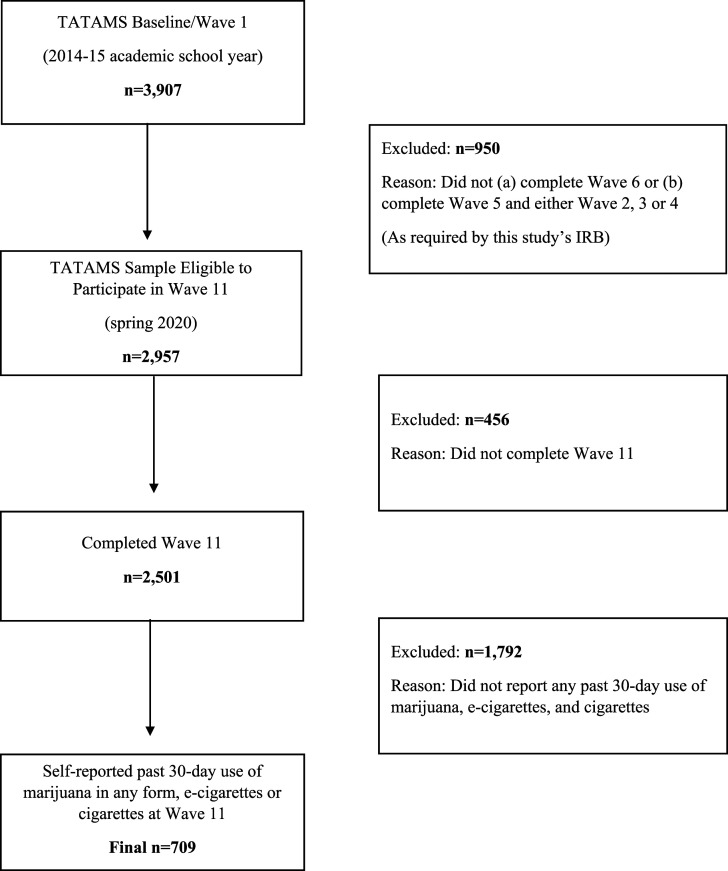
Participants were 709 past 30-day self-reported substance users from the Texas Adolescent Tobacco and Marketing Surveillance study (TATAMS; mean age = 19; 58% female; 38% Hispanic, 35% white). Multiple logistic regression models assessed cross-sectional associations between perceived stress and dependence and increased, decreased, or sustained past 30-day use of marijuana, e-cigarettes, and cigarettes due to COVID-19 (e.g., "Has your marijuana use changed due to the COVID-19 outbreak?"). Covariates included age, race/ethnicity, socio-economic status (SES), dependence (exposure: stress), and stress (exposure: dependence).
Most participants reported sustained (41%, 43%, 49%) or increased (37%, 34%, 25%) use of marijuana, e-cigarettes, and cigarettes due to COVID-19, respectively. Participants who reported symptoms of dependence were significantly more likely than their non-dependent peers to report increasing their marijuana (AOR: 1.66; 95% CI: 1.15-2.39) and e-cigarette (AOR: 2.57; 95% CI: 1.38-4.77) use. Those who reported higher perceived stress were significantly more likely to report increasing their marijuana use (AOR: 1.55; 95% CI: 1.01-2.42).
Most youth and young adults did not decrease their substance use amid a global, respiratory disease pandemic. Health messaging and interventions that address the health effects of smoking and vaping as well as factors like stress and dependence that may be barriers to decreasing use are vital in curbing the COVID-19 pandemic.
研究表明,吸烟和吸电子烟行为会增加感染新冠病毒的风险,并使新冠症状加重。本研究调查了过去30天内使用大麻、电子烟和香烟的青少年及青年成年人是否因新冠疫情而自我报告了这些物质使用情况的变化;以及感知压力、尼古丁或大麻依赖与新冠相关的使用变化之间的横断面关联。
参与者来自德克萨斯青少年烟草与市场监测研究(TATAMS),为709名过去30天内自我报告使用过物质的人(平均年龄 = 19岁;58%为女性;38%为西班牙裔,35%为白人)。多个逻辑回归模型评估了感知压力与依赖之间的横断面关联,以及因新冠疫情导致过去30天内大麻、电子烟和香烟使用增加、减少或持续使用的情况(例如,“你的大麻使用因新冠疫情爆发而改变了吗?”)。协变量包括年龄、种族/族裔、社会经济地位(SES)、依赖(暴露因素:压力)和压力(暴露因素:依赖)。
大多数参与者报告称,因新冠疫情,分别有41%、43%、49%的人持续使用大麻、电子烟和香烟,或使用量增加(分别为37%、34%、25%)。报告有依赖症状的参与者比无依赖的同龄人更有可能报告增加大麻(优势比:1.66;95%置信区间:1.15 - 2.39)和电子烟(优势比:2.57;95%置信区间:1.38 - 4.77)的使用量。报告有较高感知压力的人更有可能报告增加大麻使用量(优势比:1.55;95%置信区间:1.01 - 2.42)。
在全球呼吸道疾病大流行期间,大多数青少年和青年成年人并未减少物质使用。宣传吸烟和吸电子烟对健康的影响以及可能成为减少使用障碍的压力和依赖等因素的健康信息和干预措施,对于遏制新冠疫情至关重要。