National Clinical Research Center for Respiratory Disease, the First Affiliated Hospital of Guangzhou Medical University, Guangzhou, 510120, China.
Department of Thoracic Surgery, the First Affiliated Hospital of Guangzhou Medical University, Guangzhou, 510120, China.
Eur Radiol. 2022 Apr;32(4):2235-2245. doi: 10.1007/s00330-021-08334-6. Epub 2022 Jan 6.
Main challenges for COVID-19 include the lack of a rapid diagnostic test, a suitable tool to monitor and predict a patient's clinical course and an efficient way for data sharing among multicenters. We thus developed a novel artificial intelligence system based on deep learning (DL) and federated learning (FL) for the diagnosis, monitoring, and prediction of a patient's clinical course.
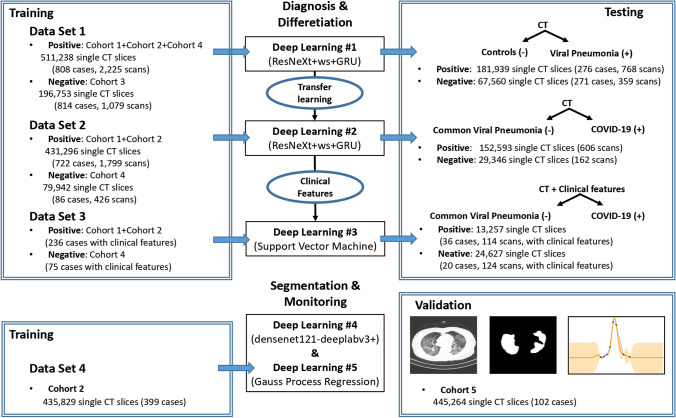
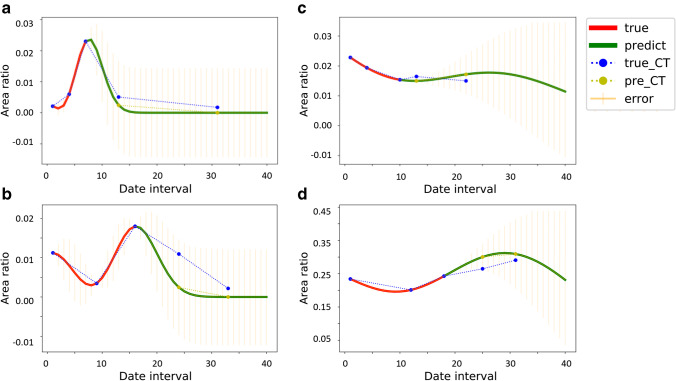
CT imaging derived from 6 different multicenter cohorts were used for stepwise diagnostic algorithm to diagnose COVID-19, with or without clinical data. Patients with more than 3 consecutive CT images were trained for the monitoring algorithm. FL has been applied for decentralized refinement of independently built DL models.
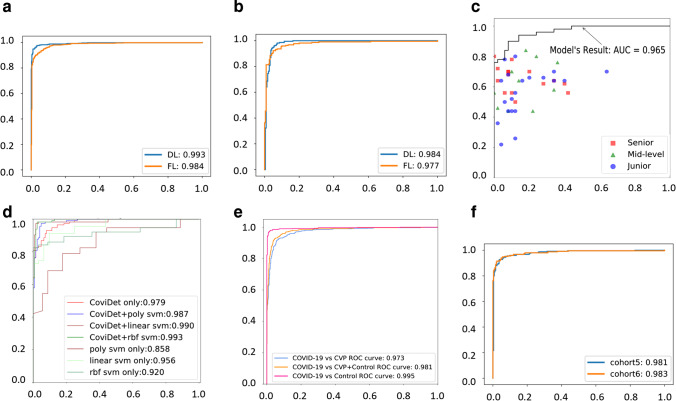
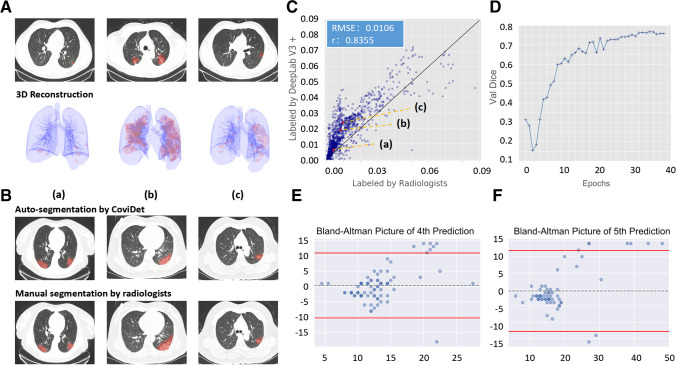
A total of 1,552,988 CT slices from 4804 patients were used. The model can diagnose COVID-19 based on CT alone with the AUC being 0.98 (95% CI 0.97-0.99), and outperforms the radiologist's assessment. We have also successfully tested the incorporation of the DL diagnostic model with the FL framework. Its auto-segmentation analyses co-related well with those by radiologists and achieved a high Dice's coefficient of 0.77. It can produce a predictive curve of a patient's clinical course if serial CT assessments are available.
The system has high consistency in diagnosing COVID-19 based on CT, with or without clinical data. Alternatively, it can be implemented on a FL platform, which would potentially encourage the data sharing in the future. It also can produce an objective predictive curve of a patient's clinical course for visualization.
• CoviDet could diagnose COVID-19 based on chest CT with high consistency; this outperformed the radiologist's assessment. Its auto-segmentation analyses co-related well with those by radiologists and could potentially monitor and predict a patient's clinical course if serial CT assessments are available. It can be integrated into the federated learning framework. • CoviDet can be used as an adjunct to aid clinicians with the CT diagnosis of COVID-19 and can potentially be used for disease monitoring; federated learning can potentially open opportunities for global collaboration.
COVID-19 的主要挑战包括缺乏快速诊断测试、用于监测和预测患者临床病程的合适工具以及在多中心之间进行数据共享的有效方法。因此,我们开发了一种基于深度学习(DL)和联邦学习(FL)的新型人工智能系统,用于 COVID-19 的诊断、监测和预测患者的临床病程。
使用来自 6 个不同多中心队列的 CT 成像来逐步进行诊断算法,以诊断 COVID-19,无论是否有临床数据。对具有 3 次以上连续 CT 图像的患者进行监测算法训练。FL 已应用于独立构建的 DL 模型的分散细化。
共使用了 4804 名患者的 1552988 个 CT 切片。该模型可以仅基于 CT 诊断 COVID-19,AUC 为 0.98(95%CI 0.97-0.99),优于放射科医生的评估。我们还成功测试了将 DL 诊断模型与 FL 框架结合使用。其自动分割分析与放射科医生的分析密切相关,Dice 系数达到 0.77。如果有连续的 CT 评估,它可以生成患者临床病程的预测曲线。
该系统在基于 CT 有无临床数据的情况下诊断 COVID-19 具有高度一致性。或者,它可以在 FL 平台上实现,这将有助于未来的数据共享。它还可以生成患者临床病程的客观预测曲线以供可视化。
• CoviDet 可以基于胸部 CT 以较高的一致性诊断 COVID-19;这优于放射科医生的评估。其自动分割分析与放射科医生的分析密切相关,如果有连续的 CT 评估,它可以潜在地监测和预测患者的临床病程。它可以集成到联邦学习框架中。• CoviDet 可以用作辅助工具,帮助临床医生进行 COVID-19 的 CT 诊断,并且可以潜在地用于疾病监测;联邦学习可以为全球合作提供机会。