Ayyoubzadeh Seyed Mohammad, Shirkhoda Mohammad, R Niakan Kalhori Sharareh, Mohammadzadeh Niloofar, Zakerabasali Somayyeh
Department of Health Information Management, School of Allied Medical Sciences, Tehran University of Medical Sciences, Tehran, Iran.
Department of Surgery, Cancer Institute of Iran, Tehran University of Medical Sciences, Tehran, Iran.
JMIR Cancer. 2022 Jan 5;8(1):e18083. doi: 10.2196/18083.
Colorectal cancer survivors face multiple challenges after discharge. eHealth may potentially support them by providing tools such as smartphone apps. They have lots of capabilities to exchange information and could be used for remote monitoring of these patients.
In this study, we addressed the required features for apps designed to follow up colorectal cancer patients based on survivors' and clinical experts' views.
A mixed methods study was conducted. Features of related apps were extracted through the literature; the features were categorized, and then, they were modified. A questionnaire was designed containing the features listed and prioritized based on the MoSCoW (Must have, Should have, Could have, Won't have) technique and an open question for each category. The link to the questionnaire was shared among clinical experts in Iran. The answers were analyzed using the content validity ratio (CVR), and based on the value of this measure, the minimum feature set of a monitoring app to follow up patients with colorectal cancer was addressed. In addition, a telephone interview with colorectal cancer survivors was conducted to collect their viewpoints regarding a remote monitoring system for colorectal cancer cases.
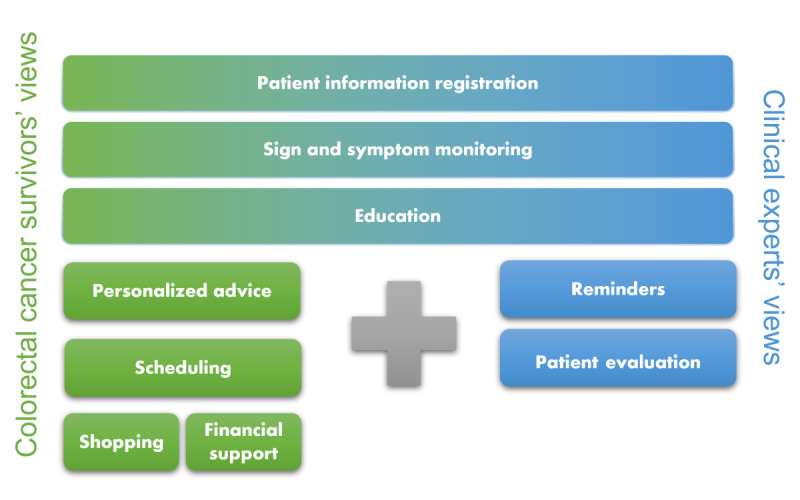
The questionnaire contained 10 sections evaluating 9 categories of features. The questionnaire was completed by 18 experts. The minimum set of features in the app was identified as patient information registration, sign and symptom monitoring, education, reminders, and patient evaluation (0.42 < CVR < 0.85). Features including physical activity, personalized advice, and social network did not achieve the minimum score (-0.11 < CVR < 0.39). We interviewed 9 colorectal cancer survivors. Information registration, sign and symptom monitoring, education, and personalized advice were the features with high priority from the survivors' perspectives. Scheduling, shopping, and financial support features were emphasized by survivors in the interview.
The requirement set could be used to design an app for the targeted population or patients affected by other cancers. As the views from both survivors and clinical experts were considered in this study, the remote system may more adequately fulfill the need for follow-up of survivors. This eases the patients' and health care providers' communication and interaction.
结直肠癌幸存者出院后面临多重挑战。电子健康可能通过提供智能手机应用程序等工具来为他们提供支持。这些应用程序有很多信息交换功能,可用于对这些患者进行远程监测。
在本研究中,我们根据幸存者和临床专家的观点,探讨了用于随访结直肠癌患者的应用程序所需的功能。
进行了一项混合方法研究。通过文献提取相关应用程序的功能;对这些功能进行分类,然后进行修改。设计了一份问卷,其中包含根据MoSCoW(必须有、应该有、可以有、不会有)技术列出并排序的功能,以及针对每个类别的一个开放性问题。问卷链接在伊朗的临床专家中进行了分享。使用内容效度比(CVR)对答案进行分析,并根据该指标的值确定了结直肠癌患者监测应用程序的最小功能集。此外,对结直肠癌幸存者进行了电话访谈,以收集他们对结直肠癌病例远程监测系统的看法。
问卷包含10个部分,评估9类功能。18位专家完成了问卷。应用程序中的最小功能集被确定为患者信息登记、体征和症状监测、教育、提醒以及患者评估(0.42 < CVR < 0.85)。包括身体活动、个性化建议和社交网络在内的功能未达到最低分数(-0.11 < CVR < 0.39)。我们采访了9位结直肠癌幸存者。从幸存者的角度来看,信息登记、体征和症状监测、教育以及个性化建议是优先级较高的功能。幸存者在访谈中强调了日程安排、购物和经济支持功能。
该需求集可用于为目标人群或受其他癌症影响的患者设计应用程序。由于本研究考虑了幸存者和临床专家的观点,远程系统可能更充分地满足幸存者随访的需求。这简化了患者与医疗保健提供者之间的沟通和互动。