Nanjing Hospital of Chinese Medicine affiliated to Nanjing University of Chinese Medicine, Nanjing, 210023, China.
School of Medicine & Holistic Integrative Medicine, Nanjing University of Chinese Medicine, Nanjing, 210023, China.
J Exp Clin Cancer Res. 2022 Jan 6;41(1):11. doi: 10.1186/s13046-021-02220-1.
Currently, multiple myeloma (MM) is still an incurable plasma cell malignancy in urgent need of novel therapeutic targets and drugs.
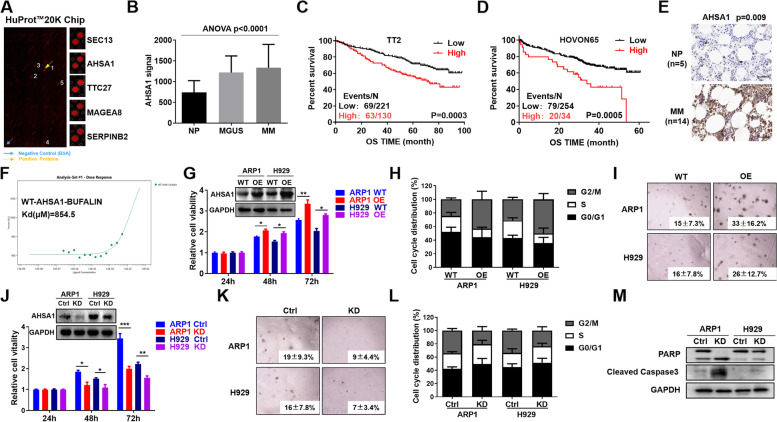
Bufalin was known as a highly toxic but effective anti-cancer compound. We used Bufalin as a probe to screen its potential targets by proteome microarray, in which AHSA1 was the unique target of Bufalin. The effects of AHSA1 on cellular proliferation and drug resistance were determined by MTT, western blot, flow cytometry, immunohistochemistry staining and xenograft model in vivo. The potential mechanisms of Bufalin and KU-177 in AHSA1/HSP90 were verified by co-immunoprecipitation, mass spectrometry, site mutation and microscale thermophoresis assay.
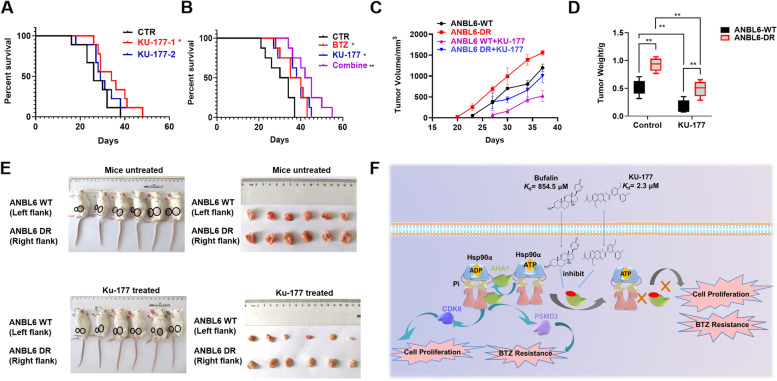
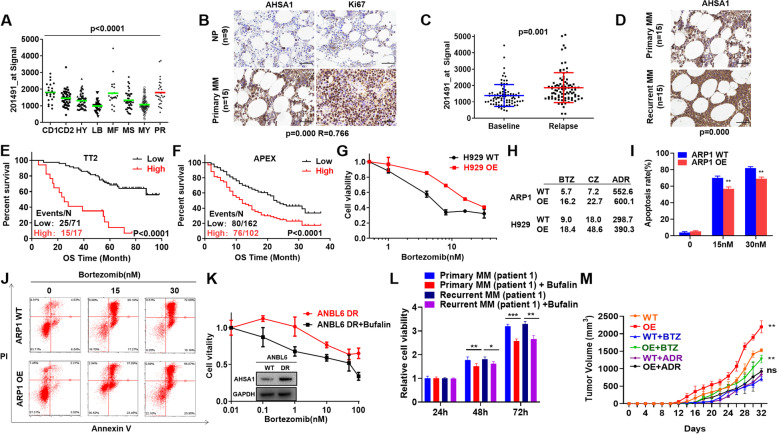
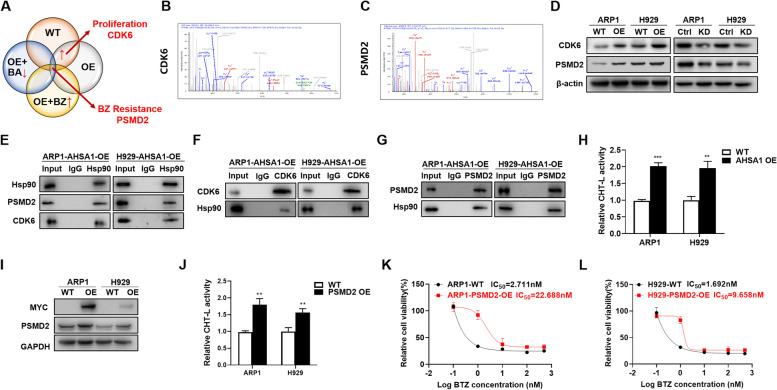
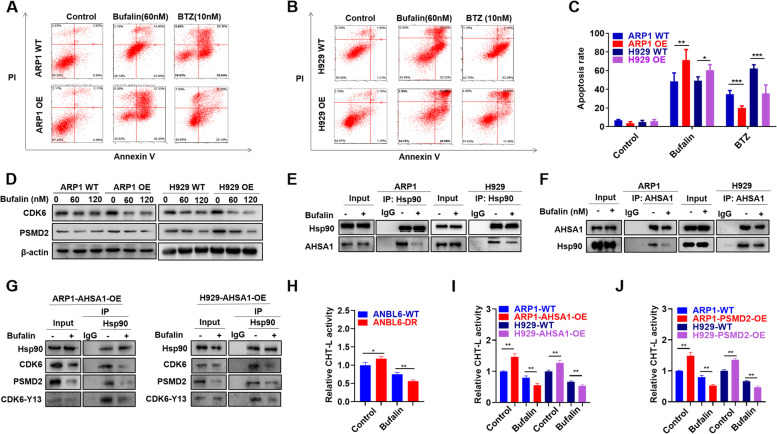
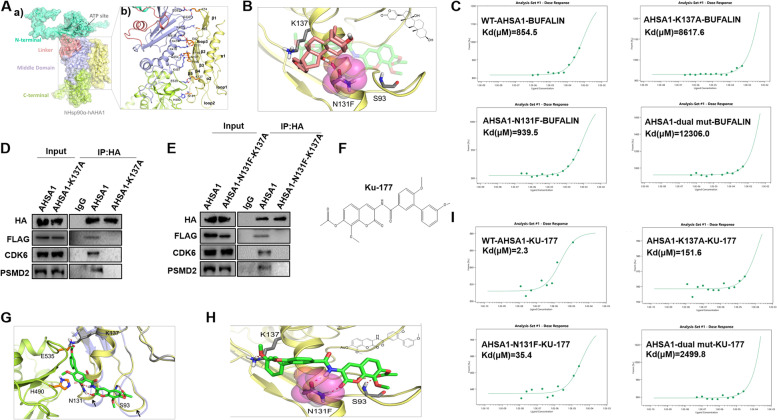
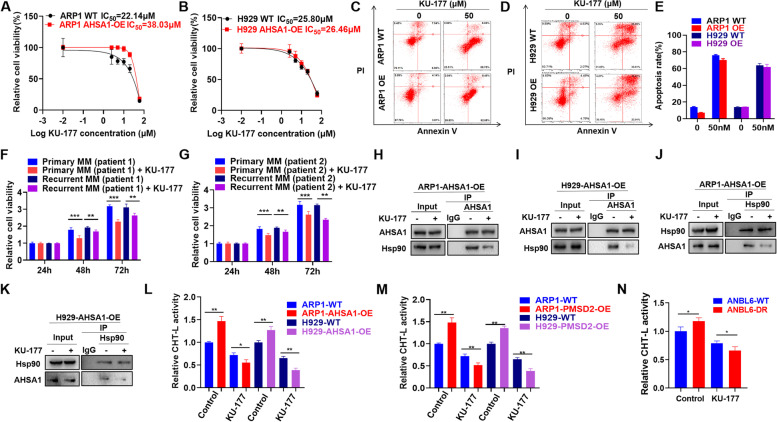
AHSA1 expression was increased in MM samples compared to normal controls, which was significantly associated with MM relapse and poor outcomes. Furthermore, AHSA1 promoted MM cell proliferation and proteasome inhibitor (PI) resistance in vitro and in vivo. Mechanism exploration indicated that AHSA1 acted as a co-chaperone of HSP90A to activate CDK6 and PSMD2, which were key regulators of MM proliferation and PI resistance respectively. Additionally, we identified AHSA1-K137 as the specific binding site of Bufalin on AHSA1, mutation of which decreased the interaction of AHSA1 with HSP90A and suppressed the function of AHSA1 on mediating CDK6 and PSMD2. Intriguingly, we discovered KU-177, an AHSA1 selective inhibitor, and found KU-177 targeting the same site as Bufalin. Bufalin and KU-177 treatments hampered the proliferation of flow MRD-positive cells in both primary MM and recurrent MM patient samples. Moreover, KU-177 abrogated the cellular proliferation and PI resistance induced by elevated AHSA1, and decreased the expression of CDK6 and PSMD2.
We demonstrate that AHSA1 may serve as a promising therapeutic target for cellular proliferation and proteasome inhibitor resistance in multiple myeloma.
目前,多发性骨髓瘤(MM)仍是一种无法治愈的浆细胞恶性肿瘤,迫切需要新的治疗靶点和药物。
蟾毒灵是一种剧毒但有效的抗癌化合物。我们使用蟾毒灵作为探针,通过蛋白质组微阵列筛选其潜在靶点,其中 AHSA1 是蟾毒灵的唯一靶点。通过 MTT、western blot、流式细胞术、免疫组化染色和体内异种移植模型,确定 AHSA1 对细胞增殖和耐药性的影响。通过共免疫沉淀、质谱分析、点突变和微尺度热泳实验验证蟾毒灵和 KU-177 在 AHSA1/HSP90 中的潜在机制。
与正常对照相比,MM 样本中 AHSA1 的表达增加,与 MM 复发和不良预后显著相关。此外,AHSA1 在体外和体内促进 MM 细胞增殖和蛋白酶体抑制剂(PI)耐药。机制研究表明,AHSA1 作为 HSP90A 的共伴侣,激活 CDK6 和 PSMD2,分别为 MM 增殖和 PI 耐药的关键调节因子。此外,我们鉴定出 AHSA1-K137 是蟾毒灵在 AHSA1 上的特异性结合位点,该位点突变降低了 AHSA1 与 HSP90A 的相互作用,并抑制了 AHSA1 介导 CDK6 和 PSMD2 的功能。有趣的是,我们发现了 AHSA1 选择性抑制剂 KU-177,并发现 KU-177 与蟾毒灵作用于相同的位点。蟾毒灵和 KU-177 治疗可抑制原发性 MM 和复发性 MM 患者样本中流式 MRD 阳性细胞的增殖。此外,KU-177 可阻断因 AHSA1 升高引起的细胞增殖和 PI 耐药,并降低 CDK6 和 PSMD2 的表达。
我们证明 AHSA1 可能是多发性骨髓瘤细胞增殖和蛋白酶体抑制剂耐药的一个有前途的治疗靶点。