Department of Research and Evaluation, Kaiser Permanente Southern California, Pasadena, CA, USA.
Department of Population and Public Health Sciences, Keck School of Medicine of USC, CA, Los Angeles, USA.
J Gen Intern Med. 2022 Mar;37(4):830-837. doi: 10.1007/s11606-021-07139-z. Epub 2022 Jan 6.
The demands for healthcare resources following a COVID-19 diagnosis are substantial, but not currently quantified.
To describe trends in healthcare utilization within 180 days for patients diagnosed with COVID-19 and identify patient factors associated with increased healthcare use.
Observational cohort study.
A total of 64,011 patients with a test-confirmed COVID-19 diagnosis from March to September 2020 in a large integrated healthcare system in Southern California.
Overall healthcare utilization during the 180 days following COVID-19 diagnosis, as well as encounter types and reasons for visits during the first 30 days. Poisson regression was used to identify patient factors associated with higher utilization. Analyses were performed separately for patients who were and were not hospitalized for COVID-19.
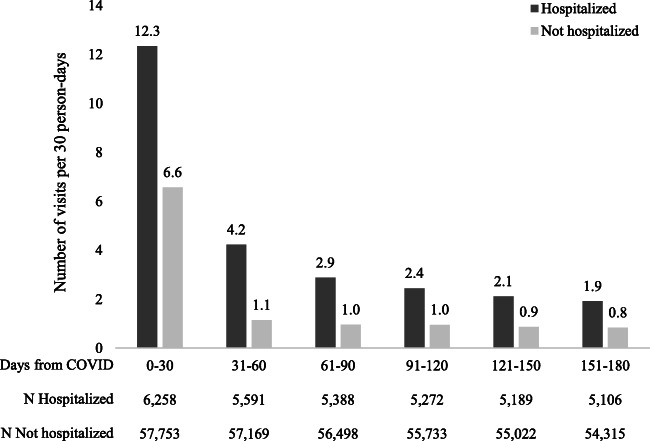
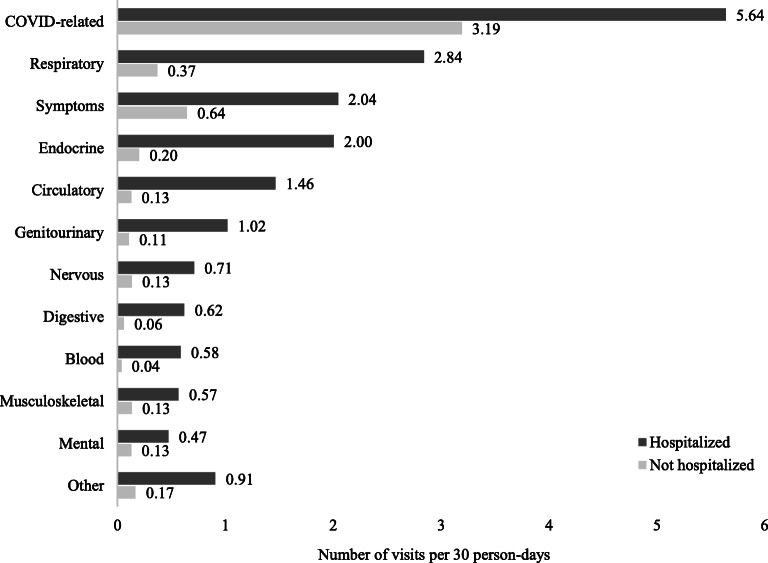
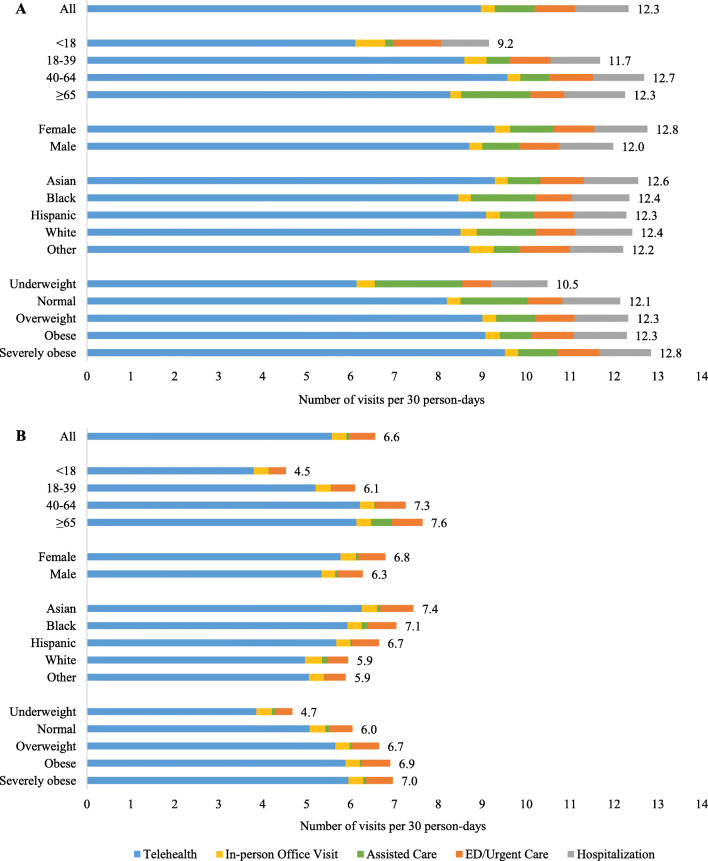
Healthcare utilization was about twice as high for hospitalized patients compared to non-hospitalized patients in all time periods. The average number of visits was highest in the first 30 days (hospitalized: 12.3 visits/30 person-days; non-hospitalized: 6.6) and gradually decreased over time. In the first 30 days, the majority of healthcare visits were telehealth encounters (hospitalized: 9.0 visits; non-hospitalized: 5.6 visits), and the most prevalent reasons for visits were COVID-related diagnoses, COVID-related symptoms, and respiratory-related conditions. For hospitalized patients, older age (≥65: RR 1.27, 95% CI 1.15-1.41), female gender (RR 1.07, 95% CI 1.05-1.09), and higher BMI (≥40: RR 1.07, 95% CI 1.03-1.10) were associated with higher total utilization. For non-hospitalized patients, older age, female gender, higher BMI, non-white race/ethnicity, former smoking, and greater number of pre-existing comorbidities were all associated with increased utilization.
Patients with COVID-19 seek healthcare frequently within 30 days of diagnosis, placing high demands on health systems. Identifying ways to support patients diagnosed with COVID-19 while adequately providing the usual recommended care to our communities will be important as we recover from the pandemic.
新冠肺炎确诊后对医疗资源的需求很大,但目前尚未量化。
描述新冠肺炎确诊患者在 180 天内的医疗保健使用趋势,并确定与医疗保健使用增加相关的患者因素。
观察性队列研究。
2020 年 3 月至 9 月期间,南加州一家大型综合医疗系统中,经检测确诊为新冠肺炎的 64011 名患者。
新冠肺炎确诊后 180 天内的整体医疗保健使用情况,以及前 30 天内的就诊类型和就诊原因。使用泊松回归确定与更高使用率相关的患者因素。分别对因新冠肺炎住院和非住院的患者进行分析。
在所有时间段,与非住院患者相比,住院患者的医疗保健利用率大约是后者的两倍。在最初的 30 天内,就诊次数最多(住院患者:30 人天 12.3 次就诊;非住院患者:30 人天 6.6 次就诊),并且随着时间的推移逐渐减少。在前 30 天内,大多数医疗保健就诊是远程医疗就诊(住院患者:9.0 次就诊;非住院患者:5.6 次就诊),就诊的最常见原因是与 COVID 相关的诊断、与 COVID 相关的症状和呼吸道相关疾病。对于住院患者,年龄较大(≥65 岁:RR 1.27,95%CI 1.15-1.41)、女性(RR 1.07,95%CI 1.05-1.09)和更高的 BMI(≥40:RR 1.07,95%CI 1.03-1.10)与更高的总利用率相关。对于非住院患者,年龄较大、女性、更高的 BMI、非白种人种族/民族、以前吸烟和更多的预先存在的合并症都与利用率增加有关。
新冠肺炎确诊患者在诊断后 30 天内频繁寻求医疗保健,这对卫生系统提出了很高的要求。在我们从大流行中恢复的过程中,找到支持新冠肺炎确诊患者的方法,并为我们的社区提供适当的常规推荐护理将是非常重要的。