Abdelrahim Nada Abdelghani, Fadl-Elmula Imad Mohammed, Hartskeerl Rudy A, Ahmed Ahmed, Goris Marga
Department of Medical Microbiology, Faculty of Medical Laboratory Sciences, Nile University, Khartoum, Sudan.
Department of Pathology & Clinical Genetics, Al-Neelain University and Assafa Academy, Khartoum, Sudan.
Res Rep Trop Med. 2021 Dec 30;12:267-274. doi: 10.2147/RRTM.S339058. eCollection 2021.
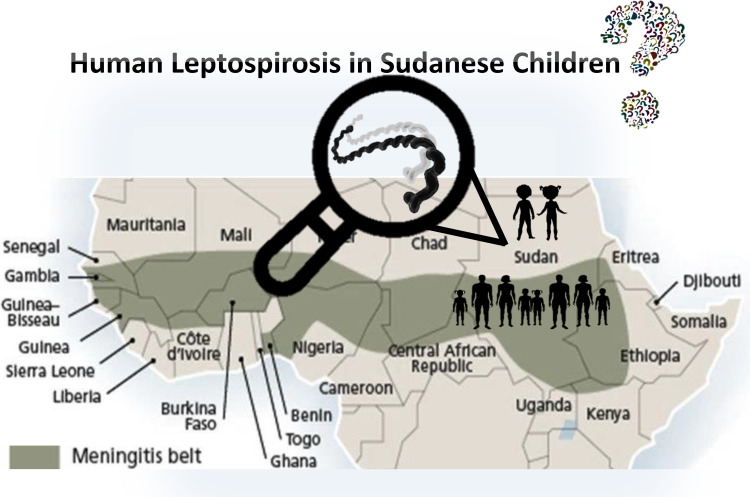
Clinical presentations of leptospirosis are diverse, with meningitis easily confused with other microbial causes. We aimed to investigate the involvement of pathogenic leptospira in the cerebrospinal fluid (CSF) of meningitis-suspected children in Sudan.
A total of 153 CSF specimens were collected over 5 months from patients attending a reference pediatric hospital in Omdurman, Sudan. All patients had provisionally been diagnosed with meningitis on admission. Demographic, clinical, and conventional laboratory findings were obtained. DNA was extracted using a QIAamp mini kit, and the gene investigated using real-time PCR.
Nine of 153 (6%) CSF specimens were positive for pathogenic leptospiral DNA. All these patients were male (seven infants and two toddlers aged ˂4 years). Typical conventional laboratory findings for aseptic meningitis (ie, CSF turbidity/pleocytosis, normal or reduced CSF glucose, normal or elevated proteins) were seen in five (56%). All patients presented with fever and seizures, 56% vomiting and stiff neck, and 29% bulging fontanel. Most (67%) patients presented in summer (March to May). Polymicrobial infections were identified in three patients (33%).
We conclude that pathogenic leptospira are probably a common cause of meningitis in children in Sudan; therefore, we recommend including leptospirosis in the differential diagnosis of CNS infections and other undifferentiated febrile illnesses in this country.
钩端螺旋体病的临床表现多样,脑膜炎易与其他微生物病因相混淆。我们旨在调查苏丹疑似脑膜炎儿童脑脊液中致病性钩端螺旋体的情况。
在5个月的时间里,从苏丹恩图曼一家参考儿科医院的患者中收集了153份脑脊液标本。所有患者入院时均初步诊断为脑膜炎。获取了人口统计学、临床和常规实验室检查结果。使用QIAamp微型试剂盒提取DNA,并通过实时聚合酶链反应研究该基因。
153份脑脊液标本中有9份(6%)致病性钩端螺旋体DNA呈阳性。所有这些患者均为男性(7名婴儿和2名4岁以下幼儿)。5例(56%)出现了无菌性脑膜炎的典型常规实验室检查结果(即脑脊液浑浊/细胞增多、脑脊液葡萄糖正常或降低、蛋白质正常或升高)。所有患者均有发热和惊厥,56%有呕吐和颈部僵硬,29%有囟门隆起。大多数患者(67%)在夏季(3月至5月)发病。3例患者(33%)发现有混合感染。
我们得出结论,致病性钩端螺旋体可能是苏丹儿童脑膜炎的常见病因;因此,我们建议在该国中枢神经系统感染和其他未分化发热性疾病的鉴别诊断中纳入钩端螺旋体病。