Adomako Michael Opoku, Xue Wei, Roiloa Sergio, Zhang Qian, Du Dao-Lin, Yu Fei-Hai
Institute of Wetland Ecology & Clone Ecology, Zhejiang Provincial Key Laboratory of Plant Evolutionary Ecology and Conservation, Taizhou University, Taizhou, China.
Institute of Environment and Ecology, Academy of Environmental Health and Ecological Security, School of the Environment and Safety Engineering, Jiangsu University, Zhenjiang, China.
Front Plant Sci. 2021 Dec 23;12:735495. doi: 10.3389/fpls.2021.735495. eCollection 2021.
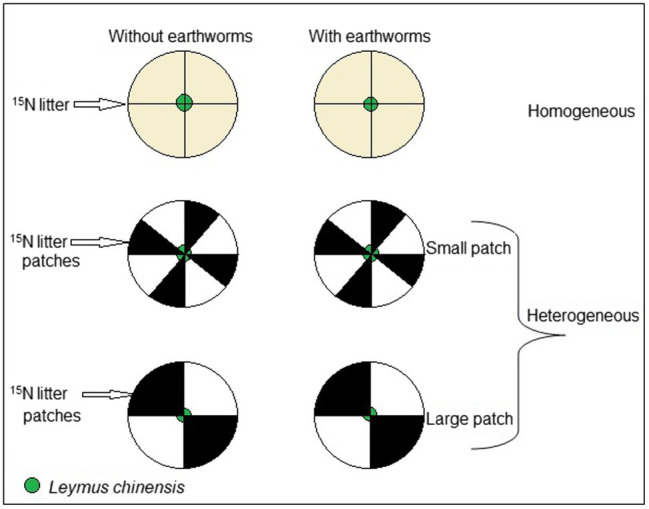
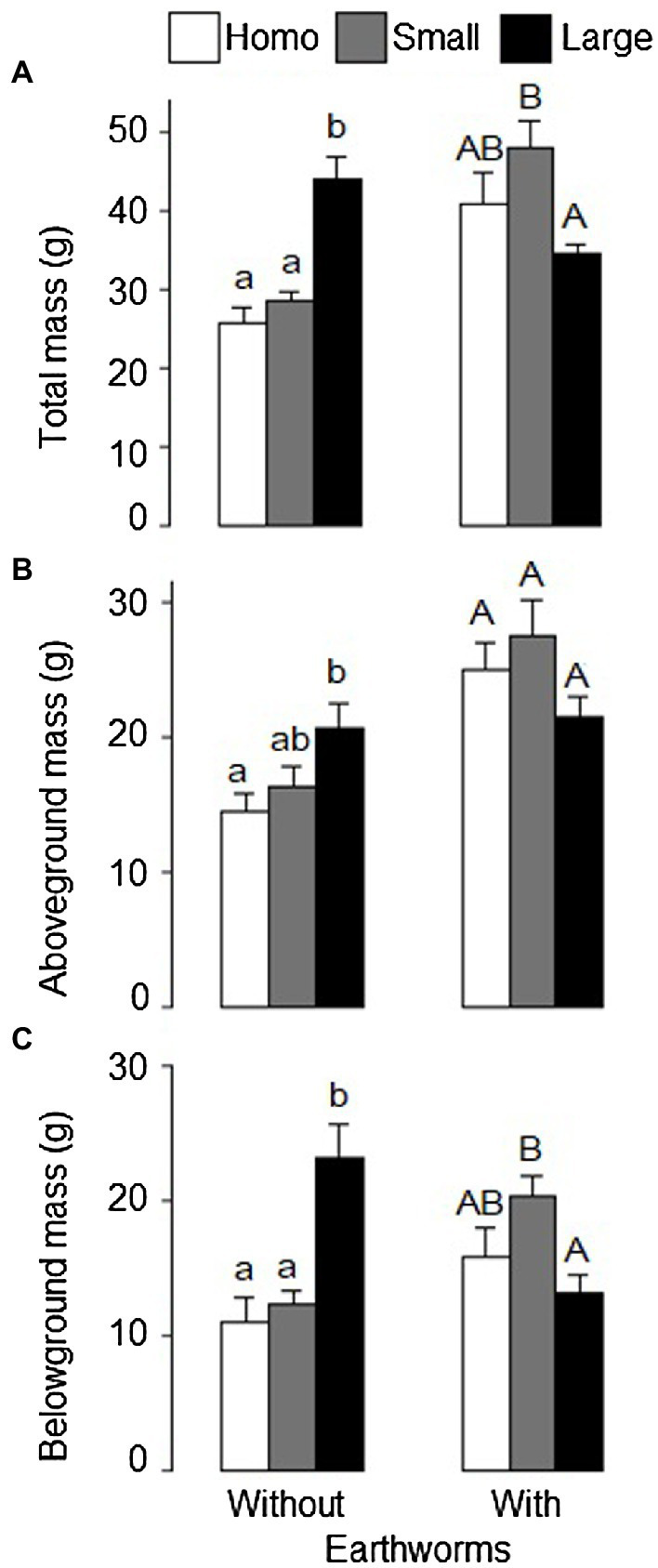
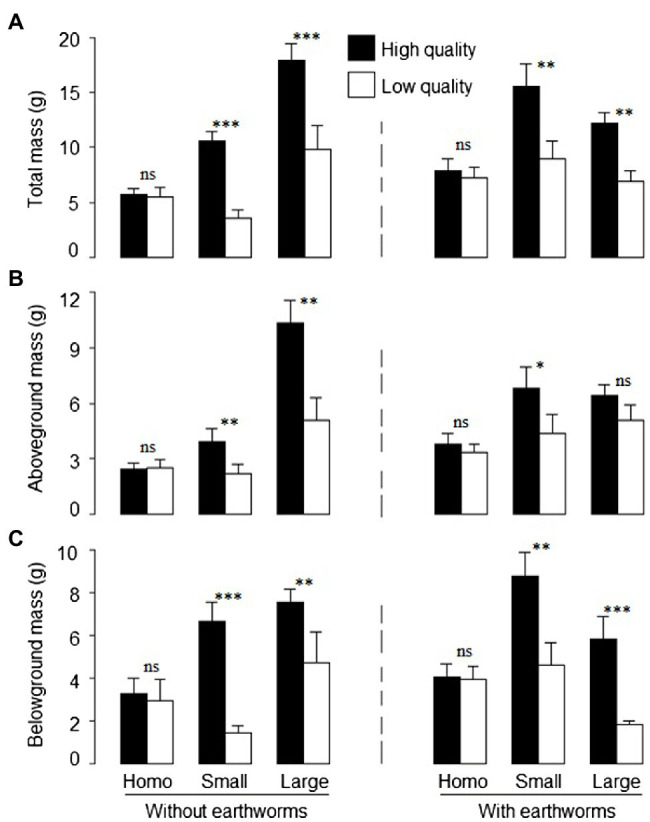
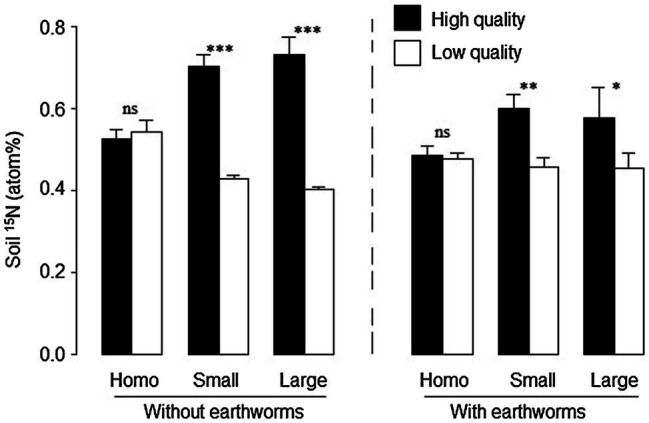
Soil heterogeneity (uneven distribution of soil nutrients and/or other properties) is ubiquitous in nature and can greatly affect plant growth. As earthworm activity can influence nutrient redistribution in the soil, we hypothesize that earthworms may alter the effect of soil heterogeneity on plant growth and this effect may depend on the scale of soil heterogeneity. To test these hypotheses, we grew the clonal grass in three soil treatments (heterogeneous large vs. heterogeneous small patch vs. homogeneous soil treatment) with or without earthworms [i.e., Savigny (Lumbricidae, epigeic redworm)]. In the heterogeneous treatments, the soil consisted of patches with and without N-labeled litter (referred to as high- and low-quality patches, respectively), and in the homogeneous treatment, the soil was an even mixture of the two types of soil patches. Biomass of was significantly higher in the high- than in the low-quality patches, showing the foraging response; this foraging response occurred at both scales and under both earthworm treatments. Compared to the homogeneous treatment, the heterogeneous large patch treatment increased biomass of without earthworms, but decreased it with earthworms. In contrast, biomass of in the heterogeneous small patch treatment did not differ from that in the homogeneous treatment, irrespective of earthworms. Belowground biomass was much greater in the heterogeneous small than in the heterogeneous large patch treatment without earthworms, but it did not differ between these two scale treatments with earthworms. In the heterogeneous treatments, soil N was greater in the high- than in the low-quality patches, but this effect became much weaker with than without earthworms, suggesting that earthworm activity homogenized the soil. We conclude that earthworms can change the impact of soil heterogeneity on plant growth homogenizing the soil, and that this effect of earthworms varies with patch scale. Such scale-dependent interactive effects of soil heterogeneity and earthworms could be a potential mechanism modulating plant community structure and productivity.
土壤异质性(土壤养分和/或其他特性的不均匀分布)在自然界中普遍存在,会极大地影响植物生长。由于蚯蚓活动会影响土壤中的养分再分配,我们推测蚯蚓可能会改变土壤异质性对植物生长的影响,且这种影响可能取决于土壤异质性的尺度。为了验证这些假设,我们在三种土壤处理(大尺度异质斑块与小尺度异质斑块与均质土壤处理)中种植克隆草,每种处理又分为有蚯蚓和无蚯蚓的情况[即萨维尼蚯蚓(正蚓科,表栖红蚯蚓)]。在异质处理中,土壤由带有和不带有氮标记凋落物的斑块组成(分别称为高质量斑块和低质量斑块),而在均质处理中,土壤是这两种类型土壤斑块的均匀混合物。高质量斑块中的生物量显著高于低质量斑块,表明存在觅食反应;这种觅食反应在两种尺度以及两种蚯蚓处理条件下均会出现。与均质处理相比,大尺度异质斑块处理在无蚯蚓时增加了生物量,但在有蚯蚓时降低了生物量。相反,小尺度异质斑块处理中的生物量与均质处理中的生物量无差异,无论有无蚯蚓。在无蚯蚓时,小尺度异质斑块处理中的地下生物量远大于大尺度异质斑块处理中的地下生物量,但在有蚯蚓时,这两种尺度处理之间的地下生物量没有差异。在异质处理中,高质量斑块中的土壤氮含量高于低质量斑块,但与无蚯蚓相比,有蚯蚓时这种差异变得弱得多,这表明蚯蚓活动使土壤均质化。我们得出结论,蚯蚓可以通过使土壤均质化来改变土壤异质性对植物生长的影响,并且蚯蚓的这种影响随斑块尺度而变化。土壤异质性和蚯蚓之间这种依赖尺度的交互作用可能是调节植物群落结构和生产力的一种潜在机制。